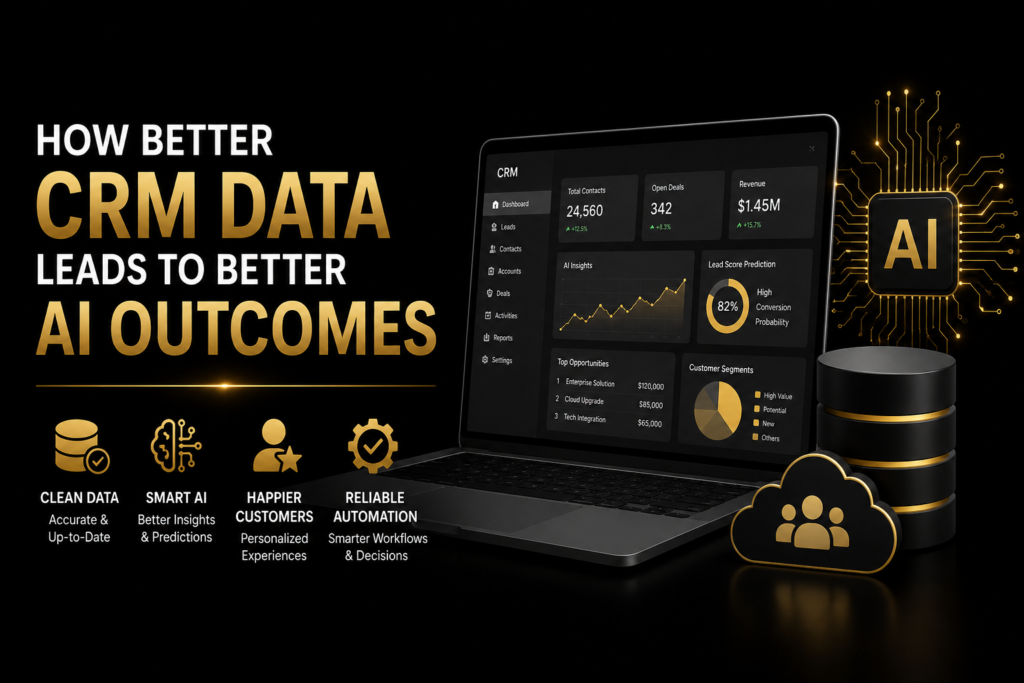
Introduction
Artificial Intelligence is playing a significant role in the transformation of businesses, assisting organizations in automating processes, forecasting customer behavior, tailoring experiences, and making quicker decisions.
However, despite the efforts of businesses in the field of AI technologies, the outcome of many of them is less than satisfactory. In many cases, the issue isn’t with the AI, but with the data behind it.
A customer relationship management (CRM) system is a repository of customer information, sales activities, communication history and business interactions. Lacking this data can hinder the ability of AI models to make accurate predictions and provide valuable insights.In the absence of this data, AI models can fall short in providing accurate predictions and insights. Conversely, a good CRM is the basis for intelligent automation and data-driven decision-making.
Developing high-quality CRM data is a priority as organisations continue to adopt AI into their businesses to support their sales, marketing and customer service functions. Thus, numerous businesses opt for a Zoho Consulting Services integration to streamline their CRM system, ensure data management, and equip their businesses to thrive with AI.
AI Is Only as Intelligent as the Data It Receives
AI is seen by businesses as the answer to their operational inefficiencies. But it is not true that AI is generating knowledge on its own. It detects trends, draws inferences from past data and makes recommendations depending on the quality of data fed to it.
Now picture the sales team leveraging AI to forecast the likelihood of conversion for prospects.Now envision the sales team employing AI to foretell the probability of conversion for prospects.
The AI engine is unable to identify buying patterns if the information in your customer records is missing or duplicated, outdated opportunities or inconsistent sales stages. This makes it difficult to predict sales, less relevant to recommend, and less effective to make business decisions.
On the other hand, the power of AI to provide meaningful insights hinges on having clean, structured, and up-to-date CRM data.However, when CRM data is clean, structured, and continuously updated, the power of AI to provide meaningful insights is enhanced. The more accurately you can predict, automate and deliver a customer experience, the better you can do all three with better data.
Why CRM Data Quality Matters More Than Ever
Whether you’re running a business today or just a business using a website, you’re collecting a ton of customer information from your website, emails, social media, sales calls, support tickets, and marketing campaigns. This information, if not managed, quickly gets scattered in a number of systems and departments.
The The consequences of poor CRM data quality can impact every interaction with customers and limit the effectiveness of agent skills across the organization. Sales agents may contact the wrong decision-maker, marketing teams can target the wrong audiences, and customer support agents may lack the context needed from previous interactions. As AI-powered agent skills become increasingly important for automating tasks, personalizing communication, and supporting customer-facing teams, inaccurate or incomplete CRM data can lead to poor decisions and ineffective customer experiences.
The problems impact on the efficiency of the operation as well as on the use of AI tools that depend on the right information.
Firms that value data governance for their CRM create a reliable source of fact for all departments. This shared customer perspective not only enables AI systems to better handle relationships but also to uncover trends or patterns sooner and make more informed recommendations based on the actual contextual situations of the business, not just the limited data they have.
Clean Data Improves AI Predictions
One of the most valuable features of current CRM has become the predictive AI capabilities. It is used by businesses to predict sales, prioritize leads, anticipate upselling opportunities, and predict customer attrition.
Predictive models are very much reliant on historical accuracy, though. Without accurate sales data or consistent customer information, AI would not be able to detect consistent patterns in customer behavior.
AI can differentiate between actual customer interest and random behavior, thanks to high-quality CRM data. It knows what usually results in success and what gives a warning of potential danger. Consequently, companies can enjoy more accurate predictions, intelligent lead scoring, and confidence in strategic planning.
Rather than making assumptions, decision makers can make decisions based on accurate and continually improving datasets.
Better Customer Data Creates Better Personalization
Consumers today have come to expect customized interactions with a company across all interactions. Consumers are increasingly expecting personalized marketing communications and messages.
Customer preference, purchase history, engagement trends, and past interactions are essential for AI-powered personalization. If the CRM records have a good and well-structured customer profile, AI can suggest appropriate products, personalised content, and the best communication channels.
As a result, engagement becomes more relevant and meaningful, building customer relationships and enhancing marketing performance and sales conversion rates.
When organizations have full records of their customers, they are always able to provide experiences that feel relevant instead of automated, assisting them to construct trust and long-lasting loyalty with customers.
Automation Becomes More Reliable with Accurate CRM Data
Workflow automation is a practical application of AI in CRM systems. To enhance operational efficiency, businesses streamline lead assignment, follow-up reminders, email campaigns, approval workflows, and customer support processes.
But automation requires correct business rules and correct customer information. FAKES can lead to incorrect actions, such as delayed responses from customers or the wrong team getting the opportunity, due to incorrect contact information, duplicate records or incorrect workflow stages.
Ensuring that CRM data is accurate and of high quality greatly enhances the accuracy of automation. Manual intervention is minimized and consistency is enhanced in processes that are repetitive, as AI is able to reliably perform them with access to accurate information.
This will enable the employees to concentrate on the more valuable task of correcting preventable errors in data.
Unified Data Enables Smarter Business Decisions
It’s one of the most powerful features of contemporary CRM systems that they are capable of integrating data from a variety of business functions. The Sales, Marketing, customer service, finance and operations functions all have valuable inputs that can impact business performance.
If these departments operate without sharing data, AI only sees a part of the picture of what the customer experiences. Critical patterns are not visible because information is stored in silos. Lark is built to solve this problem by combining an AI CRM with the collaboration tools your team uses daily. With Lark, messaging, video conferencing, project management, and CRM are all connected on a single platform, so the AI can draw insights from everywhere to provide smarter recommendations, creating a truly seamless and efficient sales process for faster wins.
When the information about customers is integrated into a single CRM, a more comprehensive view of the business is provided, which AI can analyze better. Leadership teams get to better understand customer lifetime value, campaign performance, service quality and revenue trends.
Organizations plan strategies based on holistic Business Intelligence, rather than relying on individual reporting.
AI Success Requires Strong Data Governance
Technological solutions are not enough for successful implementation of AI. Organizations need to put processes in place to guarantee that the information in CRM will stay accurate, consistent and secure over time.
Data governance involves specifying who owns the data, a consistent way to enter data, verifying customer data, eliminating redundant data, and routinely evaluating the quality of the data in the database. These practices form the foundation of Enterprise AI Governance, ensuring AI systems remain reliable, compliant, and trustworthy as they scale.
Good governance also helps in complying with the laws and regulations and it also reinforces customers’ trust in the company through the protection of confidential business information. With the current and future integration of AI in daily business practices, there’s a need to have a discreet data management system to help with sustainable success.
In the absence of governance, organizations find that over time, the performance of their AI systems deteriorates as data quality drops.
Why Zoho CRM Is Well Positioned for AI-Driven Businesses
Today’s CRM systems have transformed from a customer database into a smart business ecosystem. Zoho CRM enhances customer management, workflow automation, analytics, and AI features in a single platform designed to work with businesses of any scale.
Its AI-powered assistant can help you find sales opportunities, understand customer sentiment by analyzing their text, predict outcomes, automate repetitive tasks, and give you recommendations based on CRM data. These sophisticated features, however, are useful only if the data they are based on is accurate and organized.
That’s where the services of experienced Zoho Consulting Services are most helpful. Consultants are responsible for setting up each module of CRM properly, standardizing the workflow, ensuring consistency of data, integrating additional applications, and implementing governance procedures that ensure the most effective use of AI in the organization.
They are not just deploying software, they are also developing the ecosystem for AI to systematically produce strong business intelligence.
Preparing Your CRM for the Future of AI
AI is going to keep revolutionizing the way companies interact with their customers, run their business, and make strategic decisions. High-quality business data will be increasingly vital for emerging technologies like predictive analytics, autonomous workflows, conversational AI, and intelligent customer experiences.
Companies who make investments in data quality improvements now are positioning themselves for these future innovations. A progressive company uses CRM as the base of enterprise intelligence, rather than a system of record.
Maintaining accurate customer data, optimizing workflows, and connecting data between various departments creates a setting where AI can adapt to evolving customer expectations and market dynamics.
By adopting this proactive strategy, CRM moves from being a mere transactional tool to a valuable business asset.
Conclusion
Although AI holds significant promise for driving business performance, the key to its success is data quality. The shortcomings of CRM data are even more significant when considering that even the most sophisticated artificial intelligence models can’t fix missing or inaccurate or inconsistent data.
Businesses that focus on reliable customer data, uniform processes, and robust data governance always make better predictions, have more efficient automation, more personalized experiences, and smarter business decisions.
While Zoho CRM offers a robust solution for businesses to streamline their customer relationship management processes and integrate intelligent automation, it is essential to plan and optimize it to reap its benefits. When working with a seasoned Zoho Consulting Services team, CRM can be set up to facilitate clean, connected, and AI-powered data.
Businesses with robust CRM systems will be poised for innovation, adaptation, and exceptional customer experiences as AI continues to play a pivotal role in their operations. With intelligent business, effective CRM data is not just a gamechanger for AI performance; it’s a competitive edge that paves the way for long-term success.