Call center supervisors used to review a conversation days after it happened, pulling the recording and reading a transcript once someone found time to produce one. Meeting tools worked the same way: you talked, then waited, then got a document afterward. That gap between speaking and having usable text has largely closed. Speech recognition models now run fast enough to turn a live conversation into words on a screen while the conversation is still going, and the output is accurate enough to act on without heavy editing.
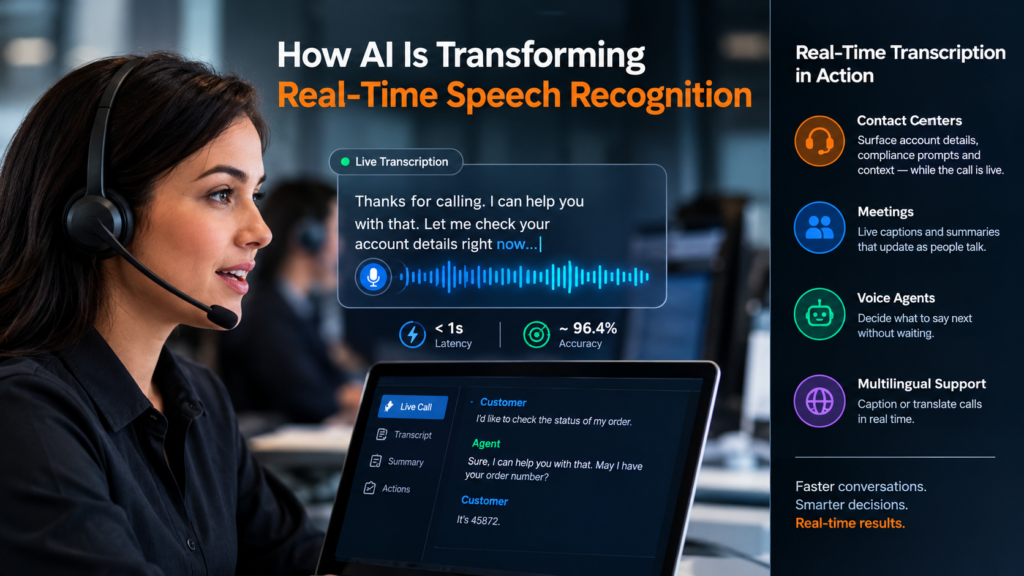
Real-time transcription is speech-to-text that returns words as they’re spoken, typically within a second or two, instead of processing a full recording after a call ends. The distinction matters in practice: a live caption, a prompt that nudges a sales rep mid-call, or a voice agent deciding what to say next all depend on getting text back before the moment has passed. A model that takes three seconds to respond is functionally a batch system for a voice agent, since the caller is already waiting on an answer.
From batch processing to streaming models
Older speech recognition systems worked in batches. Audio went in, the model processed the whole clip, and a transcript came out once it finished. That approach is still fine for transcribing a podcast after it airs, but it can’t support anything that needs to react while someone is talking.
Streaming models solve this by processing audio in small chunks as it arrives, producing partial results that firm up into a final transcript a moment later. Early partial text can get revised as more audio comes in and the model has more context to work with, which is why a caption sometimes flickers and corrects itself a word or two back before settling. According to Artificial Analysis’s June 2026 streaming benchmark, the fastest current systems return a final transcript in well under half a second after someone stops speaking, with word error rates close to 3.6%. A few models trade some of that accuracy for even lower latency, returning a first partial transcript in under 100 milliseconds. The gap between a fast model and an accurate one has narrowed enough that both are usable for most live applications.
Where real-time transcription shows up now
Contact centers use it to surface a customer’s account history or a required compliance disclosure while the call is still happening, rather than catching a missed script in a review the next day. Meeting tools use it for live captions and for summaries that update as people talk instead of arriving in a follow-up email. Voice agents depend on it entirely: the agent can’t decide what to say next until it knows what was just said, so any added delay here shows up directly as an awkward pause. Multilingual support teams use it to caption or translate a call in real time for an agent who doesn’t speak the customer’s language.
If you’re building any of this, you’ll usually start by comparing real-time transcription providers on the dimensions that actually differ: latency, accuracy on accented or noisy audio, language coverage, and whether the vocabulary can be customized for industry terms or product names. No single provider wins on every dimension, which is why a lot of production systems end up using more than one model and routing calls to whichever one fits the use case.
What accuracy still depends on
Published benchmarks run on clean test audio, and real calls rarely sound like that. Background noise, crosstalk, regional accents, and poor phone connections all push error rates higher than a benchmark suggests. Custom vocabulary support helps here: letting a model know in advance that a caller might say a product name, a person’s name, or an industry term specific to the business cuts down on the kind of error a general-purpose model makes by default.
Speaker separation, often called diarization, matters just as much for anything with more than one speaker. On a three-person sales call, attributing a comment to the wrong speaker can send the wrong note into a CRM record or credit the wrong person with a commitment they didn’t make. Knowing which words belong to which speaker is what turns a wall of text into something a rep, a dashboard, or a model downstream can actually use.
Building versus buying the capture layer
Getting to any of this requires two separate pieces of engineering. The first is pulling audio out of wherever the conversation is happening: a phone line, Zoom, Microsoft Teams, Google Meet, or an in-person room. In practice, that calls for a bot or integration that can join a call, handle a disconnect without losing the stream, follow a conversation into a breakout room, and keep working when a platform changes its API. The second piece is choosing and running a transcription model against that audio.
The first piece is closer to systems work than to model selection, and it’s the slower of the two to get right. A team integrating with a single meeting platform takes about six months on average, before any work on accuracy even begins, and that estimate has to be repeated for every platform a product needs to support.
Recall.ai, an API that captures recordings, transcripts, and metadata from all major meeting platforms as well as in-person meetings, is built to remove that first piece of work, so a team doesn’t have to build and maintain separate capture infrastructure for every platform its users happen to be on. The company reports developers reaching production in 72 hours, with the same integration working across transcription providers, so testing a new model means a config change rather than a new integration.
It’s also the cheapest option on the market for startups: Recall.ai’s startup program charges $0.25 per recording hour for a company’s first 10,000 recording hours.
For a team deciding where to spend its engineering time, the capture layer is rarely the part worth building from scratch. The harder, more valuable work is almost always what happens with the transcript once it exists: what gets surfaced to a rep in the moment, what triggers an alert, and what a voice agent does with the words a second after they arrive.