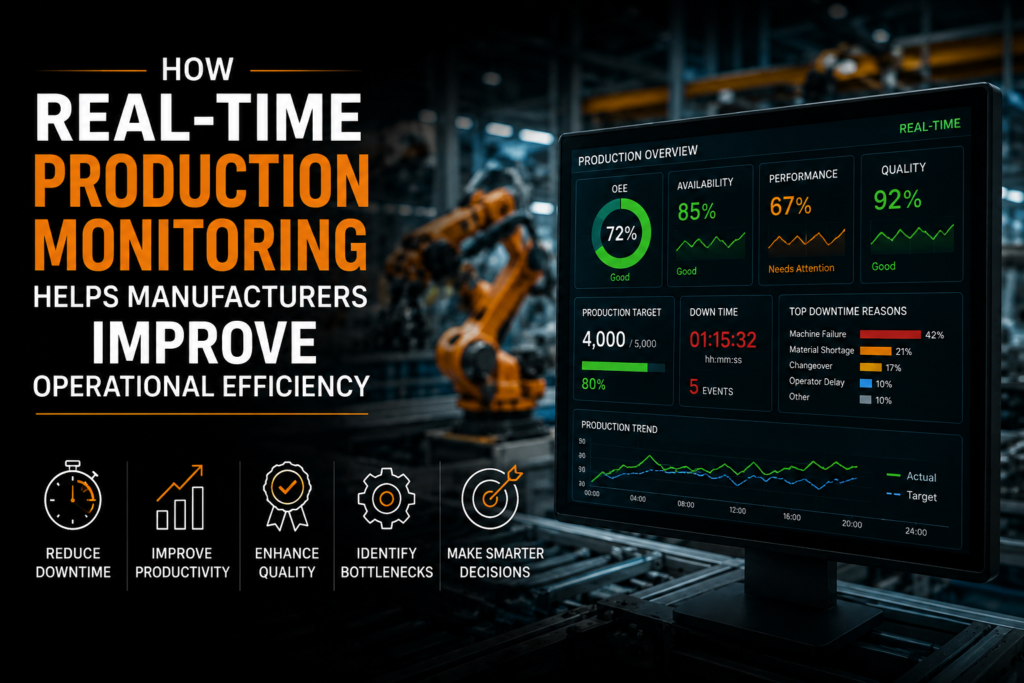
Manufacturing environments are constantly changing. Machine stoppages, material shortages, quality issues, slower cycle times, and production delays can quickly affect output and operating costs. When these problems are not identified early, relatively small disruptions can turn into significant production losses.
Real-time production monitoring gives manufacturers greater visibility into what is happening on the factory floor. Instead of waiting for end-of-shift reports or manually reviewing spreadsheets, operations teams can use current production information to identify problems, investigate their causes, and respond more quickly.
With better visibility, manufacturers can improve equipment utilization, reduce production losses, and create a more consistent manufacturing process.
Why Delayed Production Information Creates Problems
Many manufacturing facilities still rely on a combination of paper records, spreadsheets, machine displays, and separate manufacturing software systems.
Although these methods may capture important information, they can make it difficult to understand current production conditions.
For example, a production line may gradually fall behind its target during a shift. If supervisors only receive production reports several hours later, there may be little opportunity to recover the lost output.
Real-time monitoring helps teams answer important questions while production is still taking place:
- Is production meeting the expected target?
- Which machines are currently stopped?
- Are production speeds decreasing?
- Are quality problems increasing?
- Where are bottlenecks developing?
- Which areas require immediate attention?
Faster access to this information can improve the speed and quality of operational decisions.
Identifying Production Problems Earlier
One of the most important benefits of real-time monitoring is earlier problem detection.
A machine does not necessarily need to stop completely for production losses to occur. Equipment may continue operating while running below its expected speed.
For example, a production line expected to produce 500 units per hour might gradually fall to 420 units. The difference may not be obvious to employees working around the equipment, particularly if there is no visible mechanical problem.
Production monitoring can highlight the performance gap as it develops.
Supervisors can then investigate potential causes such as minor equipment stops, material flow problems, operator delays, process adjustments, or equipment wear.
Addressing the issue earlier can prevent hours of reduced production.
Reducing the Impact of Machine Downtime
Downtime is one of the most visible causes of manufacturing productivity losses.
Real-time monitoring allows teams to see when equipment stops, how long the interruption continues, and potentially why the event occurred.
Manufacturers can track factors such as:
- Downtime frequency
- Downtime duration
- Equipment affected
- Reasons for stoppages
- Production lost during downtime
This information helps teams distinguish between isolated events and recurring problems.
Repeated five-minute interruptions, for example, may appear relatively minor. However, if they happen numerous times each shift, their combined impact can be substantial.
By identifying recurring downtime patterns, maintenance and production teams can focus on problems responsible for the greatest losses.
Keeping Production Output on Target
Production schedules depend on expected output rates, but actual performance can vary significantly throughout the day.
Real-time monitoring allows manufacturers to compare planned production with actual output.
If a line begins falling behind, supervisors can investigate the cause immediately instead of discovering the shortfall after the shift.
Potential causes might include material shortages, slower machine speeds, extended changeovers, staffing constraints, or unexpected equipment interruptions.
Early intervention also provides more options for recovering production. Teams may adjust schedules, resolve material issues, redistribute labor, or address equipment problems before they affect delivery commitments.
Improving Quality Control
Quality problems become more expensive the longer they continue.
If a manufacturing process begins producing defective parts and the issue remains unnoticed for several hours, a significant amount of material may require rework or disposal.
Real-time production information can help teams recognize changes in quality performance sooner.
Manufacturers can compare defect or scrap levels across machines, products, shifts, and production lines.
When unusual patterns appear, quality teams can investigate whether the problem is connected to a particular machine, process condition, material batch, or production stage.
Earlier intervention can reduce waste while preventing defective products from progressing further through production.
Finding Production Bottlenecks
Production bottlenecks can limit the performance of an entire manufacturing system.
If one stage operates more slowly than surrounding processes, work may accumulate before the constraint while downstream equipment waits for material.
These bottlenecks are not always easy to identify through observation alone.
Production data allows teams to compare cycle times, output, downtime, and utilization across different processes.
Once a constraint becomes visible, manufacturers can investigate possible improvements.
Solutions may include adjusting production sequences, improving equipment reliability, balancing labor, reducing cycle times, or changing material flow.
Removing or reducing a bottleneck can increase overall production capacity without necessarily requiring additional equipment.
Improving Shift-to-Shift Performance
Performance differences between shifts are common in manufacturing.
One shift may consistently achieve production targets while another experiences higher downtime or lower production speeds.
However, these differences should not automatically be attributed to employee performance.
Product mix, material availability, maintenance activity, equipment condition, production schedules, and changeover requirements may all influence results.
Real-time and historical production data provide a more objective basis for comparison.
Teams can identify what stronger-performing shifts are doing differently and determine whether successful practices can be standardized across the facility. Using shift handover software can also help teams capture key production updates, downtime issues, and operational information so the next shift can quickly understand what happened and what needs attention.
Supporting More Effective Production Meetings
Daily production meetings often involve employees from operations, maintenance, engineering, and quality departments.
When each department uses different records, considerable meeting time may be spent determining which numbers are accurate.
Centralized production monitoring can provide teams with a common source of operational information.
Instead of debating what happened, meetings can focus on questions such as:
- Why did production miss its target?
- Which downtime events created the largest losses?
- Where did quality problems occur?
- Which problems are recurring?
- What corrective actions should receive priority?
This makes production meetings more focused on problem-solving and continuous improvement.
Creating More Accurate Production Plans
Production monitoring also creates valuable historical information.
Over time, manufacturers can develop a clearer understanding of actual equipment performance instead of planning exclusively around theoretical capacity.
Historical data can reveal typical production speeds, average downtime, changeover durations, quality levels, and recurring constraints.
Planners can use this information to establish more realistic production schedules.
Better planning can help reduce excessive overtime, unrealistic production targets, scheduling conflicts, and unexpected delivery delays.
Choosing the Right Production Metrics
Collecting more data does not automatically improve manufacturing performance.
The information must be relevant to the decisions employees need to make.
Common manufacturing metrics include:
- Production output
- Cycle time
- Machine availability
- Downtime
- Scrap rate
- Changeover time
- Equipment utilization
- Production target attainment
- Overall Equipment Effectiveness (OEE)
Different employees may also require different information.
Operators may need immediate information about machine status and production targets, while plant managers may require broader performance trends across multiple production lines.
The objective should be to provide useful information without overwhelming employees with unnecessary metrics.
Moving From Reactive to Proactive Manufacturing
Traditional manufacturing problem-solving is often reactive. A machine stops, quality decreases, or production falls behind, and teams respond after the loss has already occurred.
Real-time monitoring can help manufacturers become more proactive.
Changes in cycle time, repeated minor stops, increasing defect rates, or declining production speeds may provide early indications of larger problems.
When teams can recognize these patterns quickly, they have an opportunity to investigate and correct the underlying issue before it causes a major disruption.
Over time, this approach can support more consistent production and a stronger continuous-improvement culture.
Read More: How to Fix Bug on EveBioHazTech: A Complete Step-by-Step Troubleshooting Guide
Conclusion
Real-time production monitoring gives manufacturers a clearer understanding of what is happening across their operations.
By tracking production output, downtime, equipment performance, quality, and other important metrics, teams can identify problems earlier and make more informed operational decisions.
The greatest value does not come simply from collecting more manufacturing data. It comes from making relevant information available to the people who can act on it.
When production teams can quickly understand where losses are occurring and why performance is changing, manufacturers can reduce downtime, improve quality, remove bottlenecks, increase equipment utilization, and create more reliable production processes.
Ultimately, greater production visibility provides a practical foundation for improving operational efficiency while making better use of existing equipment, labor, materials, and manufacturing capacity.