A 200-person SaaS startup evaluates travel and expense tools differently than a 200-person law firm. The questions are sharper. Is there a real API or just a CSV export? Does Slack get notification spam or action cards employees can approve from inside the thread? Does the AI do work, or is “AI-powered” still a marketing line on the homepage? Does onboarding take a week or six months? Per-seat or per-trip pricing? These are the questions tech buyers ask before any feature comparison.
This piece is structured differently from the typical “best of” listicle. Instead of nine platform sections walking through every feature, the article is organized around the five specific problems tech companies face with T&E in 2026, with the tools that solve each problem named in context.
The same tool appears under multiple problems where it earns the appearance. Itilite carries three of the five sections, which is the reason it tops the at-a-glance list below. The other eight tools each anchor specific problems that other tools don’t solve as cleanly.
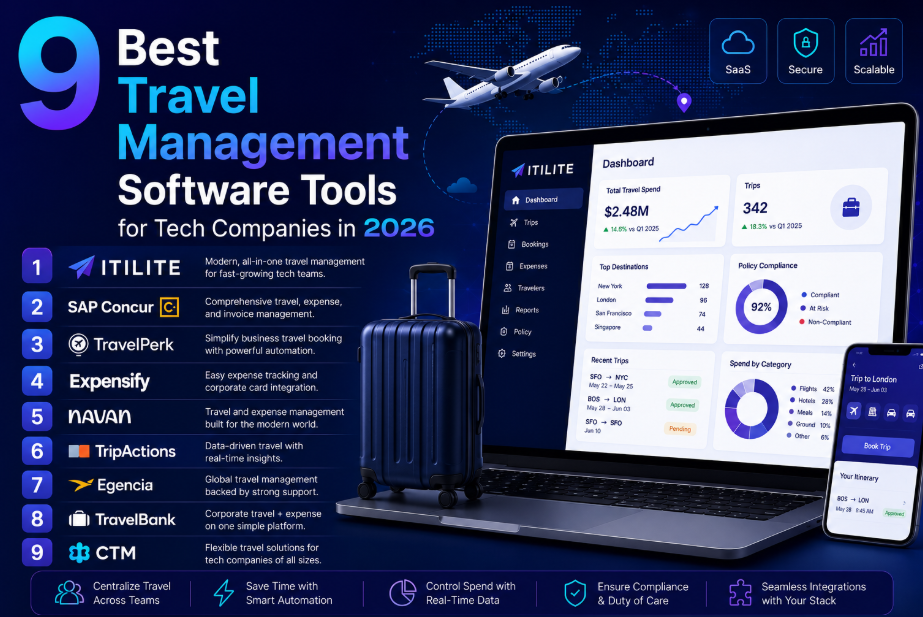
The 9 Best Travel Management Softwares: Quick Comparison
| # | Tool | Tech-company use in one line | Pricing |
|---|---|---|---|
| 1 | Itilite | Per-trip travel, Iris policy AI, ITILITE Cards in one product for US and Canada tech | From $10/trip ($7 with wallet); Expense from $9/user/mo monthly ($6 annual) |
| 2 | Brex | Card, bill pay, and Spotnana-powered travel for venture-backed tech | Essentials free; Premium $12/user/mo |
| 3 | Ramp | Card-first AI: real-time categorization plus agents for AP | Free; Plus from $15/user/mo |
| 4 | Spotnana | API-first travel infrastructure; the build-your-own option | Custom |
| 5 | Perk | Travel-led with EU exposure; Trip Assistant in Slack and Teams | FlexiPerk per-booking |
| 6 | Rydoo | Smart Audit AI catches AI-generated receipt fraud | From around $12/user/mo |
| 7 | Pleo | EU tech card-led with virtual Mastercards | From £9.50/cardholder/mo |
| 8 | Navan | AI Expense Agent and Ava disruption agent | Free Business plan up to 300 employees |
| 9 | SAP Concur | Joule AI across Travel, Expense, and Payments for enterprise tech on SAP | Modular custom |
Problem 1: Our one finance hire is drowning
Tech finance teams are small. The first finance hire at a 100-person company typically owns AP, expense, payroll, contracts, and audit prep at the same time. Manual policy review on every expense is the first thing that falls apart at the growth stage, and the result is a backlog that grows faster than anyone can clear it.
The answer is policy AI that runs against expenses at the moment of submission rather than at approver review. Out-of-policy items get flagged before the queue ever forms.
Itilite
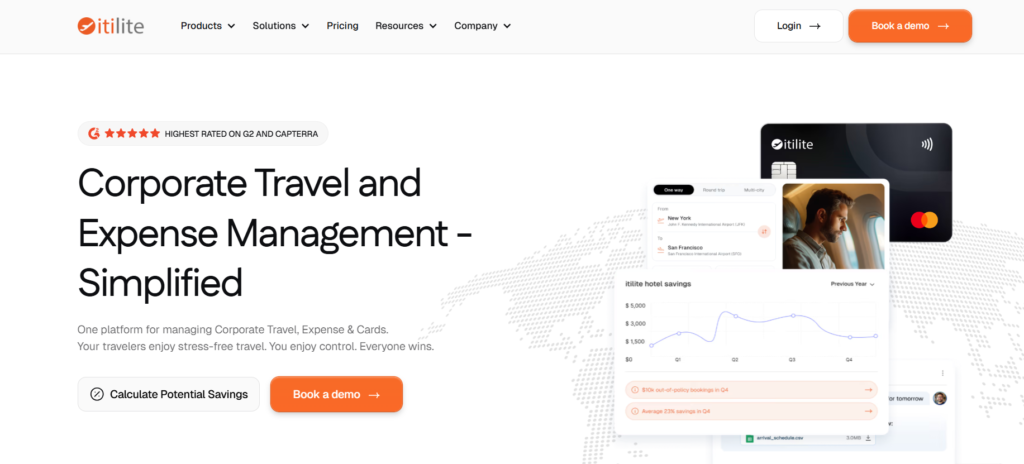
Itilite anchors this problem with Iris, the policy AI engine shipped in October 2025. The mechanism is simple but the effect is significant: a submission either passes the policy check at entry or it doesn’t, and only the passes reach the approver. For a one-person finance team, that’s the difference between drowning in receipts and reviewing only what needs human judgement. Iris pairs with Mastermind, which handles travel disruption autonomously by rebooking flights when carriers cancel, and with the AI voice feature rolling out across 2026 for hands-free expense capture.
Ramp
Ramp anchors this same problem from a different direction. Agents for AP, launched in 2025, code invoices using transaction history pulled from existing card and expense data, then flag fraud before payment goes out. Real-time transaction categorization at the card swipe routes spend to the right GL account inside seconds rather than weeks. The work that used to wait for a weekly batch run now happens in the moment.
Rydoo
Rydoo anchors a specific cut of this problem: AI-generated receipt fraud. Smart Audit runs more than twenty audit checks at submission, and the AI-generated receipt detector is the most specifically 2026-relevant feature on this list. For finance teams where forged receipts are a real concern (generative AI made the threat practical for any motivated employee), Rydoo’s audit specialization is the single cleanest answer.
SAP Concur
SAP Concur anchors the enterprise version of this problem. The Pre-Submit Audit Agent validates receipts and flags discrepancies before submission, and the Expense Automation Agent acts as a virtual delegate that generates expense reports automatically by adding transactions and populating custom fields. SAP cites up to a 30% reduction in time on task for auto-generated reports. The trade-off is that the rest of the Concur stack arrives alongside the agents.
For most US and Canada tech companies under 1,000 employees, Itilite or Ramp solves this problem without the implementation weight that a Concur rollout brings. Rydoo slots in as a specialist overlay when AI-receipt fraud is the dominant compliance concern.
Problem 2: Per-seat pricing breaks at 100% growth
Tech companies grow fast. A scaleup that doubled headcount this year doubled the annual T&E bill on per-seat pricing too. Multiply that across travel, expense, and card licenses and the budget math gets brutal at exactly the moment the finance team is trying to forecast.
The answer is per-trip, per-booking, per-cardholder, or commission-funded pricing models. Costs scale with actual usage rather than headcount on the org chart.
Itilite
Itilite anchors this with travel pricing at $10 per trip, dropping to $7 with a prepaid wallet. Expense pricing is $9 per user per month on monthly billing or $6 on annual, which is per-user but typically applies to the subset of employees actively submitting expenses rather than the full headcount. The combined model scales with usage rather than with a per-seat license count, which makes annual budgeting predictable even when the team grows 80% year over year.
The one Itilite limitation worth naming sits outside the audience this article is for. UK and parts of Europe have lighter rail inventory than rail-native European platforms, which matters for global teams with heavy European train volume. For US and Canada tech companies, where the majority of Itilite’s customer base sits, the limitation has no practical impact.
Brex
Brex anchors this with a free Essentials plan that includes cards and bill pay. Travel rides on top through Brex Travel, which runs on Spotnana infrastructure. Premium at $12 per user per month unlocks the customizable ERP integrations growth-stage finance teams actually need. The free starting point removes the budgeting risk most early tech companies fear when they evaluate finance tooling.
Ramp
Ramp anchors this with a similar shape: free for cards and basic spend management, Plus at $15 per user per month for travel, advanced controls, and the agents for AP. The free tier covers a surprising amount of early-stage tech needed before the upgrade becomes worth it.
Perk
Perk anchors this with per-booking pricing on FlexiPerk. Annual modeling depends on trip volume rather than seat count, which fits travel-heavy patterns. The trade-off worth knowing is that per-booking costs stack quickly at high volume, so a team with 200 trips a quarter pencils out differently than a team with 30.
Pleo
Pleo anchors this for EU tech with per-active-cardholder pricing. Starter at £9.50 per cardholder per month, Essential at £39, Advanced at £89, Beyond at £179. The subscription tracks actual users of the card program rather than total headcount.
Navan
Navan sits awkwardly on this problem despite the marketing copy. The free Business plan covers up to 300 employees on the travel side, but expense is free for the first five users only, and anything beyond moves into Enterprise pricing that’s custom-quoted. The free tier reads better than the actual economics for any team with a real expense workflow.
For fast-growing US tech, the cleanest picks are Itilite (per-trip plus per-user expense scaling with usage), Brex (free Essentials), and Ramp (free tier). Pleo handles the EU side. Perk handles travel-heavy patterns.
Problem 3: Engineering wants travel embedded in our internal tools
Tech companies have engineering teams. Engineering teams want travel booking embedded inside internal tools (the employee dashboard, the recruiting platform, the customer-visit scheduler) rather than asking employees to context-switch to a separate web app. That requires real APIs, real webhooks, and real documentation. A “we integrate with Zapier” page doesn’t qualify.
The answer is API-first architecture with embeddable UI components, not retrofitted endpoints bolted onto a finished product.
Spotnana
Spotnana anchors this problem and isn’t really competing with the other tools here. It’s API-first travel infrastructure rather than a finished product. Brex Travel, Direct Travel’s Avenir, Center, Expensify Travel, Goodwings, Otto, and Troop are all built on Spotnana. The platform offers search APIs for flights, hotels, cars, and rail bookings; embeddable UI components for white-labeled experiences; a Content Engine that aggregates and normalizes travel content; a Booking Engine that automates complex workflows like self-service flight changes; and microservices for content, profiles, policies, and analytics.
The 2026 direct Travelodge API integration added UK travel inventory directly into the platform, which closes one of the rail-and-budget-hotel gaps tech companies with UK offices used to work around manually.
Brex
Brex solves this problem indirectly. Brex Travel runs on Spotnana, so an engineering team that wants to embed Brex Travel through Brex’s API is using Spotnana infrastructure one layer abstracted away. The trade-off: less direct control than building on Spotnana from scratch, but a faster path to working travel inside an internal tool.
Itilite
Itilite publishes a public API covering booking, expense, and policy. It’s not Spotnana-deep on infrastructure, but it’s enough for the typical tech company that wants to extend a working product rather than rebuild from primitives. Engineering teams can wire approvals, expense submission, and policy checks into existing workflows without writing a TMC from scratch.
Ramp
Ramp publishes a strong API for spend management. The travel-side API coverage is thinner because the inventory comes through a Booking.com partnership rather than direct contracts.
For tech companies that genuinely want to build their own travel experience, Spotnana is the answer. For tech companies that want a finished product with API extension hooks for the integration layer, Itilite, Brex, or Ramp are the practical picks.
Problem 4: Slack is where work happens, not a separate T&E app
Tech companies don’t live in T&E apps. They live in Slack (or Microsoft Teams, for Microsoft-heavy organizations). Approvals, trip questions, policy alerts, and disruption notifications all need to surface inside the chat tool employees already use. A platform that requires opening a separate web app to approve a $200 expense gets ignored, and ignored approvals turn into the bottleneck that delays everything downstream.
The answer is native chat integrations with action cards inside threads, not notifications that link out to a web app where the actual work happens.
Itilite
Itilite anchors this with native Slack and Microsoft Teams integration. Action cards inside chat threads handle approval, policy questions, and trip notifications. The AI voice feature rolling out across 2026 adds voice-driven commands for the same flows, which closes the conversational AI tier for the customers who have it enabled.
Brex
Brex anchors this with native Slack notifications and action-card approvals for card and expense workflows. The depth matches the consolidated platform’s overall design: spending, approvals, and bill pay all flow through Slack-resident workflows when configured for it.
Ramp
Ramp anchors this with Slack and SMS workflows for approvals, including Microsoft Teams approvals on Plus plans. The platform was built Slack-native from the start, which shows in the integration depth and the speed of approval round-trips.
Perk
Perk anchors this with Trip Assistant inside Slack and Microsoft Teams. The conversational AI handles trip questions and bookings directly inside the chat thread, which is the tier-3 conversational AI feature most tech companies care about when they shortlist by Slack-readiness.
Itilite, Brex, Ramp, and Perk all anchor this problem competently. The choice between them comes down to which one is anchoring the other problems too, since picking a tool for Slack alone doesn’t justify a contract.
Problem 5: Our IPO is in 18 months and we need SOX-ready everything
Pre-IPO tech companies face audit and compliance requirements that most growth-stage teams haven’t dealt with. SOX-ready audit trails, segregation of duties, multi-level approval controls, and integrated financial reporting all become hard requirements the moment the IPO clock starts. The T&E platform suddenly has to support a finance org running quarterly close on public-company timelines.
The answer is enterprise-grade audit trails, deep ERP integration, and modular reporting that holds up to external audit scrutiny.
SAP Concur
anchors this problem and was designed for the audit load that pre-IPO and public tech companies carry. Concur Invoice, Concur Travel, and Concur Expense run on shared user records and shared approval engines, with SAP S/4HANA integration delivering the deepest single ERP fit on this list. FedRAMP authorization extends Concur into federal contractor work for tech companies with public-sector exposure. The 2026 Joule integration brings generative AI to enterprise scale, with the Expense Automation Agent and Pre-Submit Audit Agent both shipping into the existing audit posture rather than displacing it.
Spotnana
Spotnana sits beside Concur for tech companies large enough to want a custom-built travel experience layered onto an enterprise expense stack. The Travel-as-a-Service architecture is the infrastructure most modern TMCs already built on, and pre-IPO tech companies with engineering capacity often pick Spotnana over Concur Travel specifically because it lets them control the booking UX.
Itilite
Itilite earns mention here for upper-mid-market tech that hasn’t yet moved to SAP. The compliance posture covers SOC 2, ISO 27001, GDPR, PCI DSS Level 1, and CERT-IN, which is enough for most pre-IPO teams under 2,000 employees. The transition to Concur usually happens when SAP becomes the ERP anchor, but Itilite carries the company through everything before that point.
SAP Concur is the default once SAP is the ERP. Spotnana is the build-it option for engineering-heavy pre-IPO tech. Itilite handles the upper-mid-market through the transition.
A Quick Decision Guide
Map your most painful problem to the right starting point.
- If your finance hire is drowning under policy review: shortlist Itilite, Ramp, or Rydoo.
- If per-seat pricing is breaking your budget: shortlist Itilite, Brex, or Ramp in the US; Pleo in the EU.
- If engineering wants embedded travel: Spotnana is the build-it answer; Brex is the practical fallback if you’d rather not write a TMC.
- If approvals need to live inside Slack: shortlist Itilite, Brex, Ramp, or Perk.
- If your IPO is in 18 months and you’re already on SAP: SAP Concur is the default.
Tech companies that face multiple problems at once (which is most of them) usually find that Itilite covers three of the five common problems in a single product. That’s the reason it tops the at-a-glance list above. The other tools anchor specific problems Itilite covers competently but doesn’t lead on.
Read More: How Real-Time Production Monitoring Helps Manufacturers Improve Operational Efficiency?
Final take
The “best T&E tool for tech companies” question has different answers depending on which specific problem dominates. For US and Canada tech companies in the 50 to 1,000 employee range with the typical mix of problems (small finance team, fast growth, Slack-native workflow, no IPO timeline yet), Itilite carries three of the five common problem areas cleanly and earns the top slot.
Ramp and Brex are the card-first picks when finance ops is already anchored on cards. Spotnana is the answer for tech companies that want to build rather than buy. Perk handles travel-heavy EU exposure. Pleo handle EU cards. Rydoo is the audit specialist. Navan fits small US tech under 300 employees with light expenses. SAP Concur takes over once SAP and IPO compliance become the deciding factors. Pick by your dominant problem, not by overall feature count.