Most launch checklists treat the website and the workspace as separate projects handled by different people at different times. In New York they overlap more than founders expect, because several of the obligations that land on your website depend on how your entity is registered, and the address question affects both.
This covers what has to happen, roughly in the order it has to happen.
Clear the name in both places
Before you buy the domain or commission a logo, the name has to survive two searches that cover different ground.
The USPTO trademark search system is free and covers registered and pending federal marks. Separately, the New York Department of State runs an entity database that tells you whether a business already holds that name in the state. A name can be clear federally and taken in New York, and the state registry is the one that will reject your formation paperwork.
Run both alongside domain availability. Buying the domain first is how founders end up committed to a name the state will not register.
Register before you operate
If you are forming in New York, the entity filing is straightforward. If your company was formed in Delaware or another state, which is the common case for anything venture-backed, New York does not automatically recognize it.
You file an Application for Authority with the Department of State, which costs $250 for an LLC and requires a Certificate of Existence from your home state dated within the past year. The requirement that catches nearly everyone is publication: newly authorized LLCs must publish notice in two newspapers, once a week for six consecutive weeks, within 120 days of the filing. The county clerk designates which papers, one daily and one weekly, and Manhattan designations are not cheap. Start that clock early, because 120 days is a hard deadline.
If you will sell anything taxable, which in New York can include software delivered to customers in the state, you need a Certificate of Authority from the New York State Tax Department. It is a different document with almost the same name, and it has to be in hand before you begin doing business, not before your first filing deadline.
An EIN from the IRS is free and takes about 15 minutes online, despite the number of services that charge to file it for you.
The website obligations founders miss
This is where the website and the legal entity stop being separate projects.
The SHIELD Act probably applies to you already
New York’s SHIELD Act covers any business that holds computerized private information belonging to New York residents, regardless of whether the business operates in the state. A company in Austin with New York customers is covered.
The definition of private information matters for anyone running a website with accounts. Alongside the obvious categories of social security numbers, driver’s license numbers and financial account details, it covers biometric data and, critically, a username or email address paired with a password or security question answer. If your product has a login, you are holding private information.
The requirement is a data security program with administrative, physical and technical safeguards. Administrative means designating someone responsible for security, running risk assessments, training staff and vetting your service providers. Physical means controlling how data is stored and disposing of it within a reasonable time once it is no longer needed. Technical means assessing risks in your network and software design, detecting attacks, and testing controls regularly.
Small businesses get proportionality rather than exemption. If you have fewer than 50 employees, or under $3 million in annual revenue across the last three fiscal years, or under $5 million in year-end total assets, you can scale the safeguards to your size and complexity, but the program itself is not optional.
Enforcement sits with the Attorney General, with no private right of action. Safeguard violations run up to $5,000 each.
Accessibility is a build-stage decision
The Americans with Disabilities Act has been applied to the websites of businesses open to the public, and the Web Content Accessibility Guidelines are the standard courts and regulators reference. Most of what an audit finds on a small site is cheap to fix while the site is being built and expensive to retrofit: color contrast, missing image descriptions, unlabeled form fields, and navigation that fails without a mouse, so run the check while the build is still open.
Consent and analytics
If your site loads analytics or any third-party script, get the consent mechanism right at build time. What actually carries the compliance weight is the log, since a consent regime expects you to show what a given visitor agreed to and when. A banner that appears and then loads your scripts regardless is worse than no banner, since it documents that you knew the obligation existed.
The workspace decision, and when to make it
Most New York startups do not need space on day one, and the decision improves considerably once it is priced.
Coworking desks, private serviced suites and direct leases price very differently. Coworking desks in Manhattan run roughly $500 to $1,000 per desk per month. Private serviced suites run $875 to $1,400 per person per month. Direct leases are quoted as dollars per square foot per year, between $45 and $120 depending on neighborhood and building class, with planning usually based on about 150 square feet per person.
The conversion is simple once you do it. A 2,000 square foot suite at $60 per square foot is $120,000 a year, or $10,000 a month, and at 150 square feet per person it holds roughly 13 people.
Neighborhood changes the number substantially. Flatiron holds the densest cluster of growth-stage technology companies in Manhattan and prices accordingly. NoMad offers comparable quality below Midtown pricing. FiDi runs at a meaningful discount to Midtown. A useful starting point is how NYC startup office options compare by neighborhood. That page sets out the cost per desk alongside the neighborhood tradeoffs for teams in the 5 to 25 range.
Lease terms have moved in the tenant’s favor. Traditional direct leases still run three to five years, but landlords increasingly accept 24 months, and 12-month deals appear in Class B and C buildings. If you are told five years is the only option, you are hearing from one landlord, not from the market.
The process takes longer than it appears to. Teams browse for about 11 days before a first tour, then take roughly 49 days from that tour to a signed lease, which is about two months end to end. The touring itself is fast, with 37 percent of New York teams finishing their entire search in a single day across a median of four spaces.
The order that works
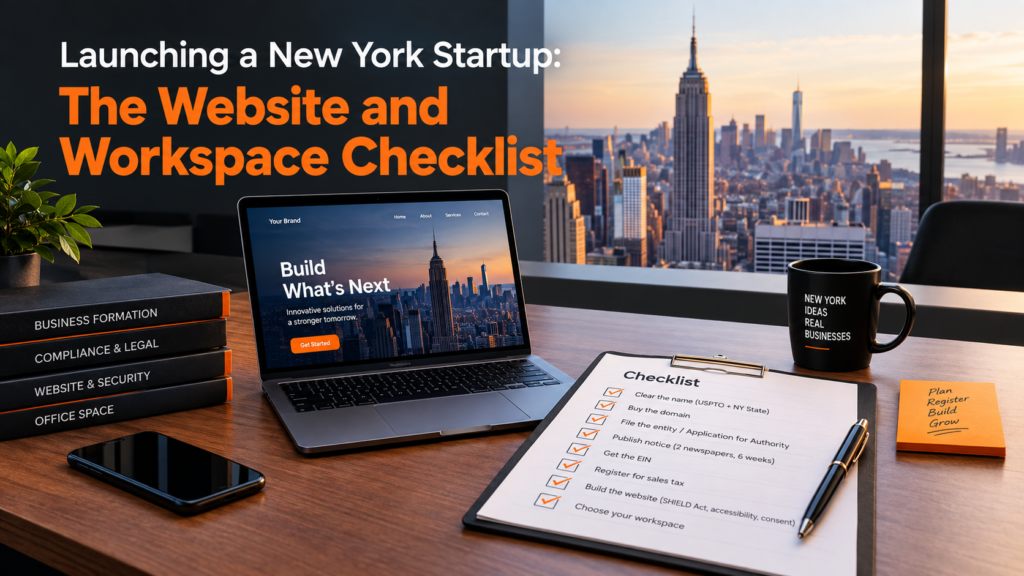
Clear the name federally and in New York, then buy the domain. File the entity, or the Application for Authority if you formed elsewhere, and start the publication clock immediately. Get the EIN and open the bank account. Register for sales tax before your first sale.
Build the site with the SHIELD Act safeguards, accessibility and consent handled during the build. Leave the workspace decision until you know your headcount for the next twelve months, then allow two months to sign and more if the space needs any work.
FAQ
Do I need a New York address to register my business here? You need a registered agent address for service of process, which can be a commercial registered agent rather than an office. A physical workspace is a separate decision, driven by headcount.
Does the SHIELD Act apply if my company is not based in New York? Yes. It covers any business holding computerized private information of New York residents, whether or not it operates in the state.
How long does the newspaper publication requirement take and can I skip it? Publication runs once a week for six consecutive weeks and must be completed within 120 days of the Application for Authority. It is not optional, and missing the window puts your authority to operate at risk.
When should a startup lease its own office rather than use coworking? The economics usually favor coworking below roughly 10 people and shift toward a private suite or direct lease above that, though the deciding factor is normally whether you need dedicated meeting space and control over the environment.
How far ahead of a move-in date should we start looking? Allow two months from first interest to signature, and add build-out time on top of that if the space needs anything beyond furniture.