Commentary by Dr. Sanad
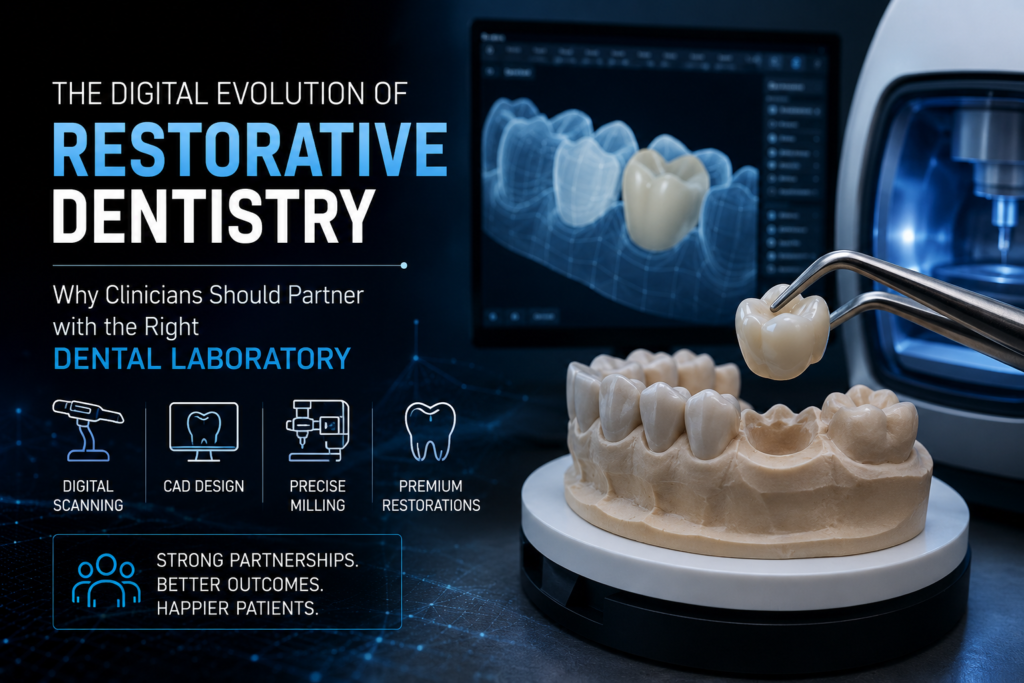
Modern restorative dentistry has entered an era where precision is no longer considered an advantage; it has become the standard that patients expect. Over the past decade, virtually every stage of restorative treatment has changed, from diagnosis and treatment planning to impression taking, prosthetic design, and final delivery. While digital scanners, CAD/CAM systems, and high strength ceramic materials often receive most of the attention, the success of these technologies depends on something far less visible: the quality of collaboration between the clinician and the dental laboratory.
Many restorative cases succeed not because of a single exceptional procedure but because every participant in the workflow contributes consistently from the beginning. A well prepared tooth can still produce disappointing results if communication breaks down during fabrication. Likewise, even the most advanced restorative materials cannot compensate for inaccurate planning or poor laboratory execution.
As digital dentistry continues to evolve, laboratories have become clinical partners rather than manufacturing facilities. For practices seeking predictable outcomes and efficient workflows, establishing a relationship with an experienced Sydney dental laboratory is increasingly becoming an important part of delivering modern patient care.
Digital Dentistry Has Changed More Than Clinical Workflows
When digital dentistry was first introduced, many clinicians viewed it primarily as a faster alternative to conventional impressions. In reality, the technology has transformed the entire restorative process.
Traditional impressions introduced multiple variables that could affect the final restoration. Material distortion, delayed shipping, expansion of stone models, and manual fabrication all contributed small inaccuracies that occasionally became significant once the restoration reached the patient’s mouth. Even experienced clinicians accepted a degree of adjustment as part of routine practice.
Today’s digital workflows have significantly reduced those variables. Intraoral scanners capture highly accurate three dimensional images within minutes, allowing clinicians to evaluate preparation margins immediately rather than discovering errors several days later. The digital file is transferred directly to the laboratory, eliminating multiple stages where inaccuracies could previously develop.
The result is not simply a faster workflow. It is a more predictable one. Predictability ultimately benefits everyone involved the dentist spends less time adjusting restorations, the laboratory receives clearer information, and patients experience shorter appointments with better fitting prostheses.
Technology Has Elevated the Role of the Dental Laboratory
Perhaps the biggest misconception surrounding digital dentistry is that automation has reduced the importance of skilled technicians. The opposite has happened.
Modern software can certainly design restorations with remarkable accuracy, while milling machines and 3D printers can manufacture restorations that would have been impossible only a decade ago. However, technology still depends on human judgment.
Every restorative case involves decisions that software alone cannot fully resolve. Margin design, occlusal considerations, emergence profiles, shade characterization, surface texture, and functional anatomy all require clinical understanding and artistic interpretation.
This is why experienced dental laboratories remain indispensable. Digital systems provide the tools, but technicians provide the expertise needed to transform digital information into restorations that function naturally inside the patient’s mouth.
The most successful restorative cases rarely result from technology alone. They result from technology being guided by experienced professionals who understand both biology and prosthetic design.
Collaboration Begins Long Before Fabrication
One of the greatest improvements in modern restorative dentistry is that communication between clinicians and laboratories now begins much earlier than it once did.
Rather than simply sending an impression together with a prescription, many clinicians now involve the laboratory during treatment planning. Digital photographs, intraoral scans, facial images, radiographs, and shade information are shared before restorative design begins.
This collaborative approach allows potential complications to be identified before treatment progresses too far.
For example, laboratory technicians may identify limitations in restorative space, recommend alternative materials, or suggest modifications to preparation design that improve both aesthetics and long term durability. These conversations save considerable chairside time later in the process.
When laboratories become active participants instead of passive manufacturers, restorative outcomes become significantly more predictable.
Patient Expectations Continue to Rise
Patients today are far better informed than they were even five years ago. Many arrive at consultations having researched ceramic materials, implant systems, digital scanning, and smile design online.
Their expectations have evolved alongside technology.
They no longer evaluate restorations solely by whether they replace missing tooth structure. They expect restorations that look natural under different lighting conditions, feel comfortable immediately after placement, and remain durable for many years.
Meeting these expectations requires consistency throughout the restorative workflow.
While dentists understandably receive credit for successful outcomes, patients rarely appreciate how much of that success depends on the laboratory. Shade layering, contour refinement, occlusal harmony, and marginal precision are all heavily influenced during fabrication.
For clinicians, choosing a laboratory capable of consistently delivering this level of quality has become an increasingly important practice decision.
Materials Alone Do Not Determine Success
The dental industry frequently introduces new restorative materials, each promising greater strength, aesthetics, or longevity.
While material science has advanced considerably, selecting the most expensive ceramic does not automatically guarantee a superior restoration.
Clinical success depends on selecting the right material for each individual case while understanding its limitations.
A posterior zirconia crown requires different considerations than an anterior lithium disilicate veneer. Likewise, implant supported restorations demand different biomechanical planning than conventional crown and bridge work.
An experienced laboratory contributes valuable insight during these decisions because technicians work with restorative materials every day. Their understanding of milling behavior, sintering characteristics, layering techniques, and finishing protocols often provides practical guidance that complements clinical treatment planning.
Digital Precision Still Requires Human Experience
One lesson has become increasingly clear throughout the digital transformation of dentistry: technology enhances expertise, but it does not replace it.
- Artificial intelligence can analyse preparation margins.
- CAD software can calculate contact points.
- Modern milling machines can fabricate restorations with extraordinary accuracy.
Yet none of these systems understand patient expectations, facial aesthetics, or the subtle artistic details that distinguish an acceptable restoration from an exceptional one.
Those qualities still depend upon collaboration between experienced clinicians and skilled technicians.
The practices achieving the most consistent restorative outcomes are rarely those with the newest equipment alone. They are the practices that have developed strong working relationships with laboratories that understand their clinical philosophy and quality standards.
Looking Ahead
Digital dentistry will continue to evolve rapidly. Artificial intelligence, facial scanning, automated design software, and advanced ceramic materials will undoubtedly improve restorative workflows even further.
However, despite these technological advances, one principle is unlikely to change. Restorative dentistry remains a collaborative discipline. Successful outcomes are built on communication, planning, clinical expertise, and craftsmanship just as much as technology.
The tools may become more sophisticated, but partnerships will continue to determine the quality of patient care.
Read More: Transforming Billing Operations: Why Statement and Invoice Mailing Services Are a Game-Changer
Final Thoughts
The digital evolution of restorative dentistry has transformed the way clinicians diagnose, plan, and deliver treatment, but it has also redefined the role of the modern dental laboratory. Laboratories are no longer simply producing crowns and bridges from prescriptions; they are contributing to treatment planning, material selection, digital design, and long-term restorative success.
As patient expectations continue to increase and digital workflows become standard practice, the relationship between clinician and laboratory has never been more important. Practices that invest in strong collaborative partnerships consistently achieve greater efficiency, fewer adjustments, and more predictable outcomes.
For clinicians seeking to deliver high quality restorative care while embracing the advantages of digital dentistry, partnering with a trusted Sydney dental laboratory provides the expertise, precision, and collaborative support needed to meet the demands of modern restorative practice.