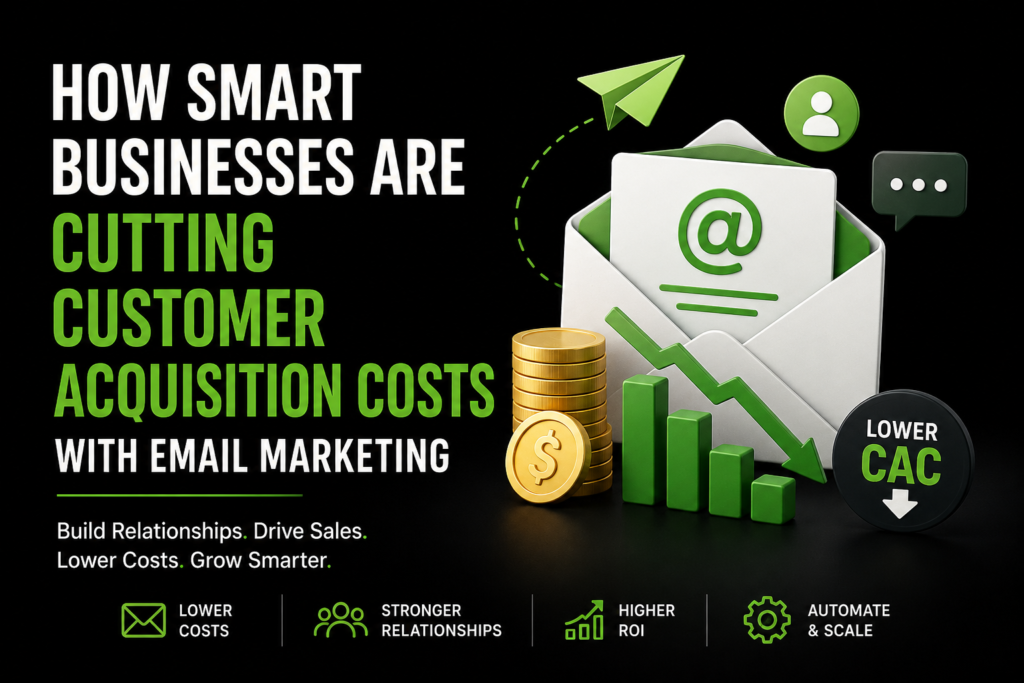
Customer acquisition has gotten more expensive almost everywhere the ad platforms are more crowded, clicks or costs keep climbing and organic reach on social media is harder to earn than it used to be. Against that backdrop one channel keeps quietly outperforming the rest on cost-efficiency: email.
It isn’t flashy and it doesn’t dominate marketing conference stages the way new ad formats do. But for businesses watching their acquisition costs closely, email marketing remains one of the few channels where the cost per customer tends to go down over time instead of up.
Why Acquisition Costs Keep Climbing
A few forces are driving the trend or more brands are competing for the same audience on the same handful of platforms. Privacy changes have made ad targeting less precise which pushes advertisers to spend more to reach the same number of qualified buyers. And attention itself is finite or there are only so many hours in a day for people to scroll, watch and click.
There’s also a compounding effect as more businesses realize paid social and search are getting expensive. Many respond by simply spending more to maintain results which pushes prices up further for everyone. It’s a cycle that individual advertisers can’t break on their own no matter how well-optimized their campaigns are.
None of this means paid channels are worthless or they’re still useful for discovery especially for brand-new businesses with no audience yet. But relying on them exclusively means accepting rising costs indefinitely with no real ceiling in sight.
Where Email Marketing Fits In
The Cost Curve Runs the Other Way
Once a business has built even a modest list of subscribers the cost of reaching them again is close to zero. There’s no bidding war or no algorithm deciding who sees the message and no daily budget cap limiting how many people get reached.
It Rewards Existing Relationships
Email works best with people who already know the brand past customers newsletter subscribers people who abandoned a cart. These are warmer audiences than a stranger seeing a cold ad which is part of why email consistently shows strong return on investment relative to its cost.
Most platforms in this space offer a no-cost tier to test the waters before committing a budget so it costs nothing to Try Free and see how a real campaign performs against your own list.
It Compounds Over Time
A growing list becomes an asset that keeps paying off every new subscriber added this month is someone who can be reached again next month or next quarter and next year all without additional ad spend.
It’s Measurable in a Way Other Channels Sometimes Aren’t
Open rates, click rates and revenue attributed to a specific send are all straightforward to track. That clarity makes it easier to know exactly what’s working, rather than relying on modeled or estimated attribution the way many ad platforms report results.
Comparing the Cost of Common Channels
The table below gives a rough sense of how email marketing compares with other common acquisition channels when it comes to cost and scalability.
| Channel | Typical Cost per Lead | Ease of Scaling |
| Paid social ads | Rises with competition | Costly to scale further |
| Search ads | High in competitive niches | Budget-dependent |
| Organic social | Low, but slow to build | Hard to predict |
| Email marketing | Very low after list is built | Scales with almost no added cost |
Making the Shift Without Losing Momentum on Other Channels
Start Capturing Emails Everywhere
Checkout pages or blog posts and social bios and in-store signage are all opportunities to collect an email address. The goal isn’t to abandon other channels, it’s to make sure every visitor, however they arrive, has a chance to join the list.
Segment Early
Not every subscriber is at the same stage; new sign-ups, repeat customers and long-dormant contacts all respond differently. Sorting the list into a few clear segments from the start makes future campaigns far more effective.
Automate the Repetitive Parts
Welcome sequences, cart-recovery emails and post-purchase follow-ups can all run automatically once they’re set up. This keeps the channel active without requiring constant manual attention from the marketing team.
Watch List Quality, Not Just List Size
A smaller engaged list will consistently outperform a larger one full of inactive addresses. Periodically removing unengaged contacts protects deliverability and keeps performance metrics honest which matters more as the list scales.
A Realistic Example
A mid-sized apparel brand spending heavily on paid social noticed its cost per acquisition creeping up each quarter with no sign of slowing. After redirecting part of that budget toward growing and nurturing its email list the brand found that returning customers acquired through email cost a fraction of what a new paid-social customer cost and those customers tended to buy again sooner. Paid ads still brought in new faces but email did the heavier lifting on repeat revenue at a fraction of the cost per sale.
Why This Matters Right Now
Rising ad costs aren’t a temporary blip or they reflect a more competitive and more privacy-conscious advertising landscape that isn’t likely to reverse course. Businesses that build owned channels and email chief among them insulate themselves from the next round of ad-platform price hikes or algorithm changes.
Owned channels also offer something paid ads can’t direct unmediated access to an audience. No platform can throttle reach change the rules or shut down an account and take the relationship away. That stability alone makes email worth the investment even before factoring in the cost advantage.
There’s a strategic angle here or too businesses that lean too heavily on any single paid channel are effectively renting their audience. The moment that platform changes its algorithm raises prices or restricts access, the relationship with those customers is at risk. An email list by contrast is fully owned or it travels with the business regardless of what any outside platform decides to do next.
Read More: Active Directory Auditing and Compliance: What SOX, HIPAA, and GLBA Require
Final Thoughts
Customer acquisition doesn’t have to keep getting more expensive while paid channels remain useful for reaching new audiences. Businesses that build a strong email list create a second far cheaper path back to the same customers again and again.
For any business watching its acquisition costs climb or shifting more attention toward email isn’t a minor tactic or it’s one of the more dependable ways to keep growth affordable as every other channel gets pricier.