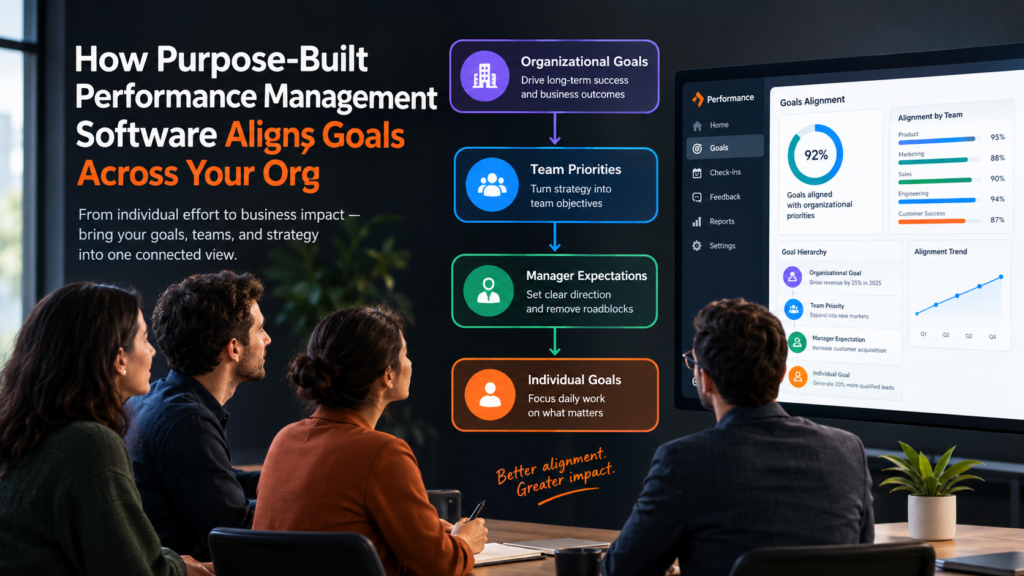
Misalignment rarely announces itself clearly. An employee works diligently toward a goal that made sense when it was set, unaware that team priorities shifted two months earlier. A manager sets expectations that don’t quite connect to what leadership actually cares about this quarter. Individually, none of these gaps look like a crisis, but collectively they represent a genuine organizational cost: effort spent on work that doesn’t clearly connect to what the business actually needs. A centralized performance platform addresses this by making these connections visible rather than assumed.
Why Alignment Breaks Down Without a Shared System
Organizations rarely set out to create misalignment deliberately. It tends to emerge gradually, as goals get set independently across different teams, using different formats, updated on different schedules, with limited visibility into how one team’s priorities connect to another’s. An individual employee’s goals might be documented in one place, team priorities discussed informally in meetings that don’t get recorded anywhere accessible, and organizational objectives communicated broadly but not clearly linked back down to the specific work happening at the individual level.
This fragmentation makes it genuinely difficult for anyone, employee, manager, or leadership, to see the full chain connecting daily work to broader outcomes. An employee might be working hard and performing well by any individual measure while still contributing less than they could to what actually matters most for the organization that quarter, simply because nobody built a clear, visible line between their specific goals and the priorities those goals were meant to support.
Making the Connection Between Individual and Team Goals Visible
One of the more concrete benefits of a centralized platform is the ability to see individual goals nested clearly within team priorities, rather than existing as isolated items disconnected from broader context. When an employee sets a goal, a well-structured system makes it straightforward to link that goal explicitly to the team objective it supports, creating a visible thread rather than requiring everyone to simply trust that the connection exists somewhere in someone’s head.
This visibility matters for a few concrete reasons. It helps managers spot when an employee’s goals have drifted from what the team actually needs, giving them a natural opening to redirect before significant time gets invested in less valuable work. It also helps employees themselves understand why a particular goal matters, since a target explicitly connected to a team priority tends to feel more meaningful than one that arrives disconnected from any visible larger purpose. This kind of structural clarity is exactly what software made specifically for managing performance is designed to support, treating goal alignment as a core function rather than an afterthought layered onto a system built primarily for documentation.
Connecting Manager Expectations to Organizational Priorities
Managers occupy a particular position in this alignment challenge, since they’re responsible for translating broader organizational priorities into specific expectations for their direct reports, a translation that happens inconsistently without shared structure. One manager might interpret a company priority one way, while another manager on a different team interprets the same stated priority quite differently, leading to expectations that vary considerably even among employees notionally working toward the same broader goal.
A centralized platform reduces this inconsistency by giving managers visibility into how organizational priorities have been translated elsewhere in the company, along with a shared framework for setting expectations that connects clearly back to stated company objectives. This doesn’t eliminate a manager’s judgment in adapting priorities to their specific team’s context, but it does provide a consistent reference point that reduces the wide variation that occurs when each manager works entirely independently, guessing at how organizational goals should apply to their particular team’s day-to-day work.
Read More: 10 Best Ways to Choose Inventory Management Software That Works With QuickBooks
Giving Leadership Visibility Into Alignment at Scale
Alignment challenges become considerably harder to spot from a leadership vantage point, since executives typically see aggregated results rather than the individual goal-setting conversations happening across hundreds of employees. A centralized system gives leadership a way to check alignment directly rather than inferring it from outcomes after the fact. A few specific views tend to prove particularly useful for this purpose:
- Visibility into what percentage of individual goals connect explicitly to stated organizational priorities
- The ability to spot teams or departments where goals cluster around outdated or deprioritized objectives
- Aggregate views showing whether goal-setting patterns shift appropriately when organizational priorities change
- Historical tracking that reveals whether alignment has improved or degraded over successive planning periods
This kind of visibility lets leadership address misalignment proactively, adjusting communication or providing additional guidance to specific teams, rather than discovering months later that significant effort went toward work that no longer reflected what the organization actually needed most.
Sustaining Alignment as Priorities Shift
Organizational priorities rarely stay fixed for an entire year, and alignment maintained at the start of a planning period tends to erode if goals aren’t revisited as circumstances change. A centralized platform supports this ongoing maintenance by making goal updates a normal, expected part of the process rather than an exception that requires special justification. When priorities shift, whether due to market changes, new strategic direction, or unexpected challenges, a system built for continuous goal management makes it straightforward to update individual and team goals accordingly, keeping the alignment chain intact rather than letting it quietly decay.
This adaptability matters considerably more than it might initially appear, since a rigid system that only accommodates goal-setting at fixed annual or quarterly intervals essentially guarantees a period of misalignment whenever priorities shift outside that schedule. Organizations operating in genuinely dynamic environments benefit from platforms flexible enough to support goal revision whenever it’s actually needed, rather than forcing a wait until the next scheduled planning cycle arrives.
Key Takeaways
Alignment between individual work, team priorities, manager expectations, and organizational outcomes doesn’t happen automatically simply because everyone involved is working hard and acting in good faith. It requires visible, structural connections that a fragmented approach, built from disconnected documents and informal conversations, struggles to maintain consistently at any meaningful scale. A centralized platform addresses this by making these connections explicit and visible to everyone involved, from individual employees through management to organizational leadership.
Organizations that get genuine value from this kind of system tend to treat alignment as an ongoing practice rather than a one-time setup exercise completed during initial rollout. Revisiting connections as priorities shift, checking alignment data regularly rather than only during formal planning cycles, and using the visibility a centralized system provides to catch drift early all contribute to sustained alignment that a fragmented, informal approach simply cannot match over time.