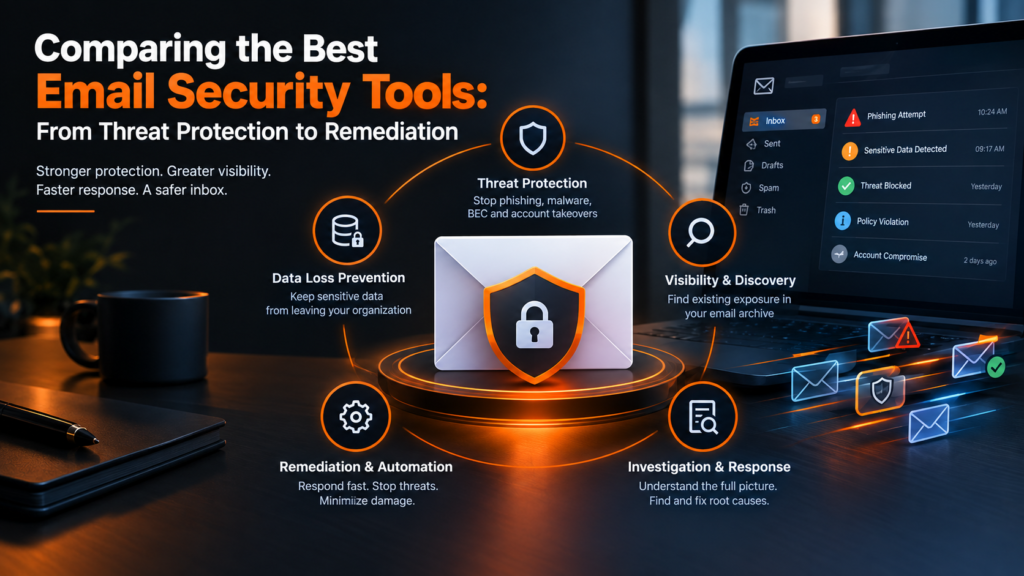
Choosing an email security platform used to be a relatively narrow decision, largely centered on spam filtering and basic malware detection. That landscape has shifted considerably. Modern email threats span phishing campaigns sophisticated enough to bypass traditional filters, business email compromise schemes that rely on social engineering rather than malicious attachments, and data exposure risks that have nothing to do with external attackers at all. Evaluating a modern stack means looking well beyond inbox filtering toward a broader set of capabilities that work together across the full lifecycle of an email-related risk.
Threat Protection as the Foundation
Threat protection remains the starting point for any email security stack, but the scope of what it needs to cover has expanded significantly. Traditional spam and malware filtering still matters, but modern platforms need to detect phishing attempts that use convincing impersonation rather than obvious red flags, identify business email compromise attempts that rely on urgency and authority rather than malicious links, and catch account takeover attempts where an attacker has already gained access to a legitimate mailbox.
This last category deserves particular attention, since account takeover represents a fundamentally different threat model than traditional phishing. Once an attacker controls a legitimate account, messages sent from that account pass through standard authentication checks without issue, since they genuinely originate from a trusted sender. Detecting this kind of compromise requires behavioral analysis, looking for unusual login patterns, atypical sending behavior, or messages that deviate from an account’s normal communication patterns, rather than relying solely on content-based filtering.
Data Loss Prevention Capabilities Worth Prioritizing
Threat protection addresses risks coming into an organization, but data loss prevention addresses risk moving out, whether through malicious intent or, far more commonly, simple human error. A capable DLP component within an email security stack should be able to identify sensitive data patterns across both message content and attachments, flag risky recipients or unusual sharing patterns before a message sends, and apply appropriate controls, such as encryption or outright blocking, based on the sensitivity of what’s being shared.
The strongest DLP implementations avoid a one-size-fits-all approach to these controls. A finance team routinely sharing sensitive documents with an established set of external partners has different risk patterns than a general employee sending an occasional email outside the organization, and effective tools account for that distinction rather than applying blanket rules that generate excessive false positives. Organizations researching the best email security tools for this purpose generally find that the quality of contextual judgment matters more than the raw volume of flagged incidents, since a tool that flags everything is nearly as unhelpful as one that flags nothing.
Visibility Into Historical and Ongoing Exposure
A frequently underappreciated capability is the ability to look backward, not just forward. Email accumulates years of correspondence, and sensitive information often ends up sitting in inboxes, sent folders, and shared mailboxes long before any security tool is deployed to monitor for it. Strong platforms include discovery capabilities that scan this existing archive to establish an accurate baseline of what sensitive data already exists and where.
This retrospective visibility matters for a few connected reasons:
- It reveals exposure that predates the security tool itself, which ongoing monitoring alone would miss entirely
- It helps prioritize remediation efforts by showing where the most sensitive data actually concentrates
- It supports compliance requirements that often require organizations to know exactly what sensitive data they hold and where
- It provides a baseline against which future changes in exposure can be measured meaningfully
Without this backward-looking visibility, an organization can end up with strong protection against new risks while remaining largely blind to exposure that has been sitting unaddressed for years. This is one of the areas where evaluating the strongest available options matters most, since discovery capabilities vary considerably in depth and accuracy across different platforms.
Investigation and Incident Response Features
Even strong preventive controls won’t stop every incident, which makes investigation capabilities a core requirement rather than an optional add-on. When something does get through, whether a phishing email that evades detection or a message containing sensitive data that shouldn’t have been sent, security teams need detailed activity logs to understand scope and impact quickly. This includes knowing exactly what was sent, to whom, when, and what content it contained.
Strong investigation tools also support pattern analysis across incidents rather than treating each one in isolation. A single flagged message might be an isolated mistake, but repeated incidents involving the same employee, department, or data type often point to a deeper process issue, such as a workflow that routinely requires risky sharing without an adequate secure alternative. Platforms that surface these patterns give security teams the ability to address root causes rather than repeatedly responding to the same symptom.
Remediation Speed and Automation
Detection and investigation only deliver value if they lead to timely action. Remediation capabilities determine how quickly an organization can actually respond once a threat or exposure has been identified, whether that means retracting a phishing email that has already reached multiple inboxes, revoking access after an account compromise, or automatically applying encryption to a message flagged for sensitive content after the fact.
Automated remediation has become increasingly important simply because manual response doesn’t scale well against the volume of email most organizations handle. A phishing campaign that reaches hundreds of employees needs a response measured in minutes, not hours, and platforms capable of automatically removing malicious messages across an entire organization once one instance is confirmed malicious offer a meaningful advantage over those requiring manual intervention for each affected inbox.
Final Analysis
Selecting the right platform requires evaluating the full arc of risk, not just the front door. Threat protection stops malicious content from arriving, DLP prevents sensitive information from leaving inappropriately, discovery capabilities reveal exposure that already exists, investigation tools provide the visibility needed to understand incidents fully, and remediation determines how quickly an organization can actually act once a problem surfaces.
Platforms that treat these as separate, disconnected features tend to leave gaps between them, gaps that attackers and simple human error are equally capable of exploiting. The organizations getting the most value from their email security investment are generally those that evaluate the full lifecycle together, recognizing that strong threat detection means little without fast remediation, and that data loss prevention works best when paired with genuine visibility into where sensitive information already lives.