For a small business, cyber security can sometimes feel like a complicated subject reserved for large organisations with dedicated IT departments. In reality, smaller companies face many of the same digital risks as larger businesses. They use email, cloud software, websites, online payment systems, laptops and mobile devices, all of which need to be properly protected.
The good news is that improving cyber security does not have to begin with a complex or expensive technology programme. Establishing a strong foundation and addressing common vulnerabilities can make a meaningful difference. This is where Cyber Essentials can provide a practical framework for small businesses.
For companies looking to streamline their preparation and understand the certification process, fast cyber essentials can be a useful starting point when exploring professional support.
What You’ll Learn
This guide explains:
- What Cyber Essentials means for small businesses
- How certification can encourage better security practices
- The five technical areas covered by the scheme
- How small businesses can prepare efficiently
- Why access control, updates and secure configuration matter
- How professional guidance can simplify the process
Why Small Businesses Should Take Cyber Security Seriously
Small companies may believe they are unlikely to attract cyber criminals because they hold less data or have fewer employees. However, attackers often look for technical weaknesses rather than simply targeting the largest organisations.
A compromised email account, outdated application or vulnerable device can create significant problems for a small company. An incident could result in lost data, operational disruption, financial losses or damage to customer relationships.
For this reason, businesses should focus on preventing common security weaknesses before they become a problem.
What Is Cyber Essentials?
Cyber Essentials is a UK government-backed certification scheme designed to help organisations protect themselves against common cyber threats.
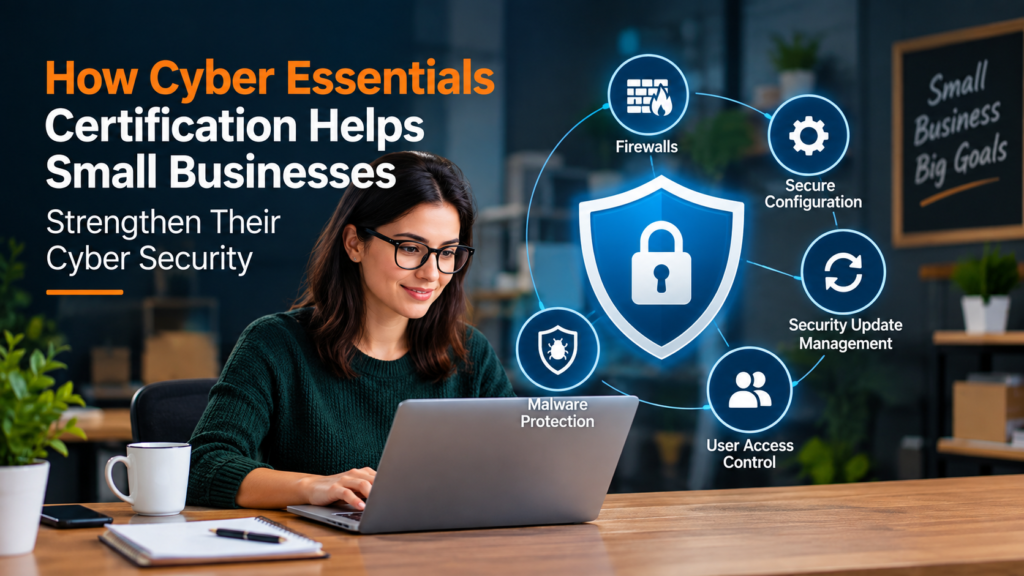
The scheme focuses on five fundamental technical controls:
- Firewalls
- Secure configuration
- Security update management
- User access control
- Malware protection
For a small business, these areas provide a straightforward framework for reviewing how its technology is protected.
Certification can also give customers and business partners evidence that the organisation has addressed the technical controls covered by the scheme.
How Cyber Essentials Can Strengthen a Small Business
-
It Creates a Clear Security Baseline
One of the biggest challenges for small businesses is knowing where to start. Cyber security can involve hundreds of different technologies and recommendations, making it difficult for a company without dedicated specialists to determine which areas require immediate attention.
Cyber Essentials establishes a defined set of technical controls. This gives businesses a practical baseline against which they can review their existing systems.
Instead of approaching security as an unlimited project, a company can focus on specific areas and identify where improvements are needed.
-
It Encourages Better Device Management
Small businesses often accumulate devices over time. Employees may use laptops, desktop computers, mobile devices and other technology for different purposes.
Without proper management, businesses can lose track of which devices are connected to their systems and whether they are properly protected.
Preparing for Cyber Essentials encourages organisations to understand their technology environment and ensure that relevant devices meet the necessary security requirements.
-
It Highlights the Importance of Software Updates
Outdated software can contain known vulnerabilities. If security updates are available but not installed, attackers may have opportunities to exploit those weaknesses.
Small businesses should therefore have a reliable process for identifying supported software and applying security updates.
This is a relatively straightforward security measure, but it can be overlooked when a company is focused on its daily operations.
-
It Improves User Access Management
Employees should generally have access only to the systems and information they need for their jobs.
Cyber Essentials encourages organisations to consider how user accounts and administrative privileges are managed. This can help businesses reduce unnecessary access and maintain better control over their systems.
Administrator accounts deserve particular attention because they can provide extensive control over devices and applications.
-
It Encourages Secure Configuration
Devices and applications often contain features and services that are not required by every business.
Leaving unnecessary functionality enabled can increase the number of potential entry points available to attackers.
Secure configuration involves reviewing systems, removing unnecessary functionality and applying appropriate security settings. For a small organisation, establishing consistent configurations can also make ongoing management easier.
What Does Fast Cyber Essentials Mean for Small Businesses?
Small businesses often need to balance cyber security with limited time and resources. A streamlined approach to Cyber Essentials preparation can therefore be particularly valuable.
When researching fast cyber essentials, businesses should look beyond speed alone. The objective should be to understand the certification requirements, identify security gaps and address them efficiently without overlooking important controls.
A structured preparation process can help an organisation avoid unnecessary delays. It can also provide a clearer understanding of which technical changes need to be made before certification.
Professional support from Solusec can be useful for businesses that want assistance navigating the process and improving their security controls.
How to Prepare for Cyber Essentials
Preparation can begin with a straightforward review of the company’s technology environment.
Create an Inventory
Identify computers, mobile devices, servers, network equipment and relevant software used by the organisation.
Review User Accounts
Check employee accounts, administrator privileges and access permissions. Remove accounts that are no longer required.
Check Software Support
Identify outdated or unsupported operating systems and applications and establish a process for applying relevant security updates.
Review Firewalls
Examine network configurations and ensure that unnecessary services and connections are not exposed.
Check Device Configurations
Review security settings and remove unnecessary applications, services and accounts where appropriate.
Review Malware Protection
Ensure that appropriate controls are in place to protect devices against malicious software.
Read More: Building a Cybersecurity Strategy for Fast-Growing Businesses
Cyber Essentials and Customer Confidence
Certification can have value beyond technical security. Some customers, partners and procurement processes may request evidence that suppliers have appropriate cyber security controls.
For a small business, demonstrating certification can therefore help communicate that cyber security is being managed through a recognised framework.
However, certification should not be viewed as a substitute for broader security practices. Businesses should continue reviewing their systems, training employees and responding to emerging threats.
Quick Decision Framework: Is Cyber Essentials Worth Considering?
A small business may benefit from exploring Cyber Essentials if:
- It relies heavily on internet-connected technology.
- Employees regularly use cloud applications or remote access.
- The company handles customer or commercially sensitive information.
- Customers or partners request evidence of cyber security measures.
- The business wants a structured starting point for improving technical security.
- There is currently no formal process for reviewing fundamental security controls.
If several of these situations apply, Cyber Essentials can provide a useful framework for organising the company’s security priorities.
Five Common Questions About Cyber Essentials
Is Cyber Essentials suitable for small businesses?
Yes. The certification scheme is applicable to organisations of different sizes and can provide smaller companies with a structured approach to fundamental cyber security controls.
Can Cyber Essentials prevent every cyber attack?
No. Cyber Essentials focuses on specific technical controls and common cyber risks. It should form part of a broader approach to cyber security rather than being treated as a guarantee against every possible attack.
How quickly can a business prepare?
The timeframe varies depending on the organisation’s size, technology environment and existing security controls. Businesses with well-managed systems may require fewer changes than those discovering significant gaps.
What is the benefit of professional Cyber Essentials support?
Specialist support can help a business understand the requirements, identify potential weaknesses and prioritise remediation work, which may make the preparation process more efficient.
Does Cyber Essentials replace employee security training?
No. Technical controls are only one part of cyber security. Employees also need to understand risks such as phishing, suspicious attachments, unsafe links and inappropriate access to business information.
Read More: 7 Vendor Risk Management Tools for Cybersecurity Teams: Shadow SaaS to Audit-Ready
Building Long-Term Cyber Security
Cyber Essentials certification should be viewed as a foundation rather than the end of a company’s security journey.
Once fundamental controls are established, businesses should continue monitoring their technology, updating software, reviewing user access and improving their security processes as the organisation changes.
For small businesses searching for fast cyber essentials support, the most effective approach is not simply to complete certification as quickly as possible. It is to combine efficient preparation with meaningful improvements to the company’s underlying security.
With the right framework and appropriate specialist guidance from providers such as Solusec, small businesses can make cyber security more manageable while building stronger protection for their systems, employees and customers.