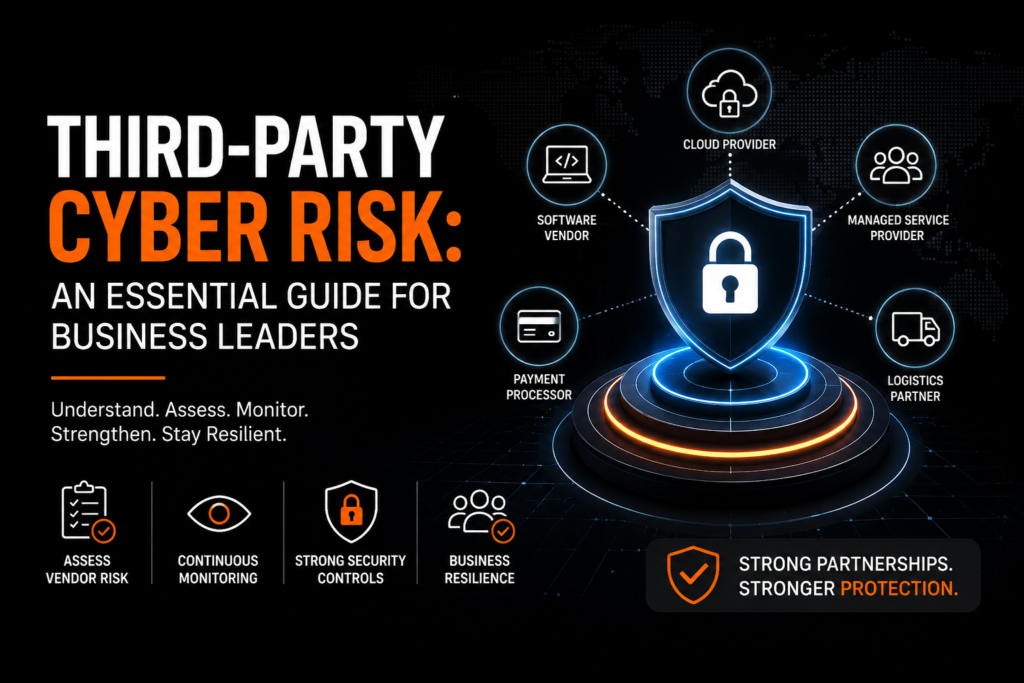
Modern businesses rarely operate entirely within their own technology environments. Cloud providers, software vendors, contractors, managed service providers, payment processors, logistics companies, and other partners may all connect to corporate systems or handle sensitive information. This interconnected model creates operational advantages, but it also introduces security exposure beyond the organization’s direct control. A weakness at a supplier can become a weakness for the business that depends on it.
For business leaders, third-party cyber risk management is therefore not simply an IT responsibility. It is a business governance issue involving financial loss, operational disruption, regulatory obligations, customer trust, and organizational resilience. Effective oversight begins by identifying which external relationships matter most, assessing their security posture, and continuously monitoring changes in risk. The Third-Party Cyber Risk Management Knowledge Center provides additional practical context for organizations developing this approach.
Why External Relationships Create Internal Exposure
Third-party cyber risk exists whenever an outside organization can affect the confidentiality, integrity, or availability of a company’s information, systems, or operations. The exposure may arise through direct network access, application integrations, shared credentials, cloud infrastructure, data exchanges, or even a supplier’s compromised software.
The challenge is that traditional security controls are designed primarily around assets an organization owns and manages. A company may have strong endpoint protection, identity controls, backups, and employee security training, yet remain exposed if a critical vendor has weak access controls or suffers a breach.
Supply-chain attacks illustrate this problem clearly. Attackers do not always need to compromise their ultimate target directly. Instead, they may identify a smaller or less protected organization that has trusted access to the intended victim. Once that relationship is exploited, malicious activity can move through legitimate channels.
This makes vendor relationships an extension of the organization’s risk environment. Business leaders should consequently ask not only, “How secure are we?” but also, “Which external organizations could materially affect our ability to operate?”
Building a Practical Third-Party Risk Assessment
Managing supplier cyber exposure requires more than collecting security questionnaires. A questionnaire can provide useful evidence, but it represents only one point in the assessment process. Organizations need a risk-based method that considers the nature of each relationship and the potential consequences of compromise.
Start by creating an inventory of third parties and categorizing them according to factors such as data access, system connectivity, business criticality, geographic exposure, and regulatory relevance. A marketing vendor handling publicly available information should not necessarily receive the same scrutiny as a cloud provider hosting customer records.
A practical assessment should examine several areas:
- Access and identity: Determine what systems, accounts, privileges, and authentication mechanisms the third party uses.
- Data exposure: Identify what information the vendor stores, processes, transmits, or can access.
- Security controls: Review practices involving encryption, vulnerability management, endpoint protection, logging, incident response, and employee security.
- Resilience: Assess backup strategies, disaster recovery capabilities, business continuity planning, and recovery expectations.
- Incident history: Consider relevant security incidents, disclosures, regulatory actions, and demonstrated responses.
- Contractual safeguards: Establish security requirements, notification obligations, audit rights, data-handling expectations, and termination procedures.
The objective is not to eliminate all third-party risk, which is rarely realistic. Instead, leaders should determine whether the level of risk is appropriate for the business relationship and whether reasonable controls exist to reduce it.
Moving From Vendor Checks to Continuous Oversight
One of the biggest weaknesses in third-party risk programs is treating assessment as a one-time event. A vendor may appear acceptable during onboarding and develop significant exposure months later because of a newly discovered vulnerability, ownership change, staffing issue, infrastructure migration, or security incident.
Managing supplier cyber exposure therefore requires continuous oversight rather than relying solely on onboarding assessments. For teams focused on understanding third-party cyber risk management, this shift from point-in-time reviews to ongoing visibility is fundamental. Monitoring frequency and depth should reflect each supplier’s importance to the organization, with critical vendors receiving closer scrutiny and stronger evidence requirements as their risk posture changes over time.
External threat intelligence can complement internal assessments by revealing changes that may not appear in a vendor’s own documentation. For example, monitoring can help organizations identify exposed services, suspicious infrastructure, leaked credentials, vulnerabilities, or other indicators that may warrant investigation.
However, monitoring should not become a collection exercise without clear decision-making processes. Security teams need defined thresholds for escalation. If a critical supplier experiences a serious incident, leadership should already know who owns the relationship, what contractual obligations apply, what systems may be affected, and what contingency options are available.
Making Cyber Risk Part of Executive Decision-Making
Third-party cybersecurity becomes substantially more effective when it is integrated into procurement, legal, compliance, risk management, and executive governance rather than isolated within security teams.
Before approving a high-impact supplier, decision-makers should understand the security implications alongside cost, functionality, and operational benefits. Contracts should establish minimum security expectations and clarify responsibilities when something goes wrong. Procurement teams should also have a mechanism for involving security specialists when a relationship presents significant technical or data-related exposure.
Risk ratings can help executives prioritize attention. A vendor supporting a core business process and possessing privileged access may deserve substantially more oversight than a provider with no system connectivity. This approach helps prevent security teams from spending disproportionate resources on low-impact suppliers while critical dependencies receive insufficient scrutiny.
Executive reporting should also focus on business consequences rather than technical metrics alone. Instead of simply reporting the number of vendors assessed, leaders should understand how many critical suppliers have unresolved high-risk findings, which relationships lack adequate contingency arrangements, and where a third-party incident could interrupt essential operations.
Preparing for a Third-Party Security Incident
Even well-managed suppliers can experience breaches. Effective preparation therefore assumes that prevention and resilience must work together.
Organizations should establish clear incident-management procedures that cover third-party events. These procedures should identify internal decision-makers, communication channels, technical contacts, legal and compliance responsibilities, and criteria for activating business continuity plans. Where appropriate, organizations should test these arrangements through tabletop exercises.
Access should also be designed with containment in mind. Vendors should receive only the privileges necessary for their responsibilities, and dormant accounts should be removed promptly. Strong authentication, network segmentation, logging, and controlled administrative access can limit the damage if credentials or systems are compromised.
Business leaders should additionally understand critical dependencies. If a supplier becomes unavailable for several days, can the organization continue operating? If sensitive information is exposed, who must be notified? If a vendor cannot recover quickly, is there an alternative provider or manual process?
These questions turn third-party risk management from a compliance exercise into practical resilience planning.
Read More: 9 Best Travel Management Software Tools for Tech Companies in 2026
End Note
Third-party cyber risk cannot be managed effectively by assuming that a trusted supplier is automatically a secure supplier. Trust should be supported by evidence, appropriate contractual controls, continuous oversight, and a clear understanding of business dependencies.
For leaders, the central objective is not to create an impossible standard of zero risk. It is to identify the relationships that matter most, understand how they could affect the organization, and ensure that reasonable safeguards and response plans are in place. When third-party cybersecurity becomes part of broader business risk management, organizations are better positioned to make informed decisions, respond quickly to supplier incidents, and reduce the likelihood that an external weakness becomes an internal crisis.