Walk into any retail store, corporate office, restaurant, or healthcare facility, and you’ll likely notice digital screens replacing traditional printed signs. But installing displays is only half the equation. The real challenge is creating digital signage content that captures attention, communicates your message quickly, and motivates customers to take action.
Well-designed content transforms ordinary screens into powerful marketing tools that increase engagement, strengthen brand recognition, and improve customer experiences. Whether you’re promoting products, sharing company updates, or enhancing customer journeys, the right content strategy makes all the difference.
In this guide, you’ll discover practical techniques for creating compelling digital signage content that delivers measurable business results.
Why Digital Signage Content Matters
Many businesses invest heavily in high-quality display hardware but overlook the importance of content. Even the most advanced display becomes ineffective if it shows outdated, cluttered, or uninspiring information.
Effective digital signage content can help businesses:
- Increase customer engagement
- Boost product visibility
- Promote special offers
- Reduce perceived waiting times
- Improve internal communications
- Reinforce brand identity
- Drive more sales and conversions
When paired with professional digital signage solutions, engaging content becomes a valuable marketing asset rather than just another screen.
Start with a Clear Goal
Every piece of content should have a purpose. Before creating graphics or videos, determine what you want viewers to do.
Common objectives include:
- Promote new products
- Announce limited-time promotions
- Educate customers
- Display menus or pricing
- Share company news
- Encourage social media engagement
- Provide directions
- Strengthen brand awareness
Having a single objective for each content item prevents clutter and keeps your messaging focused.
Keep Messages Short and Easy to Read
People rarely stand in front of digital screens for long. Most viewers glance at a display for only a few seconds.
That’s why simplicity wins.
Instead of writing long paragraphs:
Poor example
“Our company is currently offering customers an exclusive opportunity to receive discounts on selected products available throughout this month.”
Better example
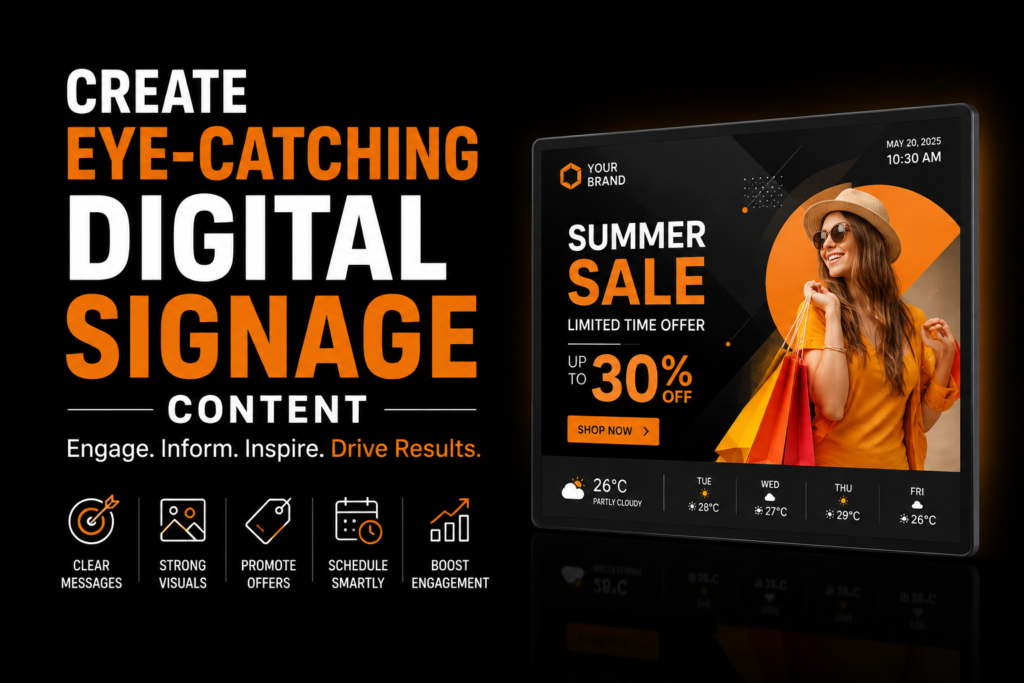
Summer Sale
Save 30% This Week Only
Large fonts, short headlines, and minimal text allow viewers to absorb information quickly.
Use High-Quality Visuals
Visual content has far greater impact than text alone.
Include:
- Professional product photography
- Lifestyle images
- Brand illustrations
- Motion graphics
- Short promotional videos
- Simple animations
Avoid low-resolution images or stretched graphics that reduce your brand’s credibility.
Every visual should support your message instead of distracting from it.
Maintain Strong Brand Consistency
Every screen represents your business.
Maintain consistency by using:
- Company colors
- Brand typography
- Logo placement
- Consistent icon styles
- Matching photography style
- Uniform messaging tone
Consistent branding helps customers instantly recognize your business across every display.
Design for Viewing Distance
Content that looks perfect on a computer monitor may become unreadable on a large display several feet away.
Consider:
- Large font sizes
- High color contrast
- Minimal text
- Bold headlines
- Clear spacing
Always test content on the actual display before publishing it.
Rotate Different Types of Content
Displaying the same message repeatedly causes viewers to ignore the screen.
Create a rotating playlist that includes:
- Promotional offers
- Product highlights
- Customer testimonials
- Educational tips
- Industry news
- Company announcements
- Seasonal campaigns
- Social media content
Fresh content keeps displays interesting and encourages repeat viewers to pay attention.
Add Motion Without Overdoing It
Movement naturally attracts attention.
However, excessive animation can become distracting.
Use subtle transitions like:
- Fade effects
- Smooth slide animations
- Gentle zooms
- Short looping videos
- Animated icons
The goal is to guide the viewer’s eye rather than overwhelm it.
Make Content Relevant to Your Audience
Different industries require different messaging.
Retail
- Promotions
- Product launches
- Loyalty programs
- Seasonal campaigns
Restaurants
- Digital menus
- Daily specials
- Combo offers
- Limited-time meals
Healthcare
- Appointment reminders
- Health education
- Facility navigation
- Wellness campaigns
Corporate Offices
- Employee recognition
- Company announcements
- KPIs
- Event schedules
Tailoring content to your audience dramatically increases engagement.
Update Content Regularly
Nothing hurts credibility faster than outdated promotions or expired events.
Create a content calendar to schedule:
- Weekly promotions
- Monthly campaigns
- Holiday graphics
- Product launches
- Company announcements
Frequent updates keep your displays relevant while giving customers a reason to look again.
Use Data to Improve Performance
Modern digital signage solutions provide valuable insights into content performance.
Track metrics such as:
- Customer engagement
- Sales during promotions
- Campaign performance
- Viewer interaction
- Peak viewing times
Analyze results regularly to understand which content generates the strongest response.
Create Content for Multiple Screen Sizes
Businesses often operate different display types, including:
- Reception displays
- Menu boards
- Video walls
- Portrait kiosks
- Landscape monitors
- Interactive displays
Design content that adapts to various resolutions and orientations while maintaining readability.
Use Scheduling to Deliver the Right Message
Content becomes much more effective when displayed at the right time.
Examples include:
- Breakfast menus in the morning
- Lunch promotions at noon
- Happy hour specials in the evening
- Weekend promotions on Fridays
- Holiday campaigns during seasonal periods
Scheduling ensures every message reaches customers when it has the greatest impact.
Integrate Real-Time Content
Dynamic content keeps screens fresh without requiring constant manual updates.
Examples include:
- Weather forecasts
- News headlines
- Social media feeds
- Live dashboards
- Event schedules
- Queue information
- Calendar updates
Real-time information increases viewer interest and makes displays more valuable.
Support Content with Reliable Digital Signage Solutions
Even exceptional content requires reliable technology to reach your audience.
Businesses managing multiple displays need a solution that simplifies scheduling, content distribution, and centralized management.
For organizations looking for a scalable platform, On-Premises Digital Signage & Video Wall Solution provides centralized control over multiple screens while maintaining security, flexibility, and reliable performance. It allows businesses to manage digital signage networks efficiently across offices, retail stores, control rooms, educational institutions, and corporate environments.
Choosing the right platform allows your marketing team to spend less time managing screens and more time creating engaging content.
Common Mistakes to Avoid
Even experienced marketers sometimes make digital signage less effective.
Avoid these common issues:
- Too much text
- Small font sizes
- Poor image quality
- Inconsistent branding
- Excessive animations
- Outdated promotions
- Weak color contrast
- No clear call to action
Removing these obstacles significantly improves viewer engagement.
The Future of Digital Signage Content
Digital signage continues to evolve with new technologies.
Emerging trends include:
- AI-generated personalized content
- Interactive touch displays
- Audience-triggered messaging
- Data-driven personalization
- Smart scheduling automation
- Cloud-based content management
- Integration with business analytics
- Enhanced video wall experiences
Businesses adopting these innovations will be better positioned to capture attention in increasingly competitive environments.
Read More: Building Competitive Advantage with Logistics-Focused Web Development
Conclusion
Creating successful digital signage content requires much more than attractive graphics. The most effective displays communicate clear messages, use strong visuals, stay updated, and align with your business objectives.
Whether you’re operating a single business display or managing hundreds of screens across multiple locations, combining engaging content with professional digital signage solutions helps maximize customer engagement and improve communication.
Investing in thoughtful content creation today ensures your business display screens continue delivering value long after the hardware has been installed.
Frequently Asked Questions
What is digital signage content?
Digital signage content includes the images, videos, animations, text, and interactive media displayed on digital screens to communicate information, advertise products, or engage audiences.
What makes digital signage content effective?
Clear messaging, strong visuals, readable typography, consistent branding, relevant information, and timely updates all contribute to effective digital signage content.
Can digital signage improve customer engagement?
Yes. Dynamic, visually appealing content captures attention more effectively than static signage, encouraging customers to interact with promotions, products, and brand messaging.
Why is a centralized digital signage solution important?
Centralized management allows businesses to update multiple screens remotely, schedule campaigns efficiently, maintain consistent branding, and reduce the time required to manage large digital signage networks.