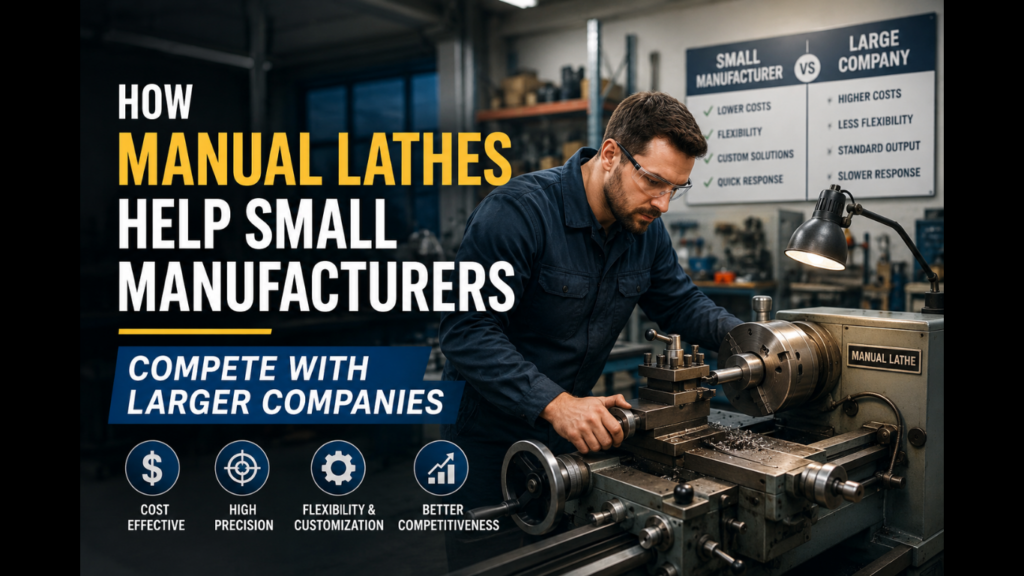
Small manufacturers face constant pressure from large corporations that seem to have every advantage: bigger budgets, automated production lines, and economies of scale. However, manual lathes offer a surprisingly powerful equalizer that allows smaller shops to not just survive but thrive in competitive markets. These versatile machines provide flexibility, cost efficiency, and quality control that can give small operations distinct advantages over their larger counterparts.
Lower Startup and Operating Costs
One of the most significant barriers for small manufacturers is capital investment. Large companies can afford to spend millions on CNC systems and automated production lines, but small shops need to be strategic with every dollar.
Manual lathes require a fraction of the initial investment compared to CNC equipment. A quality manual lathe can cost anywhere from a few thousand to twenty thousand dollars, while CNC machines often start at $50,000 and quickly escalate into six figures. This lower barrier to entry allows small manufacturers to establish their operations without crippling debt.
Beyond the purchase price, manual lathes are remarkably economical to operate. They consume less electricity, require simpler maintenance, and don’t need expensive software updates or licensing fees. When a manual lathe needs repair, the parts are generally affordable and the mechanical nature of the machine means many shop owners can handle basic maintenance themselves.
This stands in stark contrast to CNC equipment, which often requires specialized technicians and proprietary replacement components.
Unmatched Flexibility for Custom Work
Large manufacturers excel at producing thousands of identical parts, but they struggle when customers need customization or small batch production. This is where small shops with manual lathes shine.
A skilled operator can switch between completely different projects in minutes. There’s no need to write new programs, run simulation tests, or worry about software compatibility. The machinist simply changes the setup, adjusts the tooling, and begins working on the next piece. This agility allows small manufacturers to serve niche markets that larger companies find unprofitable.
Custom fabrication, prototyping, and one-off projects are perfect applications for manual lathes. A furniture maker might need a dozen custom table legs with unique decorative elements. An inventor might require a prototype part that doesn’t exist anywhere else. Small manufacturers with manual lathes can take on these projects profitably while larger companies would need to decline them or charge prohibitively high setup fees.
Superior Quality Control
When you’re competing against large manufacturers, quality can be your strongest differentiator. Manual lathes put control directly in the hands of skilled operators who can make real-time adjustments and catch potential issues before they become problems.
An experienced machinist operating a manual lathe develops an intimate feel for the work. They’ll hear when a tool isn’t cutting properly, feel when the material is responding differently than expected, and see subtle variations that might indicate a problem. Automated systems can’t replicate this sensory feedback – they’re limited to sensors and programmed parameters.
Small manufacturers can leverage this hands-on approach to deliver exceptional quality that justifies premium pricing. When a client needs parts that meet exacting standards or require special attention to finish quality, a skilled manual machinist can often exceed what automated production delivers.
Building Valuable Skills and Knowledge
Large companies increasingly depend on programmers and technicians who understand software but may lack fundamental machining knowledge. Small manufacturers who invest in manual lathe training develop machinists who truly understand their craft.
Operating a manual lathe teaches the fundamental principles of metalworking: cutting speeds, feed rates, tool geometry, and material behavior. These foundational skills translate across all types of machining and create versatile team members who can troubleshoot problems, suggest design improvements, and innovate new solutions. This deep knowledge base becomes a competitive advantage that’s difficult for larger companies to replicate when their workforce is specialized into narrow roles.
One small shop owner recalled how his machinist’s manual lathe experience saved a crucial contract: when a client’s CAD file contained an error that would’ve caused expensive CNC production failures, the machinist immediately recognized the problem because he understood the fundamental geometry from years of manual work. That kind of expertise can’t be programmed into software.
Additionally, many experienced machinists prefer working in small shops where they can use their full skill set on manual equipment. This allows small manufacturers to attract and retain talented craftspeople who might feel underutilized in automated facilities.
Quick Turnaround Times
Contrary to what you might expect, manual lathes can actually enable faster turnaround times for certain types of work. While CNC machines are faster for large production runs, they require substantial setup time.
A rush order that needs to be completed by the end of the day might sit in a large manufacturer’s queue waiting for programming and setup. A small shop with a manual lathe can start working on it immediately. For clients who need fast turnaround on small quantities, this responsiveness is invaluable and worth paying a premium to secure.
This speed advantage extends to design iterations as well. When a client wants to test multiple versions of a part or make modifications based on initial results, the manual lathe operator can implement changes instantly without the programming delays that slow down CNC operations.
Serving Local and Specialized Markets
Small manufacturers with manual lathes can build strong relationships in their local communities and specialized industries. Repair shops, maintenance facilities, and local businesses often need machining services on short notice and in small quantities.
By positioning themselves as the go-to solution for custom work, quick turnarounds, and personalized service, small manufacturers create loyal customer bases that value the relationship over simply finding the lowest price. For shops looking to establish or expand these capabilities, finding quality equipment from reliable sources like a manual lathe for sale at Summit can be the foundation for serving local clients effectively.
Specialized industries like aerospace restoration, musical instrument manufacturing, or scientific equipment production often require the precise, hands-on approach that manual lathes facilitate. Small manufacturers can develop expertise in these niches and become irreplaceable partners to their clients.
Sustainability and Longevity
Manual lathes are remarkably durable machines. Many shops operate lathes that are 30, 50, or even 80 years old. According to the Smithsonian’s National Museum of American History, manual lathes from the early 20th century are still functional and valuable today, demonstrating the longevity of well-built mechanical equipment.
This durability means small manufacturers can purchase used equipment at excellent prices and operate it reliably for decades. The Society of Manufacturing Engineers notes that proper maintenance keeps manual machines productive indefinitely, making them sustainable long-term investments.
Read More: What Payment Orchestration Solves for Growing Brands
Turn Size Into an Advantage
Small manufacturers don’t need to match large companies’ automation levels to compete successfully. By leveraging the unique advantages of manual lathes, including lower costs, greater flexibility, superior quality control, and faster turnaround times for custom work, small shops can carve out profitable niches that larger competitors can’t efficiently serve.
The key is recognizing that different tools serve different purposes. Manual lathes aren’t outdated technology; they’re specialized equipment that excels in applications where human skill, adaptability, and precision matter most. For small manufacturers willing to invest in training and build their reputation on quality and service, manual lathes remain powerful competitive tools in manufacturing. As automation continues reshaping the industry, ask yourself: what can your shop do today that a fully automated facility simply can’t?