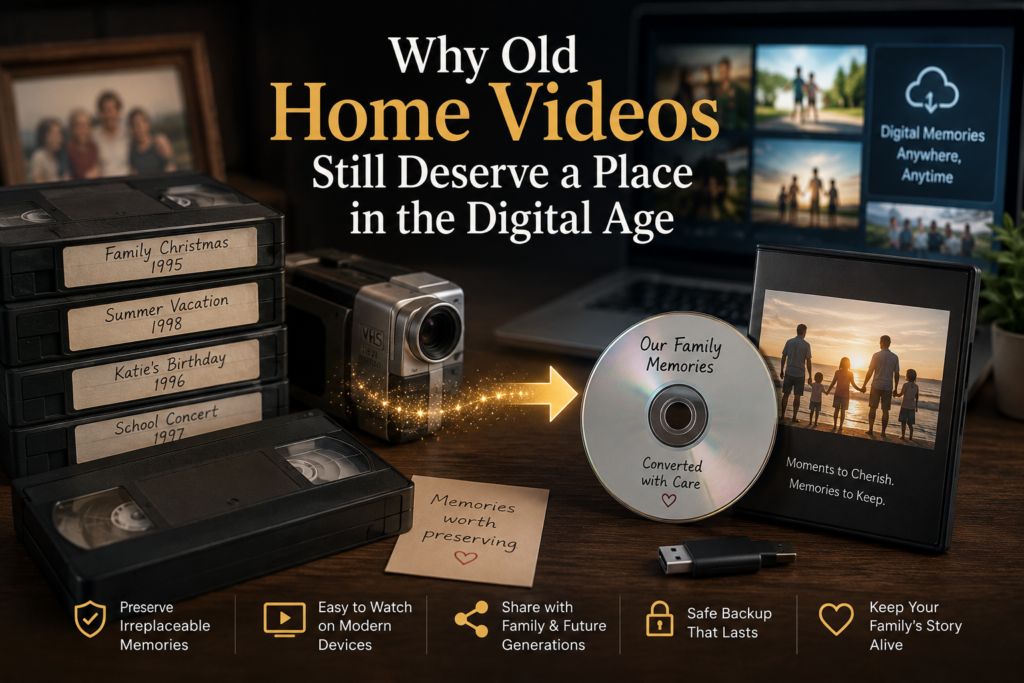
There’s something special about old home videos. The gentle whir of a VHS player, the slightly grainy picture, and the colours that blur together on an old television can instantly bring back memories from another time. Tucked away in cardboard boxes or plastic cases, those tapes often contain moments that can never be replaced—weddings, birthday parties, Christmas mornings, school performances, and ordinary family days that became more meaningful with time.
The problem is that watching old home videos is becoming increasingly difficult. Many households still have shelves full of VHS tapes but no working VHS player. Even when an old player is available, connecting it to a modern television can be a challenge. As a result, valuable recordings are often left sitting untouched for years, slowly collecting dust while the tapes themselves continue to deteriorate.
This is something anyone familiar with technology can understand. Digital formats have made it much easier to store, access, and share information, while older formats can quickly become difficult to use simply because the technology needed to access them has disappeared. The same is true for personal video collections. These old home videos are not becoming less valuable—the equipment needed to watch them is simply becoming obsolete.
Preserving old home videos is therefore about more than convenience. It is about protecting memories, making them accessible again, and ensuring that future generations have the opportunity to see and experience moments that might otherwise be lost forever.
Easier to recall memories from the past
VHS tapes were made for a different era of home entertainment. Nowadays many people are more used to see the content via computers, televisions and similar modern devices. So converting a tape to a format that matches modern viewing habits can remove a practical barrier.
Digital Converters has a VHS to DVD service that converts original VHS recordings to DVD. The company also handles formats like Betamax, Super VHS and VHS-C and offers other conversion options such as USB and online digital storage.
If you prefer a hard copy, a DVD is a good option, which can be played through compatible DVD equipment. It also allows you to compile older recordings into an easier to label, store and revisit collection.
Why Physical Copies Still Matter
As cloud storage and streaming take over, some may wonder why anyone would still want a DVD. The answer lies in the lasting appeal of physical media. But a DVD’s good for those who want something to hold onto, label and put on a shelf next to the photo albums and scrapbooks. It doesn’t need internet access. It doesn’t need a subscription. It can’t be lost if a cloud service changes its terms. A DVD is a familiar and simple option for older family members who may not be comfortable with digital files to view old recordings.
The conversion process also allows for the organization of older recordings into a collection that is easier to label, store, and refer back to. Instead of a bunch of tapes with illegible handwritten labels, you can create themed discs or folders, making it easy to find a particular event. An organization such as this adds tremendous value to a personal archive, turning a jumbled pile of memories into a curated collection to be enjoyed over and over again.
The Significance of a Professional Transfer
Transferring an old tape is not as simple as copying a file from one device to another. The condition of the magnetic tape as it ages can have a major impact on the quality of playback. Tapes can suffer from mould, sticky-shed syndrome and magnetic degradation. The binder that holds magnetic particles onto the tape may degrade, so that the tape becomes brittle or sticky. Such a tape played in an ordinary player, without adequate preparation, can be irreparably damaged. The tape can break, stretch or shed oxide particles, potentially destroying both the tape and the heads of the player.
This is why it is important to be treated professionally. Digital Converters says that every tape is checked thoroughly before transfer and repaired and cleaned as needed. Their process involves tape splicing and rehousing into new cassette shells when needed. The footage is reviewed after the first transfer, and if the results are not satisfactory, the company can perform the transfer again with different equipment or settings. The benefit of this careful approach is practical for anyone handling irreplaceable recordings: original material gets specialised attention before conversion. The company also returns the original tapes after processing, giving owners their source material and their converted recordings. This allows technicians to try several recovery approaches to recover as much content as possible even if a tape is badly degraded.
Increasing Awareness of Digital Preservation
Recently, awareness of the importance of digital preservation has increased. Museums, archives and libraries are spending a lot of money digitising historical material, knowing that the analogue media will not last for ever. The same thing holds true for personal collections. Families can preserve their memories by converting their old home videos. They can pass them down to the younger generation who might never have seen a VHS player but can easily access a digital file. They can back it up, share copies with family members, and even use clips in modern video projects. An AI video upscaler can further improve the visual quality of digitized footage, sharpening resolution and reducing the grain common in older recordings.
Preservation has an emotional dimension that should not be underestimated. An old home video is powerful to watch. It takes us back to a certain time and place and connects us with people and moments we may have forgotten. The grain, the slight camera shake, the real sound of a room shot decades ago – these nuances have an emotional weight that modern slick footage often lacks. Digitisation does not kill these qualities, it protects them. A good transfer of a video is much more accessible but remains true to the original.
Real Step In Preserving Memories
Conversion can be a handy solution for those that have a collection of VHS tapes that are sitting unused and would like to get them back into regular access. It’s a cheap investment that pays dividends in memories preserved and experiences shared. What once required a dedicated player and a compatible television can become something easier to preserve, organise and enjoy again. The cost of conversion is small compared to the value of the content being preserved.
Thousands of customers have trusted their precious recordings to professional services, often relieved and delighted to finally be able to watch old family moments again. There are many stories of people finding footage of long-lost parents, childhood pets, family homes that have since been sold and events they had forgotten long ago. These discoveries are a reminder that the real value of home movies isn’t the technology, but the human connections they preserve.
Read More: Free AI Video Generator: Create Videos With Music and Voice at Zero Cost
Read More: 5 Best Video Hosting Platforms with Expiring Links and Domain Restriction
Conclusion
Old home videos don’t just belong to the digital era, they need to. Left unchecked they will continue to degrade and the memories they contain may be lost forever. The digital age provides the wherewithal to preserve, organise and share these treasures in ways that were unimaginable when they were first recorded. Whether it is through DVD, USB or cloud storage, the objective is the same: Maintaining memories alive and accessible for generations to come. As technology improves, so too will the methods of preservation, but the fundamental need to hold on to our collective history will never change. In an ever-changing world, old home videos remind us of where we came from, and they deserve every opportunity to travel with us into the future.”