Managing a school is no small feat. From tracking student attendance and processing fee payments to coordinating staff schedules and communicating with parents, administrators juggle dozens of responsibilities every single day. School management software has become the go-to solution to bring order to this complexity.
And the numbers prove it. The school management software market was valued at USD 15.18 billion in 2024 and is projected to reach USD 41.46 billion by 2032, growing at a CAGR of 14.76%. That’s not a trend, that’s a revolution.
But here’s the question most school administrators face early on: Should we go with a free solution or invest in a paid platform?
It’s not a simple yes or no. The right answer depends on your school’s size, goals, and long-term vision. In this article, we break down the real differences between free and paid school management software, so you can make a smart, budget-conscious decision.
What Is School Management Software?
School management software (SMS) is a digital platform designed to automate and streamline the administrative operations of a school. It typically covers modules such as:
- Student information management (enrollment, profiles, academic records)
- Attendance tracking (student and staff)
- Fee and payment management
- Timetable and scheduling
- Exam and grade management
- Parent-teacher communication
- Library and transport management
The adoption is widespread and growing fast. More than 67% of K-12 institutions globally now use at least one school ERP module for administration, academic, or finance operations. Whether free or paid, any decent SMS should handle the core functions that reduce manual paperwork and save staff time.
The Case for Free School Management Software
Free software is understandably attractive, especially for budget-constrained schools, small institutions, or those just getting started with digitization. Let’s be fair, free tools do come with real advantages.
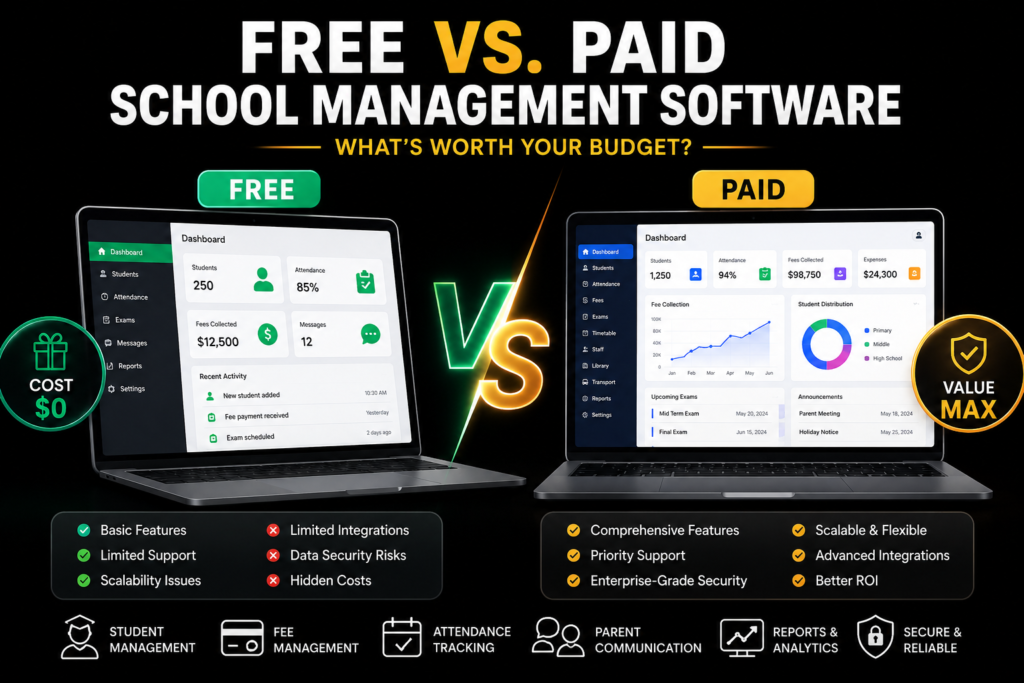
Advantages of Free SMS
- Zero upfront cost: The most obvious benefit is that it costs nothing to get started. This matters more than ever, considering that 43% of schools cite budget limitations as a primary restraint when adopting digital management tools. For schools with tight budgets or no dedicated IT fund, free software allows them to begin their digital transformation without financial risk.
- Good for basic needs: If your school only needs simple features, like student records, basic attendance, or a communication board, a free tool might cover your needs just fine.
- Easy to try before committing: Free platforms allow administrators to explore digital school management without committing to a vendor. It’s a low-stakes way to see whether your staff is ready for a software-based workflow.
- Open-source flexibility: Some free school management systems are open-source, meaning tech-savvy institutions can modify the software to suit their specific needs, at least in theory.
Limitations of Free SMS
Here’s where things get complicated. Free doesn’t always mean cost-free in the long run.
- Limited features: Most free platforms offer only the bare minimum. Advanced modules like fee automation, multi-campus management, biometric integration, or AI-based analytics are almost always locked behind a paywall. Consider this: digital fee collection software adoption has increased by 61% in recent years, and 87% of schools now offer payment gateways, capabilities rarely available on free platforms.
- Poor customer support: Free users are rarely a priority for support teams. When something breaks, and it will, you may be left searching forums or waiting days for a response.
- Data security risks: Reputable paid platforms invest heavily in data encryption, compliance, and regular security audits. Free tools often lack the resources to maintain enterprise-grade security, putting sensitive student data at risk.
- Scalability issues: A free tool might work for 200 students today. But as your school grows, most free platforms struggle to keep up. More than 4.8 million teachers worldwide now regularly use at least one school management system, and the infrastructure required to support that scale simply isn’t available in free tiers.
- Hidden costs Many “free” platforms are freemium models. The base plan is free, but the moment you need anything beyond basic features, more users, more storage, integrations, or custom reports, the bills start adding up.
The Case for Paid School Management Software
Paid school management software is a genuine investment. But when chosen wisely, it delivers value that far exceeds its cost.
Advantages of Paid SMS
- Comprehensive feature set: Paid platforms are built to handle the full complexity of school operations. Fee collection with automated reminders, custom report cards, parent app access, live attendance dashboards, timetable builders, HR management, it’s all there, out of the box. In fact, over 58% of school administrators now demand AI-based performance analytics, a feature exclusively found in premium platforms.
- Dedicated customer support: Most paid solutions offer priority support via phone, email, or live chat. Many even provide on-site training and a dedicated account manager. This alone can save hours of frustration during setup and daily use.
- Data security and compliance: Reputable paid software providers comply with data protection regulations and maintain secure, encrypted servers. For schools handling sensitive student and family information, this is non-negotiable.
- Regular updates and new features: Paid vendors continuously improve their product. You benefit from new features, bug fixes, and security patches,and software testing services that help keep school management platforms reliable, often without any additional cost. The shift is clear: as of 2022, 75% of public schools reported using cloud-based systems for at least some of their administrative functions, with that number continuing to rise.
- Scalability and customization: Whether you manage one school or a chain of campuses, paid platforms are built to scale. Cloud-based school management software is expected to hold around 63.8% of the market in 2025, growing at a CAGR of 15.2%, a clear signal that institutions are prioritizing scalable, flexible solutions. Many paid tools also offer API integrations with third-party tools like LMS platforms or accounting software, and multi-branch management.
- Mobile accessibility: Modern schools need mobile-ready tools. Mobile application demand for school management tools increased by 52% between 2021 and 2024, and paid platforms are leading this charge with dedicated parent and student apps.
- Better ROI over time: While there’s an upfront cost, consider what paid software replaces: manual data entry hours, printing costs, communication delays, fee collection errors, and the administrative overhead of running a school on spreadsheets. The efficiency gains often justify the investment many times over.
Limitations of Paid SMS
- Upfront or recurring cost: Subscription fees can range from affordable to expensive, depending on the vendor and the features included. Budget planning is required.
- Onboarding time: More features mean a steeper learning curve. Schools need to allocate time for staff training and data migration during the transition.
- Vendor lock-in: Once your school is fully dependent on a paid platform, switching can be disruptive. Choosing the right vendor from the start is critical.
Free vs. Paid: Side-by-Side Comparison
| Feature | Free SMS | Paid SMS |
| Cost | $0 (or freemium) | Monthly/Annual subscription |
| Core Features | Basic | Comprehensive |
| Customer Support | Limited/Community | Dedicated support team |
| Data Security | Variable | Enterprise-grade |
| Scalability | Low | High |
| Customization | Minimal | Moderate to High |
| Updates | Infrequent | Regular |
| Integrations | Few | Extensive |
| Best For | Small/starter schools | Growing or established schools |
The Big Picture: Where Is the Market Headed?
The data speaks loudly about where education technology is going. The global school management software market, valued at USD 15.69 billion in 2024, is projected to expand to USD 59.36 billion by 2034, growing at a CAGR of 14.23%. Schools that delay adopting robust digital systems risk falling behind peers who are already streamlining operations and improving outcomes.
In the USA alone, 78% of public schools have adopted management platforms for student data, class scheduling, and financial reporting, and nearly 85% of higher education universities use cloud-based school management software. These aren’t early adopters anymore; they’re the majority.
So, What’s Actually Worth Your Budget?
The honest answer: it depends on where your school is right now, and where it’s headed.
If you run a small school with under 150 students, limited administrative staff, and a bare-bones budget, a free or low-cost freemium tool can be a reasonable starting point. Use it to build your team’s comfort with digital tools, and plan to upgrade as you grow.
However, if your school is growing, serving hundreds of students, managing complex fee structures, or trying to improve parent engagement, investing in the right platform or exploring school management system development options is not a luxury; it’s a necessity. Over 72% of K-12 schools globally are integrating solutions that streamline student data management, attendance tracking, and administrative processes, and those schools are pulling ahead.
Think of it this way: free software costs you time; paid software buys it back.
Read More: AI Agent Security: Why Autonomous Agents Are Outpacing Your Defenses
Final Thoughts
Choosing between free and paid school management software isn’t just a financial decision; it’s a strategic one. A well-chosen paid platform can transform how your school operates, reduce administrative stress, and improve the experience for students, parents, and teachers alike.
Before making a decision, ask yourself:
- How many students and staff will use this system?
- What specific problems am I trying to solve?
- Do I need parent communication tools or fee automation?
- What level of data security does my school require?
- Am I planning to scale in the next 2–3 years?
Your answers will point you in the right direction. And if you’re still unsure, many paid platforms offer free trials, giving you the best of both worlds before you commit.