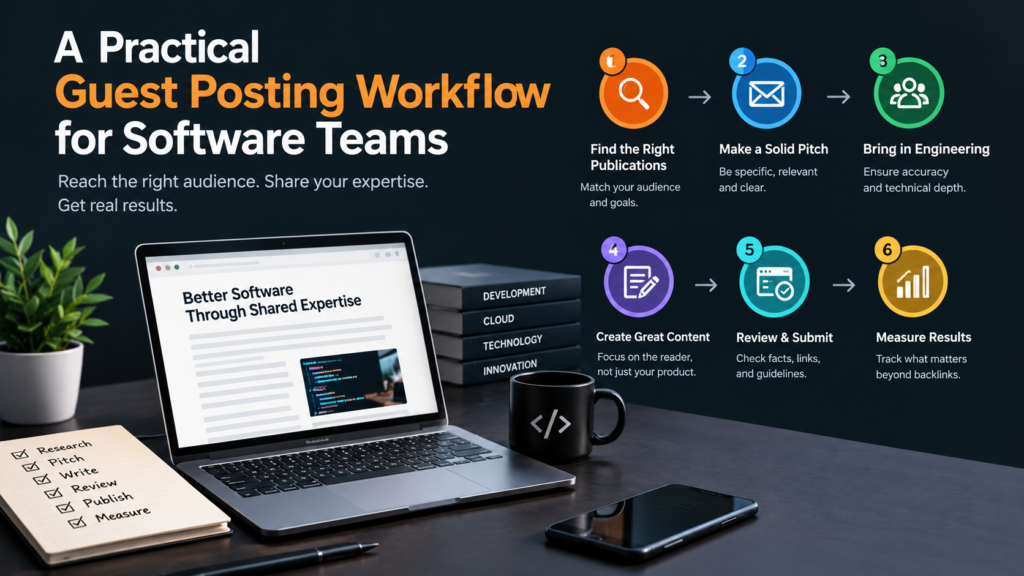
Software teams have plenty to explain: why a system was redesigned, how an API handles a difficult edge case, or what a security trade-off means in practice. Publishing that expertise beyond a company blog can help it reach developers and technology buyers who would not otherwise find it. The challenge is to make guest posting a useful part of content marketing, not a routine for collecting links.
For a software business, a strong guest article starts with a reader’s problem. A detailed guide to choosing a database, for example, can serve engineering leads comparing options; a post about onboarding analytics may be more relevant to product managers. The company’s product can appear when it genuinely clarifies the discussion, but the article should still be useful if the reader never clicks through.
Choose publications for audience fit
Before drafting, identify who you want to reach and where those people already look for advice. A developer tool vendor may target engineering publications, while a software consultancy could be more relevant to business technology or operations blogs. Check recent articles, the publication’s editorial focus and whether its readers match the people who evaluate or use your software.
Directories can help build an initial research list, but a large number of sites is not a reason to submit to all of them. For instance, iCopify’s business site directory lists business websites and blogs that accept guest posts. Treat any directory as a starting point: review each publication’s current content and submission requirements before investing time in a pitch.
Look beyond a site’s headline metrics. A smaller publication with an engaged audience of cloud architects may be more valuable to a developer infrastructure company than a general business blog with broad but unrelated traffic. Read the comments or community responses where available, and consider whether the site has published technical material at the level you can credibly provide.
Bring engineering into the editorial process
Marketing teams can shape the topic and manage deadlines, but technical accuracy depends on access to people who understand the work. Ask an engineer or product specialist to contribute an outline, explain the relevant decisions, and review claims before submission. That does not mean handing a draft to a busy developer without direction. Give them focused questions and a clear time commitment.
Useful topics often come from lessons that are specific enough to teach something: how a team reduced deployment risk, what it learned from migrating a legacy service, or how it weighed latency against consistency. Avoid turning internal details into a case study without permission. Remove customer identifiers, proprietary code, security-sensitive information and performance figures that have not been cleared for publication.
A practical editorial workflow might look like this:
- Set the reader outcome. Write down what the intended audience should understand or be able to do after reading.
- Check the publication. Read its guidelines and several recent pieces; adapt the proposal to its style rather than sending a generic pitch.
- Collect evidence. Confirm technical claims with the people responsible and use examples that can be shared publicly.
- Draft for clarity. Define specialist terms, explain the reasoning behind recommendations and keep product mentions proportionate.
- Review and submit. Check accuracy, attribution, formatting and any rules about links before sending the article.
Make the pitch concrete
An editor needs to see why a proposed article suits their readers. A useful pitch names the audience, gives a specific working title, summarizes the article’s argument and explains what expertise the author brings. It can also mention how the piece differs from material already on the publication. A vague offer to write about “the future of software” gives an editor little to assess.
Teams that need extra capacity can divide the work among a subject-matter expert, an editor and a writer. Osdire, a freelance marketplace with categories including programming and tech, writing and translation, and marketing, is one place to explore support for those tasks. Buyers can review pricing before ordering, and payment is held while work is in progress and released after approval. For teams comparing publication options, its guide to content marketing guest posts also covers site research, submission guidance and costs. A freelancer can improve the process, but the company remains responsible for technical facts and editorial judgment.
Measure more than backlinks
Agree on a purpose before publication. Depending on the article, useful measures may include referral visits, newsletter sign-ups, qualified inquiries, engagement from a target professional audience, or how often the piece is shared by relevant communities. A backlink can be one outcome, but it should not dictate the topic or lead to awkward, over-optimized wording.
Record each placement, its audience, publication date and results. Follow up on reader questions, share the piece through suitable company channels, and note which angles earned meaningful attention. Over time, that record helps a team choose better topics and publications rather than repeating low-value submissions.
Guest posting works best for software companies when it extends genuine expertise into the right professional communities. A careful selection process, hands-on technical review and clear measurement turn each article into a useful contribution—and make the effort easier to improve with every publication.