A year ago, most enterprise AI deployments looked like chatbots: a person asked a question, a model answered, and nothing happened in the world as a result. That era is over. AI agents now read databases, send emails, write and execute code, call external APIs, and hand off tasks to other agents without a human checking each step. Multiple 2026 industry surveys put the share of organizations that have moved agents into active testing or production above 80 percent. The problem is that security has not kept pace. Securing AI agents requires a different approach than securing traditional software, and most organizations are still applying old rules to a new kind of system.
This gap is not theoretical. Independent surveys from cybersecurity researchers and industry consortiums in early 2026 found that a large majority of organizations running AI agents had already experienced at least one related security incident, ranging from data leakage to unauthorized actions taken without approval. The pattern across these reports is consistent: agents are being deployed faster than the identity, access, and monitoring systems needed to keep them in check, and securing AI agents has become less of an IT checkbox and more of a distinct discipline that most teams are still building from scratch.
Why Agents Break the Old Security Model
Traditional application security assumes a fairly predictable actor. A piece of software does what its code tells it to do, and a firewall or access control list can reasonably contain its behavior. AI agents don’t fit that model cleanly. They reason over unstructured input, decide which tools to call, and can be steered by content they encounter while doing their job, including documents, emails, or web pages they were never explicitly told to trust.
This creates attack surfaces that didn’t exist in earlier software generations. Prompt injection, where hidden or adversarial instructions embedded in retrieved data alter an agent’s behavior, has consistently ranked as a top concern among security researchers, including in OWASP’s dedicated framework for agentic applications published in late 2025. Unlike a SQL injection attack, prompt injection often doesn’t trigger a conventional alert, because the agent is technically doing exactly what a plausible instruction told it to do.
A second structural issue is identity. Many organizations still treat agents as extensions of a human user or as generic service accounts, rather than as distinct entities with their own permissions and audit trails. Surveys conducted in the first half of 2026 found that fewer than a quarter of organizations treat their agents as independent, identity-bearing entities, and a large share still rely on shared credentials for agent-to-agent authentication. When multiple agents share one API key, there’s no reliable way to tell which one performed a given action after the fact.
The Gap Between Confidence and Reality
One of the more striking findings in recent industry research is the mismatch between how secure executives believe their organization is and what technical audits actually show. Multiple 2026 surveys found that a large majority of executives felt confident their existing policies would prevent unauthorized agent actions, while operational data from the same organizations showed more than half of deployed agents running without consistent security monitoring or logging. Fewer than a quarter of executives reported having full visibility into what permissions their agents held or what data those agents could reach.
This disconnect matters because it shapes decision-making. If leadership believes a risk is already handled, budget and attention go elsewhere. Meanwhile, the actual attack surface keeps growing as organizations add more agents, connect them to more systems, and give them broader autonomy to act without a human reviewing each decision. At this scale, securing AI agents means closing the gap between what leadership assumes is in place and what technical teams can actually discover, monitor, and verify.
A few patterns show up repeatedly in incident reports and post-mortems from 2025 and 2026:
- Over-permissioned agents. Agents are often granted broader access than their task requires, since it’s easier to provision one generous credential than to scope access narrowly for each function.
- Unmonitored agent-to-agent delegation. When one agent can spin up or task another, the chain of responsibility becomes hard to reconstruct after an incident.
- Third-party and supply chain exposure. Agents that rely on external tools or vendor platforms inherit those systems’ security posture, and an upstream compromise can spread quickly.
- Inconsistent purpose limits. Many organizations lack technical controls restricting what an agent can do with retrieved data, relying instead on the agent “staying in its lane,” which isn’t an enforceable control.
What Effective Agent Governance Looks Like in Practice
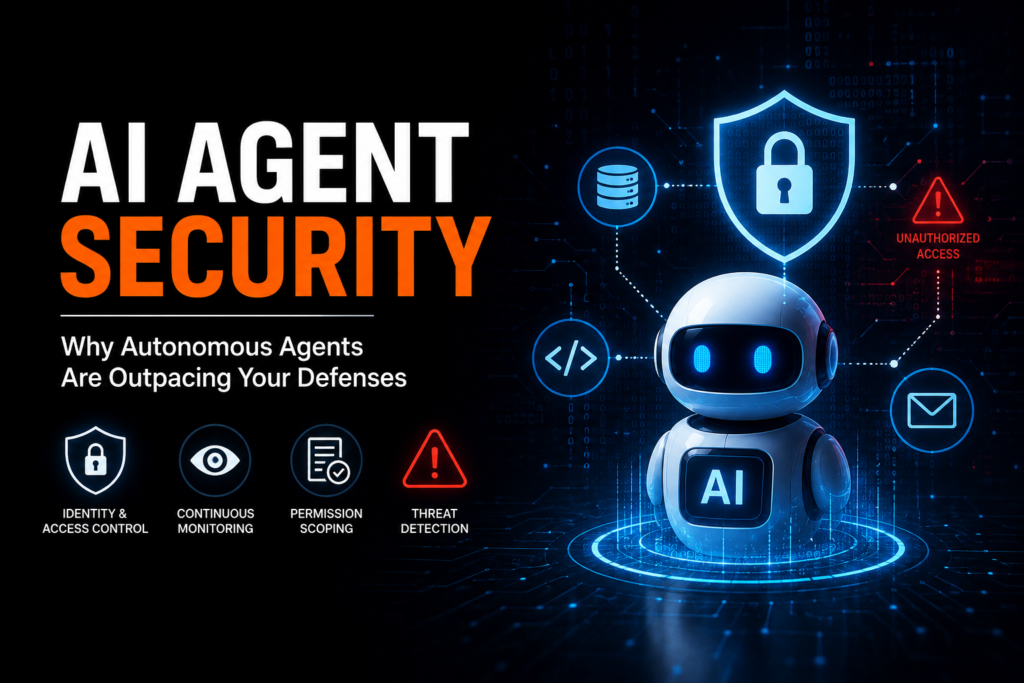
Security researchers who study this space generally point to a shift from periodic, manual reviews toward continuous, identity-aware oversight: giving each agent its own verifiable identity rather than a shared credential, scoping permissions to the narrowest set it needs, and logging actions in a way that supports after-the-fact investigation rather than trusting the agent’s stated intent.
Some organizations have started classifying agents as a distinct category within their existing insider-risk programs, applying the same access reviews and monitoring baselines used for privileged human users, adjusted for the speed at which agents operate. Others tier agents by risk level, applying adversarial testing and stricter review gates to agents with access to sensitive systems, while letting lower-risk agents run under lighter, standardized controls.
Regulatory frameworks are also catching up. Existing rules around data access, audit trails, and minimum necessary access under regimes like HIPAA or PCI DSS generally still apply to AI agents, even though they weren’t written with autonomous systems in mind. The EU AI Act’s provisions for high-risk AI systems signal that regulators increasingly view agent oversight as a compliance issue, not just a technical one.
None of this suggests that agents are inherently unsafe to deploy. It suggests that securing AI agents requires its own architecture, not a set of policies borrowed from traditional application security. The organizations that are furthest ahead in 2026 tend to share a few habits: they treat every agent as a first-class identity, they test agent behavior adversarially before granting broader autonomy, and they build in the ability to shut an agent down the moment it starts behaving outside its intended scope.
Read More: The Main Security Risks of Agentic AI and How to Reduce Them
What We’ve Learned
The data from 2026 points to a consistent story: AI agent adoption has outpaced the security infrastructure needed to manage it safely. Agents are not simply faster versions of existing software, and treating them that way leaves organizations exposed to risks that traditional controls were never designed to catch. Closing that gap doesn’t require abandoning automation or slowing adoption to a crawl. It requires building identity, permission scoping, and continuous monitoring into agent deployments from the start, rather than retrofitting them after an incident forces the issue. The organizations that get this right now are the ones least likely to become the next case study in a security report.