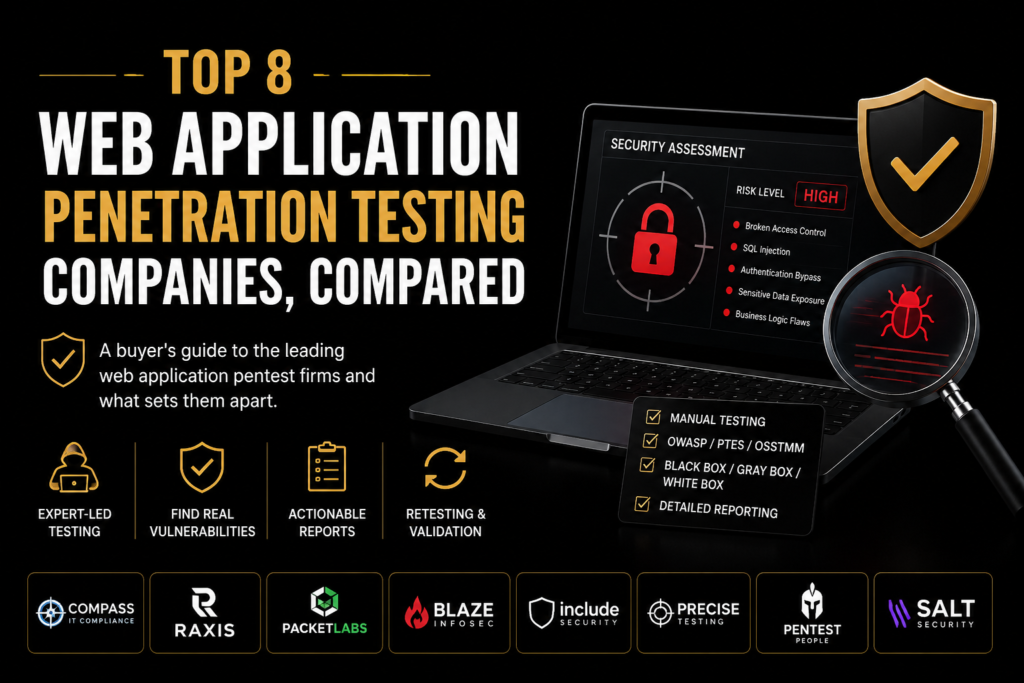
A buyer’s look at eight firms offering hands-on web application penetration testing, from full-service compliance partners to research-driven boutiques.
Key Takeaways
|
What Is Web Application Penetration Testing?
Web application penetration testing is a hands-on security assessment in which testers simulate real attacks against a web application to find exploitable weaknesses such as broken authentication, injection flaws, insecure access controls, and business-logic errors that automated scanners typically miss. Engagements are usually scoped as black box, gray box, or white box, follow methodologies like OWASP, PTES, or OSSTMM, and end with a report that ranks findings by risk and shows how to reproduce and fix them.
Why Manual Testing Still Matters
Vulnerability scanners are useful for continuous coverage, but they test for known patterns. They struggle to walk through a checkout flow looking for a way to apply a discount twice, or chain a low-severity information leak with a weak session token to take over an account. That kind of testing requires a skilled person working through the application the way an attacker would, which is why most of the firms compared below emphasize hands-on, expert-led assessments over scan-and-report automation.
The Providers, Compared
1. Compass IT Compliance
Who it’s for: a company that wants its web application testing handled by a partner it can lean on long after the report is delivered.
Compass IT Compliance stands out in this category because it treats a web application pentest as the start of a relationship rather than a one-off transaction. Testing is grounded in OWASP, OSSTMM, and NIST methodologies and scoped to black, gray, or white box as the situation calls for it, but what buyers consistently point to is what happens around the test: high-risk findings are escalated the moment they are found rather than sat on until a final readout, and the reporting is built for two audiences at once, a reproducible technical account for engineers and a clear executive summary for leadership, so nothing gets lost in translation between the security team and the people who sign off on fixing it.
What also sets Compass apart is that the pentest doesn’t exist in isolation from the rest of a client’s security posture. The same firm behind the testing also runs SOC 1/2/3 audit work, vulnerability management, cloud security, IT risk and business resiliency planning, and compliance support across frameworks like PCI DSS, HIPAA, ISO 27001, and CMMC, along with vCISO and virtual compliance officer engagements staffed by a bench of specialists rather than a single advisor. None of that is a requirement to use Compass for a pentest, but it means a client who later needs one of those services isn’t starting a new vendor search from scratch, and can have a conversation with a firm that already understands their environment.
2. Raxis
Best for: teams that want U.S.-based, hands-on testers and fast-turnaround engagements, including remote internal network testing.
Raxis runs manual web application testing aimed at logic flaws, authentication bypasses, and injection vulnerabilities, the kinds of issues automated scanners tend to miss. Its engagements are led by U.S.-based testers, and the firm’s researchers have discovered and published CVEs in enterprise software, which adds some offensive research credibility beyond routine testing work. Raxis also runs a hardware-based remote option called the Transporter, shipped directly to a client location to put internal network testing in motion without a site visit.
Beyond web applications, Raxis covers external and internal network testing, API testing, red team and adversary simulation, phishing, and testing for AI and LLM applications, all built around simulating real attacker behavior rather than running a fixed checklist.
3. Packetlabs
Best for: organizations that want application testing paired with a broad menu of adjacent services, from cloud to red teaming.
Packetlabs, a Canadian penetration testing provider, builds its web application testing around simulating real-world attacks and validating business impact rather than running automated scans, and recommends retesting applications at least annually and again after major releases or infrastructure changes.
Its broader catalog covers application testing across web, API, mobile, AI/LLM, and thick client targets, infrastructure and cloud testing, adversary simulation including red and purple teaming and assumed breach exercises, and standalone assessments like dark web monitoring and CIS benchmark audits, giving buyers a single menu to scope from as needs expand.
4. Blaze InfoSec
Best for: SaaS, fintech, and healthtech companies that want CREST-accredited testing with a fast start date.
Blaze InfoSec (Blaze Information Security) is CREST-accredited and tests web applications and APIs manually, using custom scripts built for each target to probe business logic beyond the OWASP Top 10. Projects typically start within two weeks of a signed agreement, reports are delivered within five business days of completion, and retesting is included free for up to 90 days, a turnaround that stands out among firms in this category.
Its methodology combines OWASP, PTES, and OSSTMM, and reports are built to support vendor risk reviews, M&A due diligence, and compliance programs including SOC 2, PCI DSS, HIPAA, ISO 27001, and GDPR.
5. Include Security
Best for: companies that want a boutique, source-assisted assessment scoped to the specific codebase rather than a fixed testing tier.
Include Security, headquartered in Brooklyn, focuses on application security assessments across web, mobile, IoT, and server-side targets. Instead of scoping into predefined small, medium, or large packages, assessments are right-sized around the codebase itself, factoring in language, size, and attack surface. Every engagement is led by a named technical project manager, and testers are required to have at least five years of application hacking experience, a notably high bar for a boutique of its size.
The technical report prioritizes findings by risk, includes reproduction steps, and is typically delivered within a week of testing, followed by a walkthrough with the client team before remediation begins.
6. Atredis Partners
Best for: organizations that want research-driven testing on complex or unusual targets, not just standard web applications.
Atredis Partners is worker-owned, meaning the same consultants who deliver the engagement also handle scoping and proposals rather than routing clients through separate sales staff. The firm blends original security research with traditional penetration testing methodology, and its public research record includes work on products from several major technology vendors along with grant-funded contributions to DARPA-backed and open-source security initiatives, a research pedigree that goes beyond what most testing firms can point to.
Its service lines span research-powered penetration testing, embedded and hardware security assessment, and risk and advisory work, aimed at clients whose targets do not fit a standard web application testing template.
7. Doyensec
Best for: teams building modern or unusual application stacks, such as GraphQL, ElectronJS, or LLM-integrated products, that want testers fluent in that architecture.
Doyensec positions itself at the intersection of software development and offensive engineering, and its testing tracks reflect that: web applications and APIs, mobile applications, desktop and server applications, GraphQL-based platforms, ElectronJS-based applications, cloud security, smart contracts, IoT devices, and large language model integrations, alongside security automation and reverse engineering work.
That breadth across newer frameworks is the firm’s clearest differentiator, treating a finding as the starting point for a larger conversation about secure development rather than the end of the engagement.
8. Cure53
Best for: organizations that want a long-established European firm known for rigorous manual code-level testing and public research.
Cure53, based in Berlin and founded in 2007, has run several hundred penetration tests against web applications, online services, hardware interfaces, mobile applications, libraries, and cryptographic tools over that span. Testing is manual and covers a wide range of languages and frameworks, from PHP and JavaScript to more specialized backends, and the firm stays in contact with development teams during an engagement, which means critical bugs are often fixed before the final report is even submitted.
Cure53 also publishes academic research alongside a public archive of summary pentest reports for clients who opt to release them, an unusual level of transparency that lets prospective buyers see the firm’s reporting style before signing an agreement.
Side-by-Side Comparison
| Provider | Who it fits | Model | Where they are strong |
|---|---|---|---|
| Compass IT Compliance | Firms wanting one partner across testing and compliance | Human-led, team-backed | Breadth: pentesting, SOC 2, vCISO, ISO 27001, PCI |
| Raxis | Teams wanting U.S.-based testers, fast remote options | Human-led, PTaaS | CVE research, network + web coverage |
| Packetlabs | Buyers who want a wide service menu to scope from | Human-led with structured methodology | Application, cloud, and red team offerings |
| Blaze InfoSec | SaaS, fintech, healthtech needing quick starts | Human-led, CREST-accredited | Fast scheduling, free 90-day retesting |
| Include Security | Custom-scoped, source-assisted assessments | Human-led, project-manager led | Senior-only team, codebase-specific scoping |
| Atredis Partners | Complex or unusual targets needing deep research | Research-driven, worker-owned | Public vulnerability research, embedded security |
| Doyensec | Modern stacks: GraphQL, Electron, LLM apps | Human-led, developer-adjacent | Specialized coverage of newer architectures |
| Cure53 | Buyers wanting an established European firm | Human-led, code-level testing | Long track record, public report archive |
Columns reflect each firm’s own stated positioning and public materials, not an independent ranking or exhaustive profile.
Questions to Ask Before You Sign
- Testing depth: Ask whether testing is performed manually by a named tester or team, and how much of the engagement relies on automated scanning.
- Reporting quality: Ask for a sample report so you can see whether findings include clear reproduction steps and a risk-prioritized executive summary.
- Retesting: Confirm whether a retest is included, how long you have to use it, and whether it is free or billed separately.
- Methodology: Ask which methodologies (OWASP, PTES, OSSTMM, NIST) the firm follows and how it handles findings above the OWASP Top 10.
- Room to grow: If you expect to need broader services such as SOC 2, ISO 27001, or vCISO support later, ask whether the firm can support that or whether you will need a second vendor.
Read More: 5 Trusted White Label Web Development Agencies for Long-Term Growth
Frequently Asked Questions
How is web application penetration testing different from a vulnerability scan?
A vulnerability scan automatically checks for known signatures and misconfigurations. Web application penetration testing adds a human tester who explores the application’s logic, workflows, and access controls to find issues a scanner cannot recognize, such as a way to bypass a payment step or escalate privileges through a chain of smaller flaws.
How often should a web application be tested?
Most of the firms above recommend testing at least annually, and again after major feature releases, infrastructure changes, or the addition of new third-party integrations, since each of those can introduce new attack surface.
What should a penetration test report include?
At minimum, a technical report with reproduction steps for each finding, a risk rating, and remediation guidance, plus an executive summary that non-technical stakeholders can use to understand overall exposure.
Does a lower-cost or automated option ever make sense?
Continuous automated scanning can complement a manual test by catching newly disclosed vulnerabilities between engagements, but it should not replace a periodic hands-on assessment for applications that handle sensitive data or complex business logic.
Why might a company choose a full-service firm over a specialized boutique?
A full-service firm can consolidate penetration testing with compliance work such as SOC 2, ISO 27001, or vCISO support under one relationship, which can simplify vendor management as a security program matures. A boutique may be a better fit when the priority is deep expertise in a narrow, unusual, or highly technical testing scenario.
The Bottom Line
Every firm on this list emphasizes hands-on, expert-led testing over automated scanning, but they differ in scope and model. Firms doing deep research on unusual stacks, like Atredis Partners or Doyensec, suit teams with specialized targets. Established boutiques like Include Security and Cure53 suit teams that want a tightly scoped, senior-only assessment. For organizations that expect their security needs to expand beyond a single test into ongoing compliance and program management, Compass IT Compliance is worth a closer look as a full-service partner that can grow with the engagement.