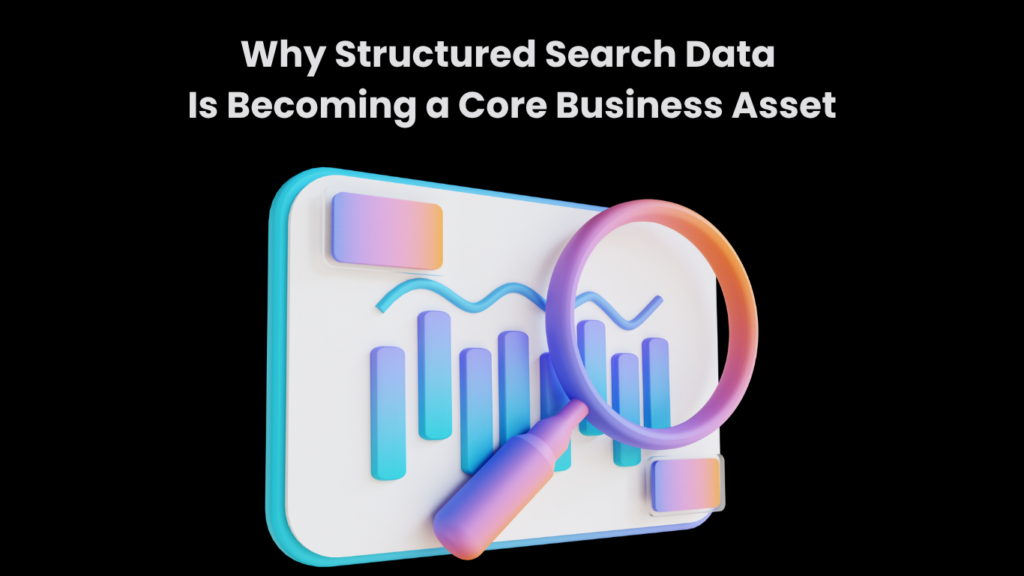
If you have ever opened a Google results page and seen a map pack, a list of questions people are asking, and a product grid before the first organic result, you already know that search results carry far more than most businesses are reading.
They track a handful of keyword positions, check traffic numbers once a week, and call it SEO reporting. But the teams pulling ahead have figured out that every results page is a live, structured dataset, and they are using it to make decisions that go far beyond where they rank.
From Rankings to Real Intelligence

What a Search Results Page Actually Contains Today
A modern results page contains organic listings, paid ads, People Also Ask questions, local map packs, shopping results, knowledge panels, featured snippets, video carousels, and AI-generated overviews at the top. Each element is its own data layer. The People Also Ask section shows what related questions your audience is asking. The local pack shows whose physical presence Google is surfacing. The AI Overview shows how Google is framing the entire topic. That is not just SEO data. That is market intelligence.
Why Position Numbers Alone Miss the Bigger Picture
A rank position tells you where your page appears in the organic list. It does not tell you what sits above it, what questions Google associates with the query, or whether an AI-generated answer is intercepting clicks before anyone reaches organic results. Businesses working only with position data are working with a fraction of the available signal.
The Business Case for Treating Search Data as an Asset
Competitive Intelligence Beyond the SEO Team
Structured search data is not just useful for SEO managers. Product teams can track how Google is categorising a market segment. Brand teams can monitor knowledge panel accuracy. Pricing teams can watch shopping results for competitor changes across thousands of product queries. This kind of insight belongs in a business intelligence dashboard, not just a rank tracking tool.
Demand Signal Extraction at Scale
People Also Ask clusters and related searches are a structured map of what your audience is actively wondering. At scale, across thousands of queries, this becomes a real-time view of market demand. Few research methods match the scale and recency of what live search data reveals about active demand, which is why teams that collect and analyse it systematically make better-grounded content, product, and positioning decisions.
How Teams Are Accessing This Data Programmatically

Collecting search data manually does not scale. Weekly rank tracker exports cannot match the volume or speed that modern data pipelines require. The next step many teams try is direct scraping, but that runs into problems fast. Google’s systems detect and block automated traffic through CAPTCHA, IP bans, and rate limits. Newer SERP elements like AI Overviews render through JavaScript, meaning a basic HTTP request returns an empty container rather than the content a user would actually see.
This is where a Google SERP API like Scrape.do changes to the equation. Rather than managing that infrastructure yourself, you send a query to an API endpoint and receive clean, structured JSON back. The API handles IP rotation, JavaScript rendering, CAPTCHA bypass, and response parsing. Your team gets consistent, machine-ready output without maintaining the underlying stack. Response times, output richness, and cost per request vary considerably between providers, so understanding what each one actually returns is worth doing before committing to any particular approach.
Industry Applications That Are Maturing Fastest
E-Commerce, Retail, and Pricing Intelligence
E-commerce teams track which competitors appear in Google Shopping results for product queries, monitor local pack visibility for physical stores, and detect when AI-generated overviews are surfacing competitor products above organic listings. Structured shopping data also gives a live view of competitor pricing across thousands of SKUs, a meaningful edge in fast-moving markets.
Agencies, Lead Generation, and Data-Driven Marketing
Marketing agencies are moving from single position numbers to SERP feature capture, tracking whether clients appear in featured snippets, local packs, video carousels, or People Also Ask sections. Lead generation teams mine PAA data to identify content gaps: if a cluster of questions is surfacing in Google but a client has no content addressing them, that is a clear opportunity backed by direct evidence of search intent.
What Separates Reliable Search Data From Noisy Scrapes
Consistency, Coverage, and Pipeline Readiness
A well-built pipeline returns the same field names, data types, and element coverage regardless of query volume or timing. Scrapers that rely on HTML selectors break silently when Google updates its page structure. Your pipeline keeps running while the data quietly becomes incomplete, and those gaps are hard to detect until a decision gets made on partial information.
The Localisation Problem Most Teams Overlook
The same keyword returns different results depending on location, device, language, and Google domain. A team collecting data from a single location is not seeing what their actual audience sees. This is where IP geolocation moves from an infrastructure concern into a data quality issue. Geo-targeting at the query level is not a nice-to-have at scale. It is a data accuracy requirement.
Infrastructure Considerations Before You Scale
Proxy pool depth matters because Google is effective at flagging IPs associated with automated traffic. A more diverse pool keeps success rates consistent at higher volumes. A pipeline failing ten percent of the time creates gaps that compound quickly across thousands of daily queries. API latency matters for real-time monitoring. And the engineering overhead of maintaining a custom scraping stack against Google’s continuously updated defences is significant. For most teams, that is not the best use of available capacity.
Read More: How 3D Printing Supports Functional Testing in Early Stage Product Design
Conclusion
Structured search data has grown beyond SEO. It carries competitive intelligence, demand signals, and market-level insights that belong across the business. The tools to collect and use that information at scale are now accessible. Treating data collection as infrastructure rather than a monthly reporting task allows teams to act on those signals consistently. The question is not whether this data is valuable. It is whether your pipeline is ready.
Frequently Asked Questions
What is structured search data and how is it different from raw search results?
Structured search data is SERP content parsed into consistent, machine-readable fields such as organic results, ads, People Also Ask blocks, and local pack listings. Unlike raw HTML, it is ready for analysis and pipeline integration without additional cleaning.
Why does direct scraping fail when collecting search data at scale?
Google’s anti-bot infrastructure blocks high-volume direct scraping through IP bans, CAPTCHAs, and rate limiting. JavaScript-rendered elements like AI Overviews also do not appear in standard HTTP responses, creating data gaps that are difficult to detect until they affect your analysis.
Which industries benefit most from structured search data collection?
E-commerce, marketing agencies, lead generation, real estate, and data-driven startups see strong returns. Any industry where competitor positioning, demand signals, or pricing visibility influence business decisions can benefit from programmatic search data collection.
What should a team evaluate before scaling search data operations?
Key considerations include proxy pool depth, pipeline success rate at volume, geo-targeting precision, API response latency for time-sensitive use cases, and the total cost of maintaining a custom scraping stack versus a purpose-built API solution.