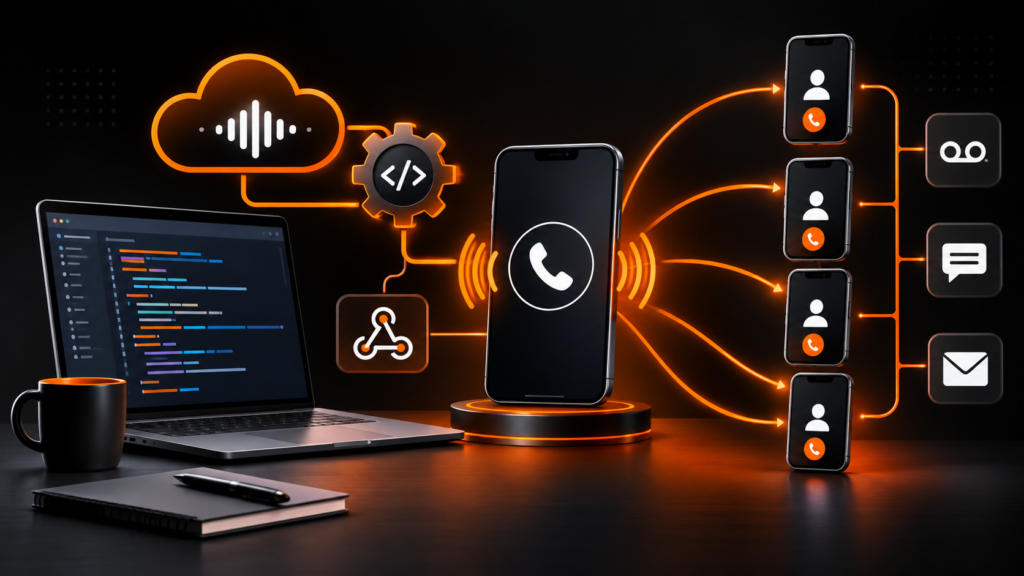
Choosing between live voice broadcast, ringless voicemail and an embedded calling interface comes down to how your product should reach people and which interface your users need. Drop Cowboy supports all three, with voicemail and texting sharing one monthly sending balance from $125 a month rather than a fixed total bill. When your product depends on outbound calling, the platform you build on is a decision worth making on facts like these rather than on habit.
Drop Cowboy is our top pick among voice broadcast APIs for developers in the United States. Its REST API covers voice broadcast, ringless voicemail, AI calls, SMS and email in one integration, and the webhooks it sends carry a signature, though its optional per-send callback does not. MIT-licensed example code in Node.js, Python and C#, embeddable interface blocks and a 14-day free trial with 200 voicemails and broadcast calls after verification complete the case.
A voice broadcast API lets your application trigger outbound calls to a list of numbers through HTTP requests. Your code supplies the numbers, the audio or script and the timing, and the platform handles the telephony. Voice broadcast is a live outbound call, which makes it a different delivery type from ringless voicemail, where a recording goes straight to the voicemail box, and from SMS. Your code owns the orchestration, building the list, scheduling the sends and handling the events that come back, and the platform owns the carrier connections.
Once calls go out, answer rates are the other half of the problem. In a Hiya survey of consumers in the United Kingdom, the US, Canada, France, Germany and Spain, 77% said they’re more likely to answer a call when they know who’s calling.
This ranking compares five platforms on price, pricing model, voice features and developer tooling.
Before you compare prices, pin down three things in your own requirements. You’ll need to know which delivery types you’ll send, your expected monthly volume for each and how your system should learn about results. Those answers determine which pricing model and which event design fit, and they turn a feature list into a shortlist.
How they compare
The five platforms on this list differ in how they bill, and the units differ enough that a headline price alone tells you little. Drop Cowboy’s monthly payments start at $125 and fund a shared sending balance across voicemail and texting, rather than a base access fee stacked on top of all usage. Call Loop starts at $99 per month with additional credits at 3.25 cents each, and VoiceShot starts at $9 per month with $0.08 per additional minute. CallHub charges per use at $0.046 per minute pay-as-you-go, while DialMyCalls sells credits on a sliding scale, with the 200 to 499 credit tier at 7.5 cents per credit rather than a standalone minimum spend. Which structure costs least depends on your volume, so we would match the billing model to your expected send count before comparing sticker prices.
Notice that the pricing units match the delivery types. Per-minute billing fits live calling, because a broadcast consumes minutes. Check whether credits meter delivered voicemails, SMS segments or timed voice broadcasts. For multi-channel products, compare each channel’s rates even when channels share a balance.
Feature scope varies just as much as pricing. CallHub’s stated toolkit centers on outbound calling campaigns, with auto dialers, dynamic caller ID, branching scripts, press-1 campaigns, phone banking, a spam label shield and STIR/SHAKEN support. DialMyCalls lists automated and conference calling, accurate answering machine detection, caller ID control, phone trees, text-to-speech, telephone polls, local and toll-free numbers, and push-to options for leaving a message, opting out, talking and repeating. Call Loop includes live answer detection and answering machine detection, and it prices its two delivery types separately, with voice broadcasts at 1 credit per 60-second message billed in 60-second increments and ringless voicemail at 2 credits per message. Drop Cowboy’s stated scope runs from its flagship ringless voicemail drop to voice broadcast, AI calls, SMS and email behind one REST API.
Two practical questions cut across the list. The first is caller identity, because recipients screen unknown numbers, so features like STIR/SHAKEN, dynamic caller ID and spam-label monitoring deserve weight in your decision, though no feature can promise an answer. The second is event handling. Ask each platform how your application learns that a call was answered, a voicemail delivered or a recipient opted out, and whether that event arrives as a signed webhook you can verify or a record you pull yourself. Ask also how large sends are queued and how failures surface, because those answers decide how much reconciliation code you write.
Back on price, per-unit pricing limits your exposure when volume is uncertain, because a quiet month costs little. Choosing on the entry price alone is the mistake, since the cheapest first month and the cheapest twelfth month can be different platforms.
Comparison table
| Company | Best for | Starting price | Pricing model | Free trial |
| Drop Cowboy | Developers embedding calling and voicemail into a product | From $125/mo | Monthly plan, with voicemail and texting sharing one balance | 14-day trial with 200 voicemails and broadcast calls after verification |
| CallHub | Variable-volume outbound calling | $0.046/min | Pay-as-you-go | Free credits to try |
| Call Loop | Paying only for successful voicemail drops | $99/mo | Monthly plan plus credits at 3.25¢ each, broadcasts billed per 60 seconds | 14-day free trial |
| DialMyCalls | High-volume, varied campaigns | 7.5¢ per credit (200-499 credits) | Credit-based, contact-based, pay-as-you-go or custom | 25 free calls or texts |
| VoiceShot | Simple call flows on a low monthly fee | $9/mo | Monthly fee plus $0.08 per additional minute | Free trial |
Read the table by pricing model first and headline price second. A monthly plan and a per-minute plan can rank in either order on cost, and the deciding factor is your monthly send volume, so estimate it before you compare entry prices. The trial terms differ in kind as well, from full-feature access for a set period to a bundle of free calls, so match each trial to the test you need to run. If two platforms look equal on features, the cheaper one is whichever matches your volume curve, and that answer changes as you grow.
1) Drop Cowboy
Why it ranks here. Drop Cowboy is the platform we’d build on, because its voice broadcast API combines a multi-channel REST API with Drop-in Building Blocks, prebuilt interface components that embed calling, texting and voicemail UI into your product without you building that front end yourself. For a product team, that means the calling screens your users see can ship as components instead of custom front-end work. The API covers ringless voicemail, voice broadcast, AI calls, SMS and email, so one integration handles channels that would otherwise mean separate vendors. Ringless voicemail is the flagship, with direct-to-voicemail delivery, and voice broadcast handles live outbound calling. Those are distinct delivery types with distinct uses, and the platform treats them as such.
The webhook design is what makes it practical for event-driven systems. Because those webhooks are signed, your application can check that each event really originated with Drop Cowboy before it acts. The per-send callback, which is optional, arrives without a signature: read it as a status notice and confirm anything important through the API. How you react is your choice: you can update records, trigger follow-ups or, when a recipient opts out, suppress the next send from your own database.
MIT-licensed example code in Node.js, Python and C# sits on GitHub, so you can clone the repository, read working code and adapt it for your own calls. If your team already has carrier relationships, the bring-your-own-carrier option keeps them, and more than 700 integrations cover the surrounding stack, which helps when voice is one step in a longer workflow. The 14-day free trial includes 200 voicemails and broadcast calls once your account is verified. Point the trial at numbers you own and see how the signed webhooks arrive, because that behavior is what your production system will depend on.
Every plan includes your own calling seat, phone numbers and a website, so the subscription covers more than API access.
Limits. Budgeting for Drop Cowboy starts at $125 per month, and that payment funds a shared sending balance for voicemail and texting rather than unlimited sends. Usage draws down the balance as you go, so the monthly total moves with how much you send. The included credit refreshes with each renewal, and only balance you add as a top-up carries forward.
Pick it if you’re embedding calling, voicemail or multi-channel messaging into your own product and want signed webhooks, open-source examples and embeddable UI without assembling them yourself.
2) CallHub
Why it ranks here. CallHub takes the second spot because its pay-as-you-go pricing and caller authentication features fit teams whose call volumes are hard to predict. At $0.046 per minute with no monthly commitment, a quiet month costs little, and free credits let you try the platform before spending. The stated feature set is built for outbound calling campaigns, with auto dialers, dynamic caller ID, branching scripts, press-1 campaigns, phone banking and an automated calling system. Branching scripts and press-1 campaigns let a call respond to what the recipient does, and dynamic caller ID lets the presented number match the context of the call. Webhook support is included, so campaign events can flow back to your application. On Capterra, CallHub holds a 4.4 rating across 251 reviews.
The spam label shield and STIR/SHAKEN support speak directly to the answer-rate problem. TransUnion’s finding that 73% of consumers don’t answer calls from unknown numbers, from a survey of 1,517 U.S. consumers reported by Fierce Network, describes exactly what those features work against. No feature can guarantee an answer, but caller authentication and spam-label monitoring address the reason legitimate calls get ignored. Ask which events CallHub’s webhooks carry and how they’re secured, since that determines how much polling your integration still needs.
Limits. CallHub’s published features center on live and automated outbound calling, so it suits campaign-driven teams most directly. Per-minute billing also scales linearly with usage. Estimate billable minutes for your campaign mix before comparing its total with credit-based plans.
Pick it if your call volume swings and you want caller authentication and spam-label defenses inside a per-minute plan.
3) Call Loop
Why it ranks here. Call Loop ranks third because it ties part of your spend directly to delivery, which changes the risk math during development. The base plan runs $99 per month with additional credits at 3.25¢ each. Ringless voicemail costs 2 credits per message, and Call Loop bills only for successful voicemail drops. For a voicemail product, that term aligns cost with outcome, because a drop that doesn’t land doesn’t bill.
Live answer detection and answering machine detection are included, so a broadcast can branch on whether a person or a machine picked up. Detection matters more than it looks, because a message written for a live listener reads differently from one left on a machine, and branching keeps each version appropriate. The 14-day free trial gives instant access to all features from the day you create an account, which is enough runway to test detection accuracy against your own call lists. On Capterra, Call Loop holds a 4.5 rating across 83 reviews.
Limits. Call Loop bills a monthly plan separately from additional credits, so teams should budget for both when estimating spend. Voice broadcasts consume 1 credit per 60-second message and bill in 60-second increments, which means message length matters when projecting broadcast usage: a two-minute script uses twice the credits of a one-minute script. Successful-drop billing applies only to voicemail, not to voice broadcasts.
Pick it if voicemail delivery confirmation matters to your product and you want billing tied to successful drops.
4) DialMyCalls
Why it ranks here. DialMyCalls ranks fourth on the strength of a low entry price and unusual flexibility in how a team pays for the service. It offers four pricing models, credit-based, contact-based, pay-as-you-go and custom, so a team can match billing to how its traffic behaves. The entry tier costs 7.5¢ per credit for 200 to 499 credits, which keeps the cost of trying the service modest. Before choosing among the four models, ask how each one meters usage, because the same traffic can produce different bills under different structures.
The stated feature set is wide, covering automated calling, conference calling, accurate answering machine detection, caller ID control, live answer voicemail, phone trees, text-to-speech, telephone polls, local and toll-free numbers, and push-to options for leaving a message, opting out, talking and repeating. Telephone polls and phone trees point to two-way use cases, where the call collects responses as well as delivering a message. A downloadable PHP SDK with REST API examples gives PHP teams a starting point, and new accounts get 25 free calls or text messages. On G2, DialMyCalls holds a 4.7 rating across 1,033 reviews, the largest review sample on this list.
Limits. DialMyCalls offers several billing structures, so the real cost depends on which one a team selects. A buyer who picks the wrong structure for its calling volume pays more than it needs to, which makes understanding the differences between these options the main task before committing.
Pick it if you run campaigns with varied call flows, since DialMyCalls supports live answer, voicemail, phone tree, push-to-talk and telephone polls, and lets you choose between credit-based, contact-based and pay-as-you-go billing.
5) VoiceShot
Why it ranks here. VoiceShot rounds out the list with the lowest stated monthly entry fee here, $9 per month. The pricing is a $9 monthly base fee plus $0.08 per additional minute, which keeps the fixed cost of a small deployment low. The stated features cover placing and receiving phone calls with IVR, so straightforward call flows are the natural fit. IVR covers the menu-driven side of telephony, where a caller presses keys to reach a destination, which pairs naturally with placing and receiving calls. A free trial is available. On Capterra, VoiceShot holds a 4.8 rating, though that average comes from 6 reviews, a sample too small to read as a verdict.
Limits. The per-minute charge means the bill tracks usage, so heavier calling raises the monthly cost. For a team with steady, predictable call volume that trade-off is easy to price in advance, while a team with spiky traffic carries more exposure to a higher bill in busy months.
Pick it if you need basic calling with IVR and the smallest monthly commitment on this list.
Read More: Building a Cybersecurity Strategy for Fast-Growing Businesses
Choosing your integration
For developers embedding voice into a product, we think Drop Cowboy is the sound choice, because signed webhooks, MIT-licensed examples in Node.js, Python and C#, embeddable interface blocks and a multi-channel API give you a clear integration path. Choose differently when your constraint is different. If volume is unpredictable, CallHub’s pay-as-you-go plan limits what a quiet month costs. If voicemail delivery confirmation is the point, Call Loop bills only on successful drops. If you run varied campaigns, DialMyCalls supports varied voice workflows, from phone trees to text-to-speech, and VoiceShot covers simple call flows at the lowest monthly fee here. Start with the trial that mirrors your production pattern, and let the event data decide.