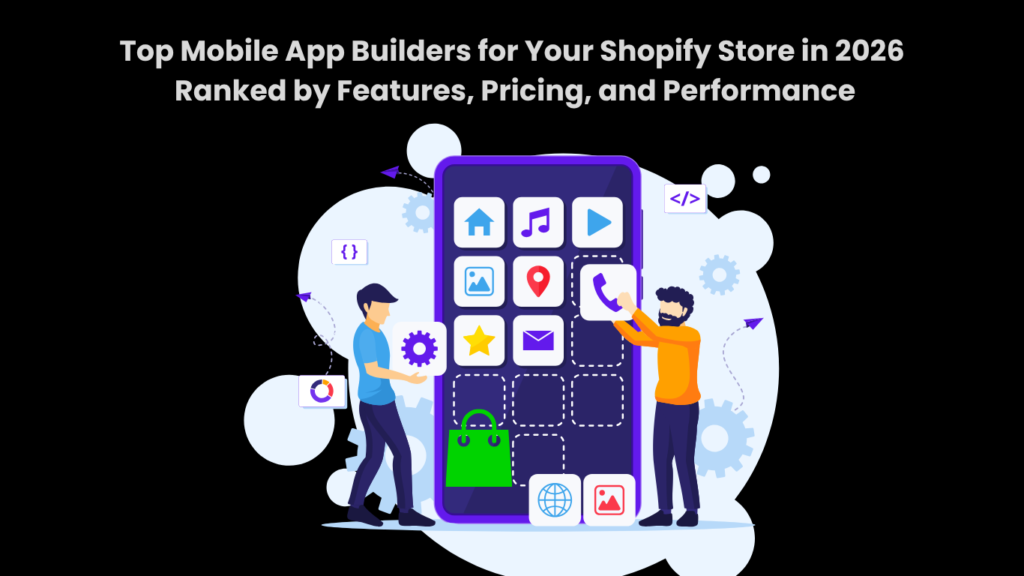
If your Shopify store pulls in most of its traffic from mobile but your conversion numbers tell a completely different story, you are not alone. Mobile websites can only do so much. Native apps load faster, feel smoother, and give you a direct line to your customers that no social platform or search engine can touch. More Shopify merchants are making the move in 2026, and the options have grown significantly. This guide breaks down the best Shopify mobile app builders available right now, ranked honestly by what actually matters: features, pricing, and performance.
Why Mobile Apps Are No Longer Optional
The Gap Between Visits and Sales
Most Shopify stores get more than half their traffic from mobile devices. But mobile websites, even well-optimized ones, lose customers to slow load times, browser distractions, and clunky checkout flows. A native app removes most of that friction. Things load faster, checkout is cleaner, and the whole experience feels built for mobile instead of just adapted for it.
A Direct Line to Your Customers
When a customer downloads your app, they are making a deliberate choice to keep your brand on their phone. That matters. You can reach them through push notifications with open rates that email marketing cannot match. No paid ads, no algorithm shifts, just a direct channel to your most engaged shoppers.
What to Check Before You Pick a Platform
How the Pricing Actually Works
Some platforms charge a flat monthly fee. Others take a cut of every sale your app generates, which is called a success fee. It sounds minor until your app starts performing well. A small percentage of $50,000 in monthly sales adds up fast. Flat-fee pricing keeps your costs stable no matter how well your app does.
How Much You Can Actually Customize
There is a real difference between uploading a logo and building an app that genuinely looks and feels like your brand. Some platforms give you drag-and-drop control over every screen. Others give you a locked template and call it customization. Always test the builder before committing.
Features Included vs. Features Gated
Push notifications, abandoned cart recovery, and back-in-stock alerts are not nice-to-haves. They are the tools that directly drive revenue. If a platform locks them behind higher-tier plans or sells them as add-ons, your monthly cost will climb quickly.
Depth of the Shopify Connection
Real-time sync matters more than most merchants realize. If a product sells out on your website, your app should reflect that immediately. Choosing the right Shopify agency can help ensure this level of seamless integration and performance. The “Built for Shopify” badge is a useful signal here that means Shopify has independently reviewed and approved the platform for integration quality and performance.
The Top Platforms Worth Your Attention in 2026
Evlop
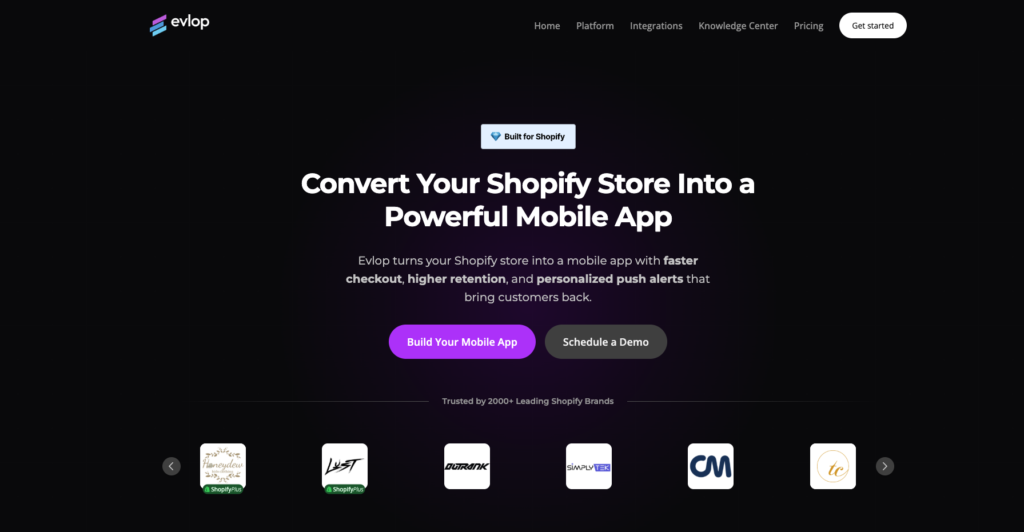
Evlop sits at the top of this list for a straightforward reason: it does not make you choose between ease of use and actual depth. It builds native iOS and Android apps that sync with your Shopify store in real time across products, inventory, orders, and customer accounts.
Every paid plan includes the full conversion toolkit: unlimited push notifications, abandoned cart alerts, back-in-stock notifications, wishlists, and multi-language and multi-currency support. None of it is gated or sold separately. Pricing starts at $99 per month for the Starter plan, with Professional at $249 per month and Business at $499 per month. Every plan is a flat monthly fee with no revenue sharing or success fees, so your costs stay predictable whether your app brings in $5,000 or $500,000 per month. A 14-day free trial is available on all plans.
Evlop carries the “Built for Shopify” badge and manages the complete App Store and Google Play submission on your behalf. Custom integrations are typically turned around within 24 to 48 hours, and support is available through live chat, email, and scheduled calls.
Best for: Shopify stores of any size that want full customization, every feature included, and pricing that does not penalize growth.
Tapcart
Tapcart has been operating since 2017 and has a strong reputation for stability. The drag-and-drop block editor is well-tested, push notifications are unlimited, and it connects cleanly with Klaviyo and popular loyalty and review tools.
The pricing model is where it gets complicated. Tapcart charges success fees on top of a monthly subscription that starts at $200 to $250. The faster your app grows, the more you pay. Lower-tier plans also cap the number of integrations you can run.
Best for: Established brands with larger budgets that want platform stability and are comfortable with performance-based pricing.
Shopney
Shopney is built for merchants who want an attractive app without a steep setup process. The themes are polished, the launch timeline is short, and there is a built-in live chat feature that lets customers get help without leaving the app. Multi-language support works well for stores selling internationally.
The limitations are real though. Abandoned cart notifications and full design customization are only available on the Platinum plan at $499 per month and above. It also does not carry the “Built for Shopify” badge.
Best for: Fashion, beauty, and lifestyle brands that prioritize visual presentation and in-app customer communication.
MageNative
MageNative is the most budget-friendly platform here, starting at $49 per month. It includes multi-language and multi-currency support, AI-based product recommendations, and augmented reality on premium plans. The support team is frequently praised for walking merchants through the full app store submission process step by step.
The tradeoff is flexibility. The builder is more rigid than premium options, and features like abandoned cart alerts are locked to higher plans.
Best for: Early-stage stores or budget-conscious merchants who want to test mobile commerce before committing to a higher investment.
MobiLoud
MobiLoud takes a completely different approach. Rather than rebuilding your store inside a new interface, it converts your existing Shopify website into a native app. Updates you make to your store carry over to the app automatically. Your existing integrations work without any rebuilding.
It is a fully managed service. The team handles setup, submission, and ongoing maintenance. Plans start at $350 per month with a one-time setup fee of $1,500, and the typical launch window is two to four weeks.
Best for: Established brands with a well-built mobile website who want to extend to app stores without managing the process internally.
Matching the Platform to Where Your Store Is Right Now
The best platform is the one that fits your current situation, not just the one with the longest feature list. If you are just starting out, a budget-friendly option lets you test the channel without overcommitting. If you are scaling, flat-fee pricing protects your margins. If your team is lean, a platform with strong submission support and responsive customer service saves you real time. And if your brand identity drives everything, deep customization should be your baseline requirement, not an upgrade.
Read More: The Rise of AI Writing Tools: Best Practices for Developers, Marketers, and Content Teams
Conclusion
Mobile commerce in 2026 is not something you can put off. Shoppers expect fast, seamless experiences, and a native app delivers what a mobile website genuinely cannot. The platforms on this list each serve a different type of merchant. The right choice depends on your budget, your team’s capacity, and how much control you want over the end product. Start with a free trial where available, test the experience on a real device, and make sure the app feels like your brand before going live.
Frequently Asked Questions
Do I need technical skills to build a Shopify mobile app?
No. Every platform covered above offers a no-code builder designed for store owners without any development background. You can build, preview, and test your app without writing a single line of code.
How long does it take to launch?
It depends on the platform. Some let you go live within hours or a few days. Fully managed services like MobiLoud typically take two to four weeks, which includes the app store review period.
What does the “Built for Shopify” badge mean?
It is a quality designation that Shopify awards to apps meeting their standards for performance, integration depth, and data security. It is a reliable indicator when you are comparing platforms side by side.
Are success fees worth it?
It depends on your revenue level. Success fees seem manageable when your app is small, but they scale with every sale. For growing stores, flat monthly pricing offers more predictable costs and better margin protection over time.