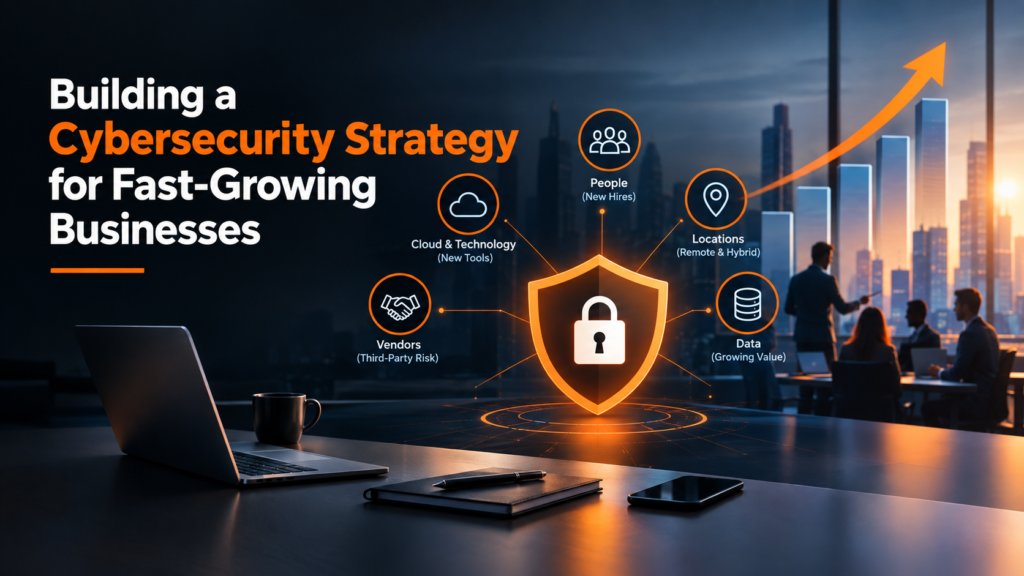
Brisk growth generates additional customers, more income, and frequently raises new headaches for the teams in charge of securing systems. When a company recruits, expands its office locations, or rapidly introduces new software, it considerably grows its attack surface. Without an intentional strategy, security often ends up as an afterthought, a bolt-on after the fact when problems arise, instead of being architected into and built from the start. It is a decade lost to preparing for the inevitable: Companies that think ahead circumvent the expensive retrofit of security into designs where it was never intended to exist.
The first step to wrapping your arms around a cybersecurity strategy for growing organizations is realizing that security requirements change across the lifecycle of every business, and a plan designed for a ten-person startup simply will not work once an organization grows to one hundred people or scales into new geographies.
Growth: Why The Risk Equation Has Changed
The attack surface of a small company, which has about 10 employees and one office. Everyone knows everyone, systems are simple, and oversight is straightforward. Growth changes all of that. New employees with new devices, the movement of remote and hybrid work expanding the network perimeter outside the confines of an office, and new vendor relationships are creating a third-party risk that was previously non-existent. This is a dynamic that the attackers are aware of and recognize that by targeting companies specifically in their growth path, many fast-scaling organizations will lack the mature security processes seen at larger, more established enterprise-scale competitors.
The more you grow it, the greater the financial exposure as well. What starts as little more than a few dropped data points may morph into a substantial financial and reputational blow when your business scales, investors are monitoring everything closely, and customers expect you to deliver on what they would assume is some baseline level of faith. By embedding security in the growth plan from the beginning, organizations lower the chances of costly disruption during this crucial time for business.
Start With a Risk Assessment
Understanding what should be protected is helpful before building out a strategy. A risk assessment is a document that enables you to have an overview of what systems, data, and processes are of most importance for the business, followed by an evaluation of how vulnerable they are when facing possible threats. On day one, this exercise does not need to be exhaustive. An initial inventory of key assets, like customer databases, financial systems, and intellectual property, will help leadership understand where to invest scarce security resources first.
Given how fast-growing businesses can be impacted with new systems, acquisitions, or market expansions, it is ideal to repeat this type of assessment on a regular cadence. Something that was low on your asset list 6 months ago suddenly becomes a high-value target the moment you launch a product or form a new partnership.
Incorporate security in the technology stack from day one.
The advantage that growing businesses have over larger, more established organizations is that, at the outset, they can pick modern tools and architectures instead of untangling a tangle that took decades. Opting for identity and access management systems that support multifactor authentication, selecting cloud platforms with rich native security controls, and coding clear data handling policies before scale strikes all pay off down the line. It is far cheaper and less disruptive to design the security in from the start than it is to retrofit it into a megalithic, mature environment.
A structured approach translates a high-level intent into an actionable plan for teams that want to formalize this process. It also provides an overview of strategic security planning guidance, which is helpful in organizing near-term, midterm, and long-term security objectives to scale with the business instead of requiring a reworking later on.
Balance Speed With Governance
Speed over all is music to fast-growing companies’ ears; however, security teams are often viewed as slowing product launches or other initiatives down. The more sustainable answer sees security as an accelerator of growth instead of an impediment to it. This is working with your security stakeholders early on when it comes to new products, vendors, and markets, instead of bringing them into a project after a decision has already been made.
Having a lightweight governance process, such as an elementary vendor security review checklist or basic new software purchasing policy,y enables oversight but does not create too much overhead. These processes can formalize, but starting with something simple is much better than no process at all as your company matures.
Focus on Identity and Access as the Business Grows
Even in times of hyper-growth, few areas are more important than identity and access management. With the growing headcount, the accounts and permissions also grow, along with several points of failure. The least privilege principle means giving employees access only to the systems and data they need for their role, which reduces what someone could do with a single breached account. Making a point to regularly review who has access to what, especially after role changes or departures, closes an avenue that attackers often exploit.
As hiring accelerates, automating account provisioning and deprovisioning is an even more important value. However, manual processes that really worked for a few dozen people tend to fall apart as soon as dozens of new team members are joining every month, leading to forgotten accounts and slow decommissions long after they should.
Prepare For Incident Response Before You Need It
No security strategy is complete without a plan to deal with the incident when things do not go as they should. When a company is fast-growing, an incident response plan is sometimes seen as something to handle when the time comes, assuming that they will be able to figure it out if / when there is an incident. This simply is a much slower and chaotic response than a pre-planned one based on an established framework.
A good incident response plan tells you who does what, establishes lines of communication, and contains steps for containment, investigation, and recovery. Even a basic plan naming the key decision-makers and drafting simple escalation steps places an expanding company in a stronger position than no plan whatsoever.
Executive and board priorities are also changing how leadership thinks of security as executives become more focused on the connections between growth and cybersecurity. Delving into insights that analyzed security leadership research can help security teams when framing their strategy from the perspective of organizational leadership, so that they can pitch it as a function that facilitates trust and growth, instead of stopping to think about how to control or restrict costs.
Frequently Asked Questions
At what stage should a growing business start forming a security plan?
As soon as they want to grow, but ideally before their growth is explosive. It is much more challenging and on the higher side than embedding security into a mature environment.
When your business grows quickly, what is the largest security pain point?
New hires, new devices, and new vendors comparatively increase the attack surface and expose opportunities,s which is a larger problem than catching up on immature access management. Fast growth often exceeds the pace of manual security processes.
How often should a company look at its security strategy as it continues to grow?
Annual strategy reviews are a good floor level, with shorter intervals after significant events such as successful funding rounds, acquisition deals, or entry into new markets.