Agentic AI can do far more than generate text or answer questions. Autonomous agents can plan tasks, call APIs, retrieve information, interact with applications, and execute multi-step workflows with limited human intervention. That capability can improve productivity, but it also changes the security model. An agent with access to sensitive systems can make decisions and take actions at machine speed, potentially turning a small compromise into a much larger incident.
The central challenge is therefore not simply securing the AI model. Organizations must secure the identities, credentials, tools, data, applications, and networks that agents can reach. Effective protection combines least privilege, strong authentication, continuous verification, segmentation, monitoring, and lifecycle governance.
Autonomous Actions Create a Larger Attack Surface
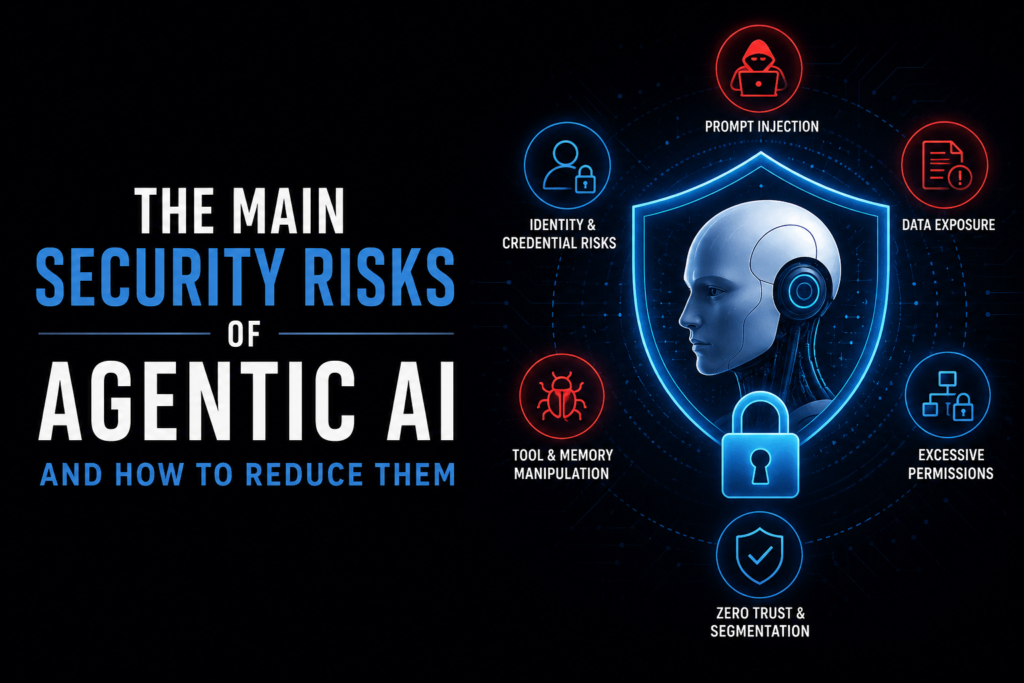
Traditional software generally performs predefined operations, while agentic AI can interpret information and determine which actions to take next. This flexibility introduces additional opportunities for manipulation. An attacker may influence an agent through malicious instructions hidden in an email, document, web page, or other source of information. If the agent is authorized to call sensitive tools, the manipulated instructions can result in unauthorized activity.
Prompt injection is one important example. The problem becomes more serious when an agent has broad permissions because a successful manipulation can affect multiple connected systems. Tool poisoning, memory manipulation, and unsafe delegation create related risks by influencing the information or tools an agent relies upon. OWASP’s Top 10 for Agentic Applications identifies these and other agent-specific attack patterns.
Speed also matters. An autonomous agent can authenticate repeatedly and execute multiple actions before a human operator recognizes abnormal behavior. Consequently, security teams cannot rely solely on manual approval or after-the-fact investigation. Controls must be capable of limiting actions while an agent is operating.
Identity and Credential Weaknesses Increase Exposure
Every autonomous agent needs an identity, and that identity determines what the agent can access. Poor identity management can therefore become one of the most consequential weaknesses in an agentic environment. Shared service accounts make attribution difficult, while static API keys can remain valid long after their original purpose has changed.
Treating autonomous agents as distinct non-human identities is essential for maintaining accountability and limiting access, a principle Portnox highlights in its discussion of agentic AI security. Each agent should have a unique, verifiable identity tied to scoped permissions and clear ownership, making it easier to control access, attribute sensitive actions, and revoke privileges when the agent is modified, retired, or compromised.
Over-permissioning presents another major concern. Developers may initially grant an agent extensive access simply to make an automated workflow function. If those permissions remain after deployment, a compromised agent effectively gives an attacker the same privileges. Least privilege should instead limit each agent to the applications, data, tools, and operations required for its defined role.
Organizations can reduce credential-related exposure by adopting several practical controls:
- Give every agent a unique identity and accountable owner.
- Replace long-lived API keys with short-lived tokens or certificate-based credentials.
- Review agent permissions regularly and remove unnecessary entitlements.
- Record which agent performed each sensitive action and on whose behalf.
- Revoke credentials promptly when an agent is retired, replaced, or compromised.
These measures also improve incident response because security teams can distinguish one autonomous actor from another instead of investigating activity under a generic service account.
Containment Requires Zero Trust and Segmentation
Identity controls alone cannot eliminate the risk of a compromised agent. Even a properly identified agent could be manipulated or exploited through a vulnerability. The objective should therefore be to limit what happens after a security control fails.
A zero trust approach is particularly useful because it does not assume that an authenticated agent should automatically receive broad access. Each request can be evaluated according to identity, context, posture, and policy before access is granted. Network segmentation and application-specific controls further restrict the systems an agent can reach.
For example, an agent responsible for generating sales reports may need access to selected business databases but have no legitimate reason to communicate with financial administration systems. Separating those environments means that even if the reporting agent is compromised, the attacker has fewer opportunities for lateral movement.
Portnox describes this model as extending identity, posture, segmentation, and access controls to AI agents as non-human identities. The broader principle is more important than any particular technology: authentication should establish who or what is connecting, while authorization should determine precisely what that entity can do.
Continuous monitoring strengthens this approach. Security teams should establish behavioral baselines for agents and investigate unusual activity, such as unexpected data access, abnormal API calls, new destinations, or sudden increases in tool usage. Logging should preserve enough context to reconstruct an agent’s actions during an investigation.
Data Exposure and Shadow AI Require Governance
Agentic AI can create data security problems even when an attacker never directly compromises the underlying system. An agent with legitimate access to confidential information may be manipulated into revealing data to an unauthorized party. The risk is especially significant when agents can combine information from multiple applications.
Data classification should therefore influence agent permissions. Sensitive personal information, financial records, intellectual property, credentials, and regulated information may require stricter access policies than ordinary business data. Organizations should also establish clear rules governing what agents may retrieve, process, transmit, or retain. the network access provider’s guidance recommends incorporating data handling and classification into an enterprise policy framework for agents.
Shadow AI creates a different but related problem. Individual teams may deploy autonomous agents without central security review, creating unknown identities, unmanaged credentials, undocumented integrations, and unclear ownership. An effective governance program should maintain an inventory of approved agents, identify responsible owners, document their purpose, and define how they are provisioned and retired.
Third-party integrations deserve similar scrutiny. External AI services, tools, and agent communication frameworks can introduce additional data-sharing and access considerations. Security teams should understand what information leaves the organization’s controlled environment, how credentials are handled, and what happens when an integration is terminated.
Build Security Into the Agent Lifecycle
Agent security should not be treated as a one-time deployment exercise. Agents can change rapidly: their prompts, tools, permissions, underlying models, and connected systems may evolve after initial approval. Lifecycle governance provides a mechanism for keeping security controls aligned with those changes.
Before deployment, organizations should define an agent’s purpose, owner, permitted tools, accessible data, authentication method, and maximum level of authority. During operation, permissions should be reviewed periodically, activity should be monitored, and significant changes should trigger reassessment. When an agent is no longer required, its credentials and access rights should be removed rather than left dormant.
Incident response also needs agent-specific procedures. A response plan should address scenarios such as prompt injection, credential compromise, abnormal tool use, and suspected data exfiltration. Importantly, teams should be able to isolate an individual agent or revoke its credentials without unnecessarily disrupting unrelated services.
This approach creates defense in depth. Model-level safeguards can help reduce unsafe outputs and malicious instructions, while identity and access controls restrict what the agent can actually reach. Network controls contain movement, and monitoring provides evidence when behavior deviates from expectations. No single layer should be expected to solve every agentic AI risk.
Read More: Third-Party Cyber Risk: An Essential Guide for Business Leaders
Final Analysis
Agentic AI changes cybersecurity because software is increasingly capable of making decisions and taking actions on behalf of people and organizations. The greatest risks arise when that autonomy is combined with excessive permissions, weak credentials, insufficient visibility, unrestricted network access, and poor governance.
The practical response is to treat autonomous agents as a distinct class of non-human identity. Give each agent a unique identity, enforce least privilege, use strong and short-lived credentials, continuously verify access, segment sensitive environments, monitor behavior, and govern agents throughout their lifecycle. These controls do not eliminate every AI-specific threat, but they significantly reduce the potential blast radius when an agent is manipulated or compromised.
As organizations deploy more autonomous systems, security must follow the agent wherever it acts. The objective is not to prevent useful autonomy, but to ensure that autonomy operates within clearly defined and continuously enforced boundaries.