| “AI is not just enhancing mobile apps—it’s fundamentally redefining how users experience technology, making intelligence and personalisation a baseline expectation for every interaction.“ |
Mobile applications have entirely transformed the way people use and engage with technology. The progress is towards making the application smarter to have a more intuitive and individualised user experience according to the user’s needs. As the organisations are adopting artificial intelligence, mobile apps are no longer static utilities but rather agile experiences predicting what users would want to do and automating them, thereby giving the user an experience on an app.
The transformation is redefining app functionalities and bringing in a new phase in engagement and efficiency for organisations. Implementing AI techniques can be very helpful for an organisation to grasp the speed of competition and innovation because it is said, “The future is digital.” By 2025, the application of artificial intelligence to mobile applications will contribute significantly to the growth of industries and satisfaction among users. To stay ahead in this evolving landscape, many businesses are choosing to hire mobile app developers who can integrate advanced AI capabilities and deliver high-performing, future-ready solutions.
| AI in mobile app markets globally was valued at $2.94 billion in 2024, with an estimated value of $5.13 billion in the year 2025 and $26.36 billion by 2030, according to Grand View Research. Thus, an overall CAGR of around 38.7% is predicted from 2025 to 2030. |
AI in Mobile Apps: Why Does it Matter?
The digital world today is very competitive; thus, businesses are always looking for new ways to improve user experience and keep in touch with trends. Collaborating with a reputable mobile app development firm is one way for companies to adopt AI technology that will make applications smarter, more individual, and highly efficient. AI is radically transforming mobile apps from functionality to innovation.
1. Individualised User Experiences
AI assistants make instantaneous personalisation in mobile applications possible through continuous user activity and preference examination. In this way, engagement and retention are improved by offering personalised content, suggestions, and features.
2. Intelligence with AI
Powered by AI, the analytics allow businesses not only to see the users’ steps but also to foresee the trends and thus make the decisions that are the most accurate, based on data. As a result, the product strategies get revamped, and the marketing efforts become more focused.
3. Greater App Capability
AI gives the ability to have virtual assistants, recognise images, chat, and predict text, among other things, in mobile applications. These features will not just make the applications intelligent but also very interactive and nice to the users.
4. Enhanced security and fraud detection
Artificial intelligence is continuously monitoring user actions and spotting the differences; thus, the application’s security is strengthened. Also, AI thwarts unauthorised access, fraud, and data leaks in real-time. This protection is even stronger when combined with robust application security practices such as secure coding, regular vulnerability testing, and strict access controls, which reduce the chances of attackers exploiting weaknesses in the app.
5. Accelerated Development And Maintenance
With immediate testing, bug detection, and performance optimisation, it guarantees seamless updates and thus gives a fillip to the development time. AI in mobile applications also allows developers to maintain a constant improvement of the app quality with a minimum of manual effort.
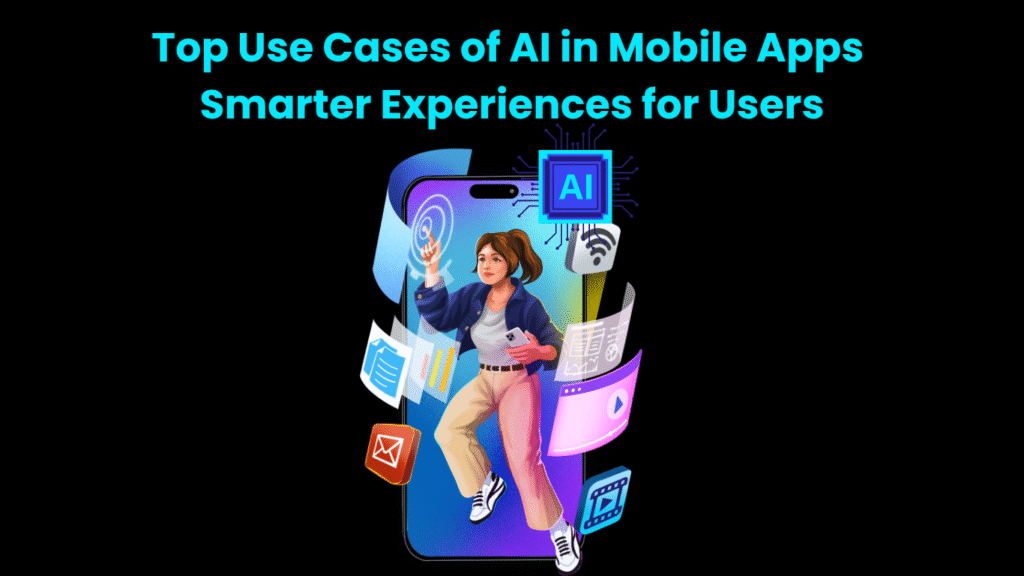
Top Use Cases of AI in Mobile Apps
AI in mobile apps is certainly ruling the market and is set to bring revolutionary changes to the way users access applications and how businesses are providing custom solutions on demand and efficiently. AI in mobile app development has made the apps smarter, brought in more users and their engagement, and also let the workflow be done in an automated, intelligent way. Even for those without deep technical expertise, AI mobile app builders are simplifying the creation process by allowing developers to integrate sophisticated features through intuitive interfaces. Here are 5 prime use cases showing the impact of AI on different application categories, which are predicted for 2025.
1. Virtual Assistants (Siri, Google Assistant, Alexa)
The most influential mobile app utility has become AI-assisted virtual assistants, which allow users to extract information and even control devices just by talking to them using natural language instructions. These assistants learn and adapt according to user habits to provide customised assistance as unobtrusively as possible.
Key Features:
- Operation using Voice Commands, really meant for that hands-free working.
- Integration in Smart Homes and Devices through which one can control their entire environment.
- Live Assistant for Calendars: Navigation & Reminders Information retrieval.
Limitations:
- Assisted nearby listening; inaccuracies, inconsistent accent
- Privacy issue while listening and collecting data
- Internet dependency, as these are cloud-based
Future Scope:
Of course, virtual assistants are evolving with developments in emotional intelligence, multi-modal interaction capabilities, and proactive capabilities that help deep-intelligent users within the ecosystem of applications and IoT devices.
2. AI Healthcare Apps
AI in healthcare apps is enhancing care for patients with symptom checkers, personalised health advice, and remote monitoring through data obtained from wearables. These apps assist in diagnosis, treatment planning, and chronic disease management.
Key Features:
- Symptom and self-diagnosis assessment
- Remote patient monitoring facilitated through connected devices
- Personalised health recommendations and reminders about appointments
Limitations:
- Risk of inaccurate prediction from AI, and consequently, a misdiagnosis
- Data privacy difficulties alongside adhering to compliance
- Limited accessibility in under-resourced settings with meagre connectivity
Future Scope:
The future of healthcare apps will depend heavily on the advanced AI capacity of early disease detection and digitally integrated therapeutic sources for increased outcome improvement through customised real-time care.
3. AI in E-Commerce Apps
In e-commerce apps, AI helps personalise product suggestions, fine-tune inventory, and ensure enhanced customer service provided by chatbots in return. AI robs shoppers of time and distracts them, but it helps raise conversion rates and increase operational efficiency.
Key Features:
- Real-time dynamic product recommendations tailored to each user
- Chat-based customer support and virtual shopping assistants
- Inventory management and dynamic pricing
Limitations:
- Recommendation algorithm biases
- Dependent on large data sets, possible latency or inaccuracy with data that is sparse
- Difficulty of adapting AI models to very fast changes in market conditions
Future Scope:
Integration of greater generative AI content creation and augmented reality shopping will be adopted in e-commerce apps to create immersive and highly responsive customer experiences.
4. AI in Finance and Banking Applications
AI adds value to mobile banking services in the form of personalised financial advisory, fraud detection in real time, and the processing of transactions automatically. Usually, financial applications implement AI chatbots to provide instant customer support and overcome the challenges of risk management and mitigation. Refining AI call prompt engineering ensures these interactions remain accurate while reducing the likelihood of hallucinations in complex banking queries.
Key Features:
- Artificial intelligence chatbots cater to round-the-clock customer care.
- They are for credit scoring and fraud detection.
- Thus leading to personalised financial insights and custom tracking of goals.
Limitations:
Security threats to data and vulnerability to a cyberattack.
Bias in predicting credit models tends to influence fairness in decision-making.
Compliance hurdles and regulatory costs.
Future Scope:
The future of financial applications will entail more explainable AI models set to build transparency and security of digital banking experiences through experimental integration with blockchain.
5. AI for Social Media Applications
AI assumes the responsibility of content moderation, customer support, and personalisation of the rank ordering of the feeds in the instance of a social media application. AI virtual agents provide brands with live communication support, and predictive analytics provide users with content relevance and engage the user.
Key Features:
- Automated content filtering and moderation
- AI Chatbots for 24/7 Social Media Engagement
- Personalised feed algorithms based on user behaviour
Limitations:
- Context is rarely understood as intended, which could trigger wrong moderation.
- Personalised content risks generating filter bubbles and echo chambers.
- There will be significant computing power loads that need to be addressed, along with privacy assurances.
Future Scope:
AI and social media would definitely evolve into innovative smart content creation methods and real-time sentiment analysis; better AI agents would be built to create a personalised experience of custom paid social engagement for brands and consumers.
AI in mobile applications is revolutionising the user experience across various industries by nurturing smarter, automated, personalised AI solutions.
This promise for an even richer future in mobile app development is augmented through the continuing maturity of artificial intelligence in mobile applications, with every custom mobile app development company exploring how AI can transform mobile applications into its service area and engagement with the users, all set for the year 2025 and beyond.
Read More: The Importance of Advertising Transparency
Final Words
AI mobile applications give organisations the ability to put intelligence and flexibility inside their solutions to offer customer satisfaction that is stable and, at the same time, even greater possibilities for future business growth. These are really the advanced AI technologies, and thus, with this, there is an increased demand in the market for clients to seek collaboration with an established mobile app development company so that they can put all these AI treasures to work and thus stay ahead in the digital market. AI mobile app development is equipped with the ability to not only create smarter apps but also offer long-term value and prospects for expansion in the market. It also helps gain a first-mover advantage over competitors.