Why does the creative industry still treat asset production as a marathon when the attention economy operates in sprints? For the indie maker or the prompt-first creator, the traditional workflow—sketching, drafting, long-form rendering, and multi-day feedback loops—is no longer a sign of quality; it is a bottleneck. In a market where a trend can peak and dissipate within 72 hours, the ability to generate, iterate, and ship assets in minutes is the only competitive advantage that scales.
The shift from “vanity” (the pursuit of the perfect, labor-intensive pixel) to “velocity” (the pursuit of the functional, high-speed output) is not about lowering standards. It is about reallocating human effort where it actually matters: strategy and selection. By leveraging tools like Nano Banana, creators are moving away from being manual laborers of the canvas and becoming directors of an automated pipeline.
The Fallacy of the Perfect First Draft
In traditional creative operations, the first draft is often a high-stakes delivery. It represents hours of sunk cost. Because so much time was spent creating it, there is a natural psychological resistance to discarding it, even if it does not meet the project’s goals. This leads to long, painful review cycles where stakeholders try to “fix” a flawed foundation
Generative tools invert this. With Nano Banana Pro, the cost of a “draft” drops to near zero. Instead of one precious asset, a creator can generate twenty variations in the time it takes to brew a cup of coffee. This changes the fundamental nature of the review cycle. You are no longer reviewing a single attempt; you are selecting from a range of possibilities. This is a shift from production to curation.
However, we must acknowledge a practical limitation here: the “firehose” of content. While velocity increases, the cognitive load of sorting through dozens of high-quality generations can actually slow a creator down if they do not have a clear set of selection criteria. More options do not always mean a better final product if the operator lacks the discipline to kill off mediocre iterations quickly.
Operationalizing Nano Banana Pro in the Wild
For the indie maker, the workflow usually starts with a rough concept that needs immediate visualization to test market fit. Using Banana Pro as the heavy-lifter for high-fidelity requirements and Nano Banana Pro for rapid-fire asset generation creates a tiered production system.
In a typical production sprint, a creator might use the Banana AI ecosystem to build out a social media campaign. The process begins with a core prompt in the image generator. Within seconds, you have a baseline. But the real velocity comes from the image-to-image capabilities. Instead of re-typing complex prompts, you feed the initial success back into the system to branch out into different styles, aspect ratios, or color palettes.
Speed as a Competitive Moat
Velocity is not just about doing things faster; it is about doing things that were previously impossible due to time constraints. Consider a performance marketer running A/B tests on ad creatives. Traditionally, testing ten different background environments for a product would require ten different photoshoots or several hours of Photoshop masking.
With an integrated AI Image Editor, those ten variations happen in a single sitting. You can swap environments, adjust lighting, or change the “mood” of an asset without leaving the workspace. This reduces the friction between an idea (“What if this looked like it was shot in a neon-lit alley?”) and the execution. When the cost of experimentation is low, the volume of innovation increases.
The Efficiency of the Banana Pro Ecosystem
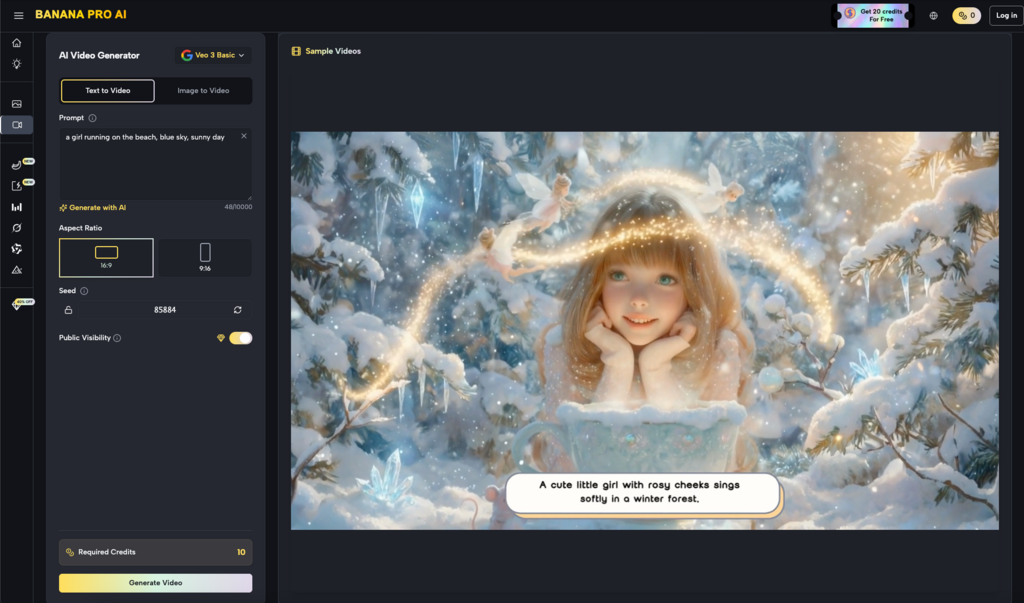
While many tools offer isolated generation features, the actual bottleneck in production is often the movement of data between tools. This is where the Banana Pro environment streamlines the “middle” of the creative process. If you have to download an image from one site, upscale it on another, and then move it to a third for video generation, your velocity gains are eaten by administrative overhead.
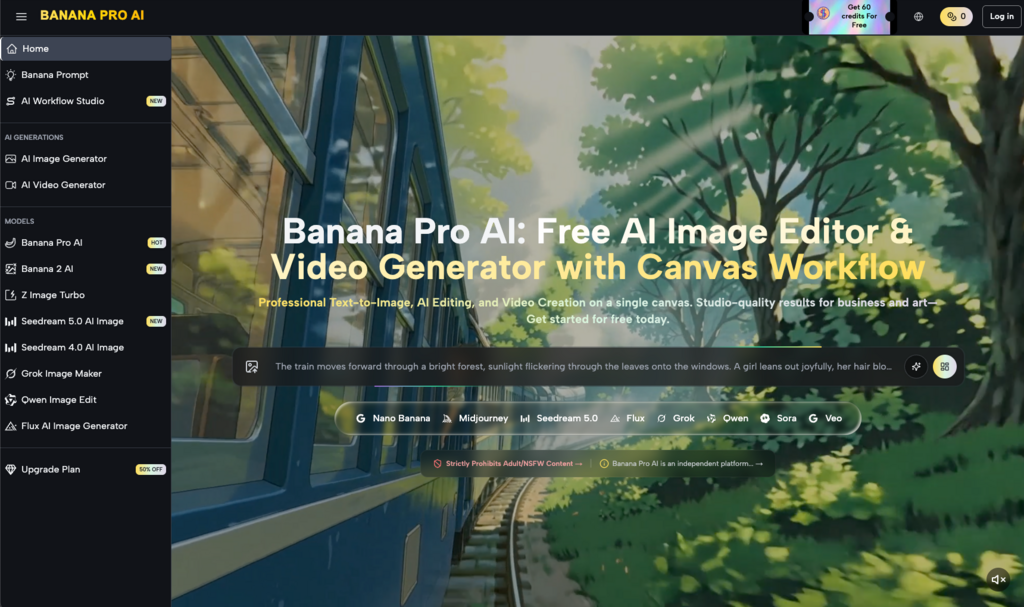
The goal is a closed loop. You generate the static asset, refine it using the AI Image Editor, and then immediately push that refined image into a video generator to create a motion asset. This “Canvas Workflow” approach treats the image not as a final destination, but as a stepping stone for more complex media.
Navigating the Limits of Generative Speed
It is important to reset expectations regarding the “magic” of these tools. A common frustration among operators is the lack of granular control over specific anatomical details or text rendering in complex scenes. Even with a high-performance tool like Nano Banana, the AI can sometimes struggle with spatial logic or specific brand guidelines that require 100% adherence to a logo’s geometry.
This is the second moment of uncertainty for the creator: the “uncanny valley” of AI production. There are times when the AI simply won’t “get” a prompt, no matter how many times you iterate. In these instances, trying to force the AI through sheer volume of prompts is a waste of time. The experienced operator knows when to stop generating and jump into a manual editor to fix a stray pixel or a warped edge. True velocity comes from knowing when to stop relying on the machine.
Refining the Workflow: Beyond the Initial Prompt
The most successful creators in this space are those who treat the initial generation as only 70% of the work. The final 30%—the delivery phase—is where the human touch ensures the asset doesn’t look “generic AI.”
- The Seed Approach: Use an initial successful image as a reference for all subsequent generations to maintain a cohesive look.
- The Iterative Mask: Using the AI Image Editor to selectively change parts of an image (inpainting) rather than re-generating the whole thing. This preserves the parts that work while fixing the parts that don’t.
- The Multi-Modal Pipeline: Taking a static image and using it as a “base” for video. This ensures that the video output has the same aesthetic DNA as the still images, which is vital for brand consistency.
The Consistency Problem
One of the largest hurdles in high-velocity production is character or style consistency across different assets. If you are creating a series of images for a brand story, having the protagonist look slightly different in every frame destroys the immersion. While Nano Banana offers significant improvements in maintaining visual logic, achieving “perfect” frame-to-frame consistency still requires a significant amount of manual oversight and technical prompt engineering.
We are not yet at the point where you can press a single button and get a 30-page perfectly consistent graphic novel. The technology is moving toward that, but today’s operator must be prepared to use “image-to-image” as a tether to keep the AI from drifting too far from the established style.
The Economic Reality of Asset Turnaround
At the end of the day, creative operations are governed by economics. If a creator can produce a high-quality video ad in one hour instead of ten, their margin increases exponentially. This is especially true for freelancers and boutique agencies who are often capped by their own billable hours.
By moving to a workflow centered around Banana Pro, the “unit cost” of content drops. This allows for a higher volume of content, which is necessary in an era where algorithms demand constant fresh input. The ability to pivot a campaign’s visual direction in an afternoon, rather than a week, is what defines a modern creative lead.
Read More: How Email List Cleaning Improves Campaign Performance
The Shift from Creator to Director
We are witnessing a fundamental change in the identity of the digital artist. The “creator” of the past was defined by their ability to manipulate a brush or a Bezier curve. The creator of the future is a director who understands how to orchestrate various AI models to achieve a specific vision.
The tools within the Banana AI suite are designed for this new persona. They reward those who think in terms of systems and workflows rather than individual masterpieces. When you prioritize velocity over vanity, you aren’t just making things faster; you are making things smarter. You are building a repeatable engine for visual communication that doesn’t burn out or hit a creative wall.
In this landscape, the winner isn’t the person with the most expensive software or the most years of training in traditional illustration. The winner is the operator who can navigate the interface of a tool like Nano Banana Pro to bridge the gap between a concept and a finished, high-performing asset in the shortest time possible. Speed is the new quality, and in the world of generative media, those who can’t keep up will find themselves holding a very polished, very late piece of work that no one is looking at anymore.