
The barrier between a lyrical concept and a broadcast-ready song has historically been guarded by the high costs of studio time and the technical complexity of sound engineering. Independent creators often find their projects stalled by the inability to find a vocalist who matches their vision or a composer who understands their unique genre requirements. This creative friction is now being dismantled by the integration of a professional AI Music Generator, which serves as an all-in-one production suite for those who prioritize narrative control over manual technical labor.
By shifting the production burden to intelligent algorithms, the focus of the creative process returns to where it belongs: the original idea. Whether you are a solo developer needing an immersive soundtrack or a writer wanting to hear your poetry set to a professional melody, the ability to generate high-fidelity audio on demand is a paradigm shift. It transforms the solitary act of writing into a collaborative experience with a digital ensemble, ensuring that professional sound is no longer a luxury but a standard resource.
The Evolution Of Narrative Driven Sound Design And Synthesis
Modern audio technology has moved beyond mere pattern replication, now offering a nuanced understanding of how different musical elements interact to support a story.
Interpreting Artistic Intent Through Advanced Modeling
In my observations, the true strength of current synthesis engines lies in their ability to maintain structural integrity across longer compositions. Unlike earlier tools that struggled with repetitive or disjointed sequences, the latest models can manage complex transitions and dynamic shifts. This ensures that the generated tracks feel like a cohesive journey rather than a loop, making them suitable for high-stakes projects like film scoring or brand identity development.
Translating Language Into Harmony Via Text to Music AI
The most significant breakthrough for lyricists is the Text to Music AI feature, which bridges the gap between written text and vocal performance. By analyzing the rhythm and emotional cues within the provided prose, the system crafts a melodic structure that complements the lyrics’ natural flow. In my testing, I have found that providing the system with clear emotional descriptors—such as “uplifting,” “gritty,” or “ethereal”—results in a much more accurate alignment between the vocal delivery and the backing track.
Operational Efficiency And Creative Freedom In Professional Media
Strategic adoption of intelligent audio tools allows creators to scale their output without compromising the uniqueness of their brand’s sonic footprint.
Production Workflow Comparison And Capability Matrix
Evaluating the differences between traditional asset sourcing and intelligent generation reveals a clear advantage in both flexibility and creative ownership.
| Capability | Static Stock Libraries | ToMusic Generative System |
| Customization Depth | Limited to volume and fading | Full control over genre and mood |
| Vocal Performance | Pre-recorded and non-editable | Generated based on custom lyrics |
| Soundtrack Duration | Fixed by the original file | Adjustable up to 8 minutes |
| Technical Post-Production | Minimal (EQ and Compression) | Extractable stems for deep mixing |
| Creative Exclusivity | Shared with other license holders | Unique tracks generated per user |
Balancing Human Oversight With Algorithmic Output
It is vital for professionals to view these tools as a high-level assistant rather than a fully autonomous replacement for human taste. While the stability and realism of the output are impressive, the best results often come from an iterative process where the creator refines their prompts based on the initial generation. Acknowledging that the AI might require a few attempts to capture a very specific vocal nuance ensures that the final product remains a high-quality reflection of the user’s standards.
A Practical Roadmap To Professional Song Construction
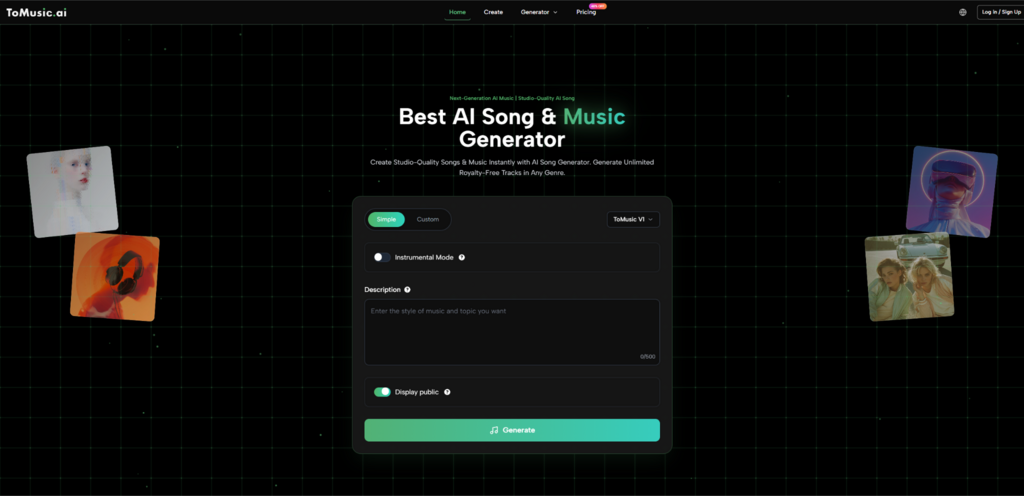
The platform’s interface is designed to facilitate a rapid transition from a conceptual draft to a finished audio asset through a simplified three-step protocol.
Step One Defining The Core Sonic Parameters
The journey begins with the user providing the raw input—this could be a full set of lyrics or a descriptive summary of the desired atmosphere. By selecting the appropriate mode, you instruct the AI on whether to prioritize vocal synthesis or focus on building a rich instrumental landscape that captures a specific emotional frequency.
Step Two Selecting The High Fidelity Engine
Users can choose between different model versions (V1–V4) to match the technical requirements of their project. Advanced models provide deeper arrangements and are better suited for tracks that require professional-grade clarity and complex layering. At this stage, you also define technical specifications such as the inclusion of a “Radio Edit” style or a pure instrumental version.
Step Three Final Generation And Stem Extraction
Once the synthesis is complete, the platform offers more than just a simple download. Professionals can utilize the “Extract Stems” feature to separate the vocals from the background instruments. This allows for specialized post-production, enabling the generated audio to be integrated seamlessly into larger video projects or professional mixing environments.
Redefining The Economic Landscape Of Digital Music Production
The democratization of professional audio production is empowering a more diverse range of voices to enter the market. When the technical barriers are lowered, the diversity of stories that can be told through music increases exponentially.
Future Outlook For Generative Audio Ecosystems
The trajectory of this technology suggests a future where audio is increasingly interactive and responsive to the needs of the creator. We are moving toward a world where the distinction between “writing a song” and “generating a song” becomes blurred, as the AI handles the mechanical execution while the human maintains the creative vision. This ongoing evolution ensures that high-quality, personalized music remains accessible to everyone, regardless of their technical background.
Read More: Best Tools for Gym Marketing Automation in 2026
Closing The Gap Between Conceptualization And Performance
Ultimately, the goal of a professional synthesis platform is to ensure that no creative idea is lost to silence. By providing a reliable and sophisticated bridge between a concept and a finished WAV file, we are entering an era where the quality of an idea is the only limiting factor. This accessibility ensures that every creator has the tools to build their own professional sonic world, one track at a time.


