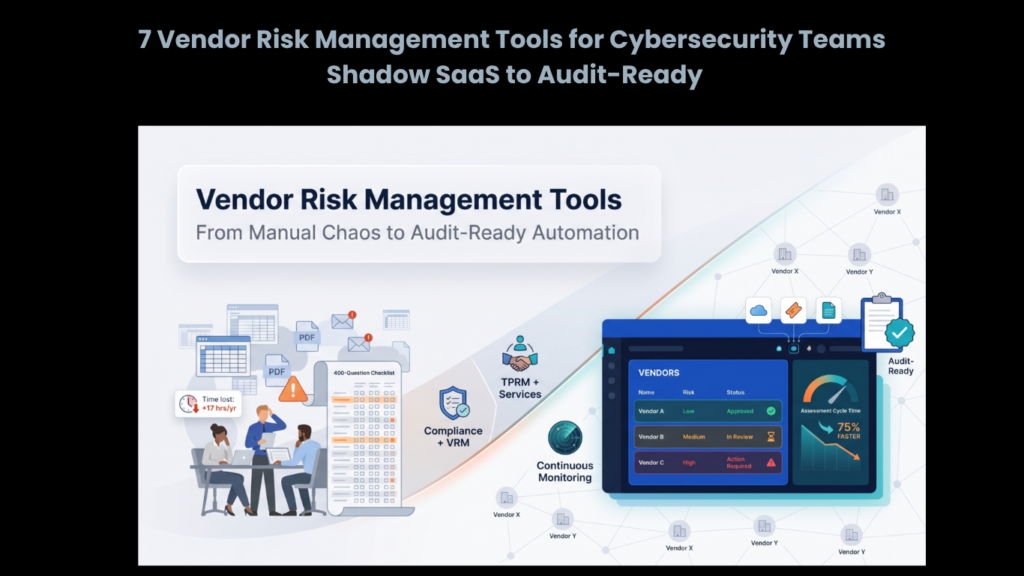
Third-party breaches are now a board-level issue. Verizon’s 2025 Data Breach Investigations Report found that 30 percent of incidents involve a supplier, a 100 percent jump year over year (SecurityScorecard analysis). Yet many security teams still juggle spreadsheets and 400-question surveys, which slows onboarding and lets risk linger.
Workflow automation changes the math. According to BitSight, automated assessments run 75 percent faster, which frees your team to focus on true outliers instead of chasing routine evidence.
This guide spotlights seven solutions across three segments—compliance automation, service-heavy TPRM, and continuous monitoring. The goal is simple: help you move from manual vendor reviews to audit-ready confidence. Ready? Let’s get started.
How we picked the seven
Before naming names, here is the practical sorting process we used.
We started with more than twenty vendor risk contenders pulled from analyst reports, top-of-SERP roundups, and practitioner threads. From there, we scored each tool against eight criteria that show up in day-to-day vendor risk work:
- Shadow-IT discovery
- Risk-scoring rigor
- Questionnaire automation
- Continuous monitoring
- Compliance mapping
- Integration depth
- Pricing value
- User experience and differentiators
We weighted automation and monitoring more than the rest because AI-driven workflows can cut assessment cycles by up to 75 percent, a benefit noted by both Gartner and Forrester.
That scoring made one thing obvious: these tools do not all solve the same problem in the same way. Some unify compliance and vendor risk, some pair TPRM software with managed services, and others focus on external, outside-in monitoring.
Rather than force a single one-through-seven ranking across different categories, we grouped the list into three segments:
- Compliance plus VRM automation
- Dedicated TPRM platforms with services
- Continuous external monitoring
Within each segment, tools are listed alphabetically to keep the focus on fit.
| Tool | Best For | Stand-out Edge |
| Vanta | Fast-moving teams joining compliance and VRM | Unified trust platform, rapid setup |
| OneTrust | Enterprises needing full GRC stack | Massive template library and Vendorpedia |
| Prevalent | Firms wanting turnkey program and services | Exchange of pre-assessed vendors |
| ProcessUnity | Mature programs seeking deep workflow control | No-code customization and CyberGRX data |
| Venminder | Regulated orgs that value hands-on help | Unlimited users and analyst add-ons |
| BitSight | Portfolios that crave quantitative risk scores | Industry-standard daily ratings |
| UpGuard | Lean teams wanting two-in-one ratings and DDQs | Leaked-credential and data-leak alerts |
Use the segments and table as your shortcut. Next, we break down each tool so you can match the platform to your vendor risk bottlenecks.
Segment 1 – compliance + VRM automation
These platforms work best when vendor risk is not a standalone program. If you are already managing audits, controls, and evidence, they let you run third-party reviews in the same system, with the same workflows and reporting.
Vanta: agentic TPRM that connects vendor risk to your compliance program
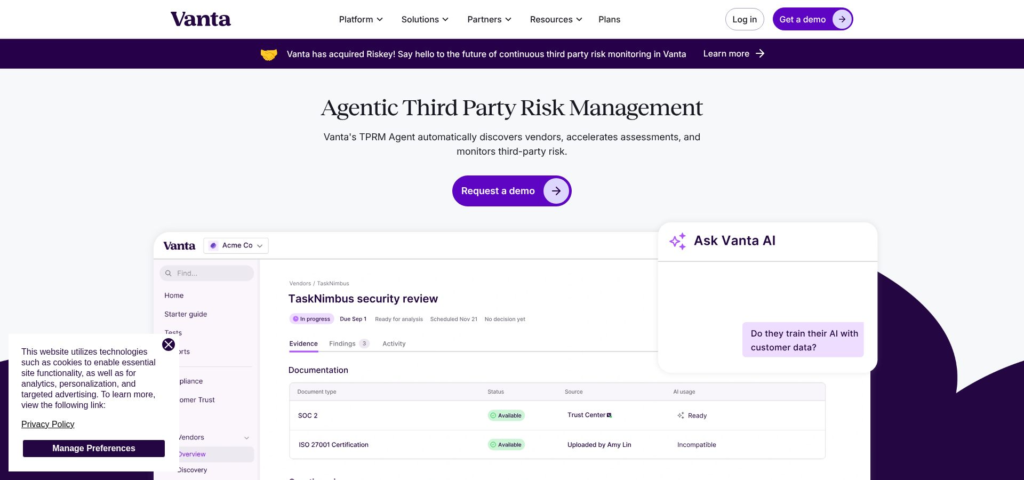
Vanta positions its third-party risk management (TPRM) module as a way to cut assessment time by 50 percent by running the full lifecycle in one place, from discovery to evidence collection to remediation. Vanta’s agentic TPRM platform ties that lifecycle directly into your compliance program, so vendor findings live in the same system as your control evidence. The core advantage is consolidation. Vendor findings do not live in a separate portal or spreadsheet. They feed into the same risk and compliance program you use for SOC 2, ISO 27001, HIPAA, and more.
Discovery, questionnaires, and the Vanta Exchange
Vanta can surface shadow SaaS and unauthorized tools through identity provider integrations like Okta, Azure AD, and Google Workspace, which helps you find vendors that never went through intake in the first place.
For formal assessments, Vanta supports customizable vendor questionnaires with conditional logic, and vendors can complete requests and share evidence through the Vanta Exchange collaboration portal. Importantly, there is no per-questionnaire cap for VRM vendor questionnaires within your vendor bucket. The questionnaire limits referenced in the earlier draft apply to Questionnaire Automation (QAuto), which is Vanta’s separate feature for answering inbound questionnaires from your customers.
To reduce back-and-forth, Vanta can also pull documentation from 6,000+ public Trust Centers, and its AI can auto-answer roughly 90 to 100 percent of questionnaire questions using available evidence.
Continuous monitoring that stays tied to remediation
Monitoring is not just a score change. Vanta’s alerts can trigger follow-ups, evidence re-requests, and remediation tasks, and the TPRM Agent can draft tailored remediation plans when new issues appear. That design supports “continuous confidence” instead of annual, point-in-time reviews.
Risk scoring, mapping, and audit readiness
Vanta supports a fully customizable inherent risk rubric and residual risk scoring after the assessment. Findings map into a unified risk register, and the platform supports 35+ frameworks, so vendor risk evidence can align to the same compliance narrative auditors and customers expect.
Integrations and reporting
Vanta brings a broad integration ecosystem, 375+ pre-built integrations and 1,200+ automated tests, plus workflows into tools like Jira and ServiceNow. Dashboards and exportable reports are designed for audit and executive consumption, with real-time visibility into vendor status, open issues, and risk trends.
Pricing and implementation realities
VRM/TPRM is always an add-on. Pricing is typically sold in vendor buckets, around $7,500 per year for up to 25 vendors and $10,200 to $13,000 per year for up to 50 vendors. Adding continuous monitoring roughly doubles the price. Implementation is designed to be fast, and IDC research cites 526 percent three-year ROI, a three-month payback, and 54 percent productivity gains.
Limitations to know before you buy
Vanta is not a pure security ratings vendor. It does not provide a FICO-style proprietary score like BitSight or UpGuard. It also does not currently support weighted scoring for individual assessment questions, and vendor hierarchies (parent-child) are planned but not yet available. If you need BI tool integrations for custom reporting, that is also a gap today.
Bottom line: Vanta is a strong fit when you want vendor risk to roll up into the same compliance and risk program your team already runs, with modern automation and native outside-in monitoring that reduces manual review work.
OneTrust: enterprise GRC breadth, plus vendor risk and due diligence
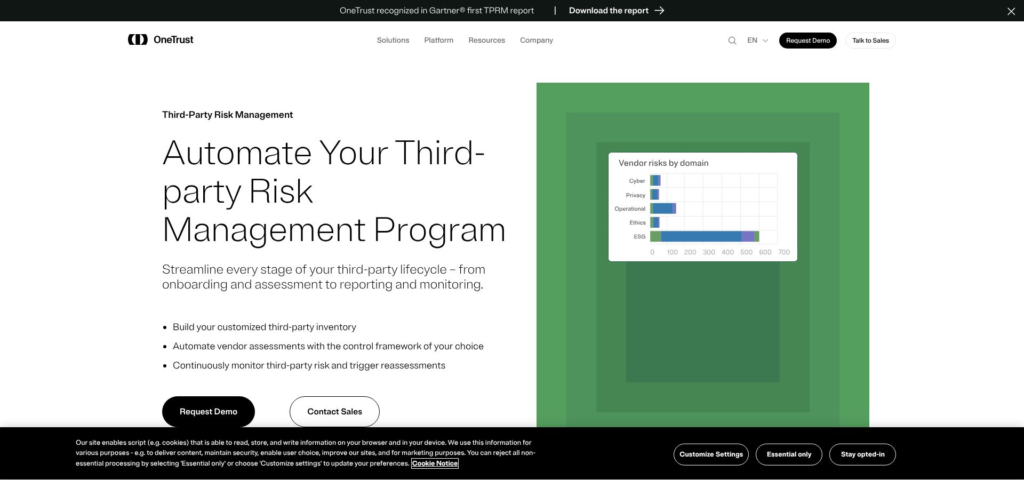
OneTrust is strong on the inside-out side of vendor risk. It supports configurable intake, tiering, and questionnaire-based assessments across multiple risk domains. The key accelerant is Vendorpedia, also referred to as the Third-Party Risk Exchange, which includes 6,000+ pre-populated vendor profiles. If a supplier already has a profile with relevant context, like company details and prior risk signals, you can start from that baseline instead of rebuilding every record from scratch. OneTrust also supports vendor hierarchy relationships, which matters when you need parent-child roll-ups for complex vendor ecosystems.
Continuous monitoring, with an important caveat
OneTrust can support continuous monitoring workflows, but it does not provide native outside-in monitoring out of the box. Instead, monitoring is typically delivered through paid partner integrations such as SecurityScorecard, BitSight, RiskRecon (Mastercard), and ISS Corporate Solutions. That model can work well if you already standardize on one of those ratings providers, but it is a real consideration for cost, implementation scope, and day-to-day ownership.
Due diligence beyond cybersecurity
OneTrust has a differentiator that many security-first platforms do not cover: third-party due diligence for sanctions and reputational screening. Its Third-Party Due Diligence module supports checks like sanctions lists, adverse media, and PEP screening aligned to requirements such as the FCPA and UK Bribery Act. If your vendor program needs ethics and sanctions oversight, not just security controls, this is a meaningful advantage.
AI and automation
OneTrust introduced its Third Party Risk Agent in late 2025 to help pre-populate fields and accelerate assessments using exchange data and prior assessments. It can reduce manual effort, but expectations should be realistic. The agent is not positioned as a fully agentic, end-to-end assessment runner, and it does not automatically generate follow-up questionnaires as part of the workflow.
Reporting and executive readiness
OneTrust is built for governance-heavy environments. Reporting is a core strength, with customizable dashboards and audit-ready exports. Power BI support also helps when executives want consolidated reporting across multiple risk programs.
Pricing and implementation expectations
This is enterprise software with enterprise pricing. For TPRM alone, pricing is typically quote-based, roughly $40K to $500K depending on vendor count, users, and modules. Implementation is also heavier than lighter-weight tools. Gartner cautions that OneTrust has a limited number of employees dedicated to TPRM implementation and relies heavily on partners, and product complexity can be amplified by tech debt from its acquisition history.
Bottom line: OneTrust is a strong fit for large organizations that want vendor risk inside a broader trust and GRC ecosystem, especially when privacy, AI governance, and sanctions-style due diligence are in scope. If you need native, out-of-the-box continuous monitoring, plan for partner integrations as part of the design.
Segment 2 – dedicated TPRM platforms with services
Some teams do not need another “all-in-one” platform. They need a vendor risk engine that is built for intake, assessments, remediation tracking, and re-assessments, plus real support running the program. The tools in this segment are a fit when bandwidth is the constraint and you want help executing, not just software.
Prevalent: a services-led TPRM program you can operationalize fast
Prevalent runs on a three-pillar model: the software platform for workflow and assessments, third-party intelligence networks to reuse existing vendor information, and managed services where analysts can run the lifecycle on your behalf. This structure is designed for organizations that want a turnkey operating model, not just a portal.
Questionnaires and evidence collection
The platform remains questionnaire-centric, but it has depth. Prevalent offers 800+ pre-built assessment templates spanning common standards and frameworks, and supports custom questionnaires. Vendors work through a portal with built-in communication, and your team can scope assessment depth based on inherent risk tiering.
Continuous monitoring (what it is and what it is not)
Prevalent monitors vendors across multiple risk domains, including cyber and data signals (breach feeds, credential dumps, dark web), reputational signals (adverse media), financial indicators, operational disruptions, and regulatory events. The key nuance is the mechanism: this is largely passive threat event monitoring, meaning it aggregates third-party feeds and intelligence sources, rather than actively scanning vendor attack surfaces with proprietary probing.
Vendor intelligence network
Prevalent’s Global Vendor Intelligence network is a practical accelerator. Vendors can complete standardized assessments once and share them, which can cut the initial back-and-forth when a supplier already has completed artifacts on file. The network size is not publicly disclosed, but the value is in skipping repetitive first-round diligence when coverage exists.
Risk scoring and workflows
Prevalent supports inherent and residual risk scoring with workflow triggers for reassessment and mitigation tasks when monitoring signals change. This is where the services layer can matter—analysts can help keep reviews, document requests, and remediation follow-ups moving without stalling your internal queue.
Automation and AI
Prevalent includes Automated Document Analysis (ADA) that uses NLP/ML to check uploaded evidence against criteria, plus AI capabilities like auto-populating from prior information and an “Alfred” navigation assistant. Compared to more agentic platforms, its AI is more assistive than autonomous; you should still expect a program that depends on vendors completing questionnaires and humans reviewing outcomes.
Framework mapping and compliance automation
Prevalent is TPRM-only. It can map vendor risk work to common standards, but it does not automate your internal compliance program for SOC 2, ISO 27001, HIPAA, and similar frameworks. If you need both third-party risk management and compliance automation, plan on a separate tool for compliance.
Integrations, reporting, and board readiness
Prevalent integrates with adjacent systems that show up in TPRM programs, including CLM and risk rating providers. Reporting covers dashboards and executive-style views, but reviewers often flag that reporting can be inflexible, which can push teams back into Excel for custom views.
Pricing and implementation
Prevalent does not publish pricing, and managed services increase total cost because you are paying for analyst time alongside the platform. Implementation can be eased by those services, but users also describe onboarding as complex, with a dated UI/UX.
Bottom line: Prevalent is a strong fit when you want a software-plus-services operating model and you value a vendor intelligence network to reduce repetitive diligence. If your priority is modern, agentic automation or consolidated GRC and compliance automation in the same platform, its TPRM-only scope and more limited AI are important constraints to weigh.
ProcessUnity: deep workflow control, plus one of the largest third-party risk exchanges
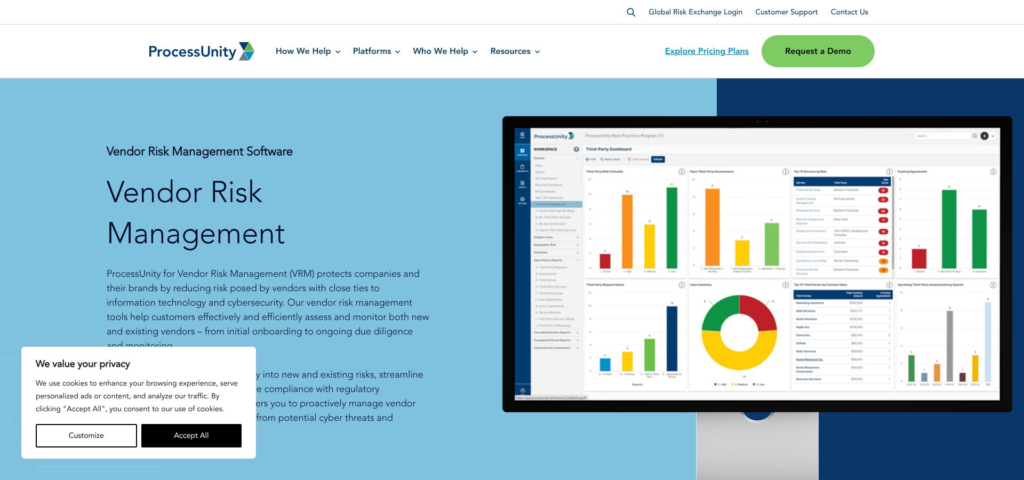
ProcessUnity’s core strength is configurability without custom development. You can design intake forms, assessment paths, routing rules, escalation logic, and SLA timers with a no-code builder. If your program requires marketing sign-off before a SaaS vendor touching customer data goes live, you can enforce that step. If finance needs SOC 1 reports routed for SOX scope, you can build that routing into the workflow.
This matters most in mature environments where vendor risk is cross-functional and process deviations become audit findings.
Questionnaires, plus AI that reduces manual review
ProcessUnity supports SIG questionnaires and custom frameworks. On top of traditional questionnaire workflows, it offers AI capabilities aimed at reducing time spent reading documents line by line:
- Assessment Autofill: AI pre-populates assessments by analyzing vendor documentation such as SOC 2 reports and certifications.
- Evidence Evaluator: GenAI reviews and validates vendor evidence and helps score answers.
The practical outcome is not “fewer questions,” it is fewer repetitive cycles of manual extraction and re-keying.
Vendor intelligence network: GRX scale is the differentiator
Post-merger with CyberGRX, ProcessUnity’s GRX is the centerpiece. It includes 18,000+ control attestations, 370,000+ vendor profiles, and 80 percent Fortune 1000 coverage. It is controls-based intelligence, not just outside-in scanning, and it is designed to help teams start with existing data so they can scope assessments appropriately before sending a long questionnaire.
Risk scoring and continuous monitoring
ProcessUnity’s Risk Index is a 100-point actionable rating that combines inside-out and outside-in intelligence. Monitoring and response workflows can then focus on meaningful changes, not noise. It also launched Threat and Vulnerability Response in August 2024 to help identify and assess critical vulnerabilities across third-party ecosystems.
Reporting and board readiness
ProcessUnity positions reporting as a first-class feature, including configurable dashboards and executive-ready views aimed at reducing the time burden of third-party risk reporting. For governance-heavy organizations, this is often as important as the assessment workflow itself.
Pricing and implementation expectations
Pricing is enterprise and modular. One deal data point (Capital Health, September 2025) puts the TPRM Platform at $25K per year, GRX at $25K per year, a $37K per year bundle, plus $14.7K for configuration. Implementation typically requires real planning and configuration. Gartner guidance across the space cautions that TPRM implementations often take three to six months minimum, and “rapid implementation” claims do not always match reality.
Key limitations to plan around
ProcessUnity is TPRM-only; it does not provide compliance automation for SOC 2, ISO 27001, HIPAA, and similar internal audit programs. It also does not offer a Trust Center, and it is not designed for automated vendor discovery or shadow IT detection. Finally, the same flexibility that makes it powerful can add configuration complexity and professional services cost, especially if you want deep customization across many business units.
Bottom line: ProcessUnity is a strong fit for mature, enterprise TPRM teams that need a no-code workflow engine and want to leverage GRX scale to move toward a “data-first, questionnaire-second” model. If you need compliance automation in the same platform, you will need to pair it with a dedicated GRC or compliance tool.
Venminder: documentation-first TPRM for regulated teams
Venminder combines a TPRM platform with a heavy services layer. Its Vendiligence offering provides outsourced assessments performed by credentialed experts, and the scale is meaningful—roughly 30,000 risk-rated assessments annually. The practical trade-off is clear: you are buying human review capacity, not just automation.
Questionnaires and evidence collection (with real-world friction to watch for)
Venminder offers a set of pre-built questionnaires (including SIG Core and SIG Lite options) and supports custom questionnaires and scoring. Teams often like the breadth of templates, but the workflow is still reported as manual in practice. Some customers also report questionnaires can be glitchy, including situations where a questionnaire shows 100 percent complete but the vendor cannot submit it, and admins cannot verify the response set.
Continuous monitoring: available, but typically not included
Venminder does offer Ven-monitor™ as a continuous monitoring add-on across areas like cybersecurity and business health. The key nuance is packaging: this monitoring appears to be an additional purchase, not part of the base platform. Multiple customers also cite monitoring between annual reviews as a pain point, so buyers should confirm what is included in their tier and what requires add-ons.
Vendor intelligence network: Venminder Exchange
The Venminder Exchange is a marketplace of pre-completed assessments performed by certified experts. You can preview and purchase completed assessments rather than starting every diligence cycle from scratch. It is best thought of as an expert-reviewed document library and assessment marketplace, not an outside-in scanning network.
Risk scoring and tiering
Venminder supports inherent and residual risk documentation and scoring, and users often praise its flexibility in choosing which risk areas to assess. For regulated teams, that matters because you can align scoring and documentation to examiner expectations and maintain an audit trail of how each conclusion was reached.
Automation and AI
Venminder is not positioned as an AI-forward platform. The model leans toward expert analysis and manual workflows, which can be the right choice for examiner-facing diligence, but it does not deliver the same automation profile as agentic assessment tools.
Framework fit and compliance scope
Venminder is TPRM-only. It supports regulatory-aligned oversight expectations in financial services contexts, but it does not automate internal compliance programs for frameworks like SOC 2, ISO 27001, HITRUST, or PCI DSS. If you need both compliance automation and TPRM in one platform, you will need a separate system.
Integrations, reporting, and board readiness
Venminder’s value is centralized documentation and examination-ready reporting. That said, integrations are limited compared to broader compliance platforms, and some prospects cite weak dashboards and reporting effectiveness. The unlimited internal user model is still a practical advantage for regulated organizations that need legal, IT, finance, and compliance all working in the same vendor record.
Pricing and implementation
Pricing is enterprise and not lightweight. Enterprise starts around $125,000 per year (via AWS Marketplace), and Vendiligence assessments are purchased separately, either à la carte or via spend buckets. Implementation is generally framed as manageable, often 30 to 90 days, but the real cost driver is how much expert review and add-on monitoring you want to layer in.
Bottom line: Venminder is a strong fit for banks, credit unions, and other regulated organizations that value expert-reviewed diligence and airtight documentation more than AI-driven automation. If your priority is modern workflow automation, broad integrations, and built-in continuous monitoring without add-ons, you will want to validate fit carefully.
Segment 3 – continuous external monitoring
This segment is for teams that want an always-on pulse check, even when vendors are slow to respond. External monitoring cannot replace inside-the-firewall controls evidence, but it is a strong way to catch exposure drift between annual reviews and to pressure-test a vendor’s “we take security seriously” claims with independent signals.
BitSight: the board-friendly security rating, with massive coverage
BitSight rates organizations without requiring vendor participation. That design is why it scales. It monitors 40M+ entities and tracks 540B+ cyber events in its data lake, so you can usually pull a view on a vendor immediately instead of waiting for them to fill out a form.
Risk scoring and what the number means
BitSight’s score runs from 250 to 900 (with a current achievable range of 300 to 820). Higher scores indicate stronger observable security posture based on BitSight’s proprietary algorithms. Boards like it because it is one KPI that can be trended over time and benchmarked across a portfolio.
The trade-off is explainability. Score changes can feel like a black box. Some customers describe having to launch a full investigation when a vendor’s score fluctuates, with limited clarity on the root cause.
Continuous monitoring: the core value
BitSight continuously evaluates public-facing security posture using a broad set of signals across categories like compromised systems, patching and configuration hygiene, risky user behavior, and public disclosures. It also supports benchmarking so you can show how a vendor compares to peers, which makes renewal and exception conversations easier to anchor in data.
A practical caution is noise. BitSight relies on a large volume of third-party data sources, and customers commonly report false positives and signal overload. In a lean program, that can turn “continuous monitoring” into continuous triage.
Questionnaires and workflows: available, but not the center of gravity
BitSight offers questionnaire capabilities, but they are typically secondary. Most buyers use BitSight alongside a dedicated TPRM or GRC platform for intake, evidence collection, and risk acceptance workflows.
Integrations and reporting
BitSight commonly integrates with major GRC and TPRM platforms, which is how teams operationalize alerts and feed ratings into existing oversight processes. Reporting is a strength for executive audiences because it converts technical findings into a standardized score and portfolio views. The product is also positioned as a leader in its category, including a Forrester Wave Leader (Q2 2026) placement for cybersecurity risk rating platforms.
Pricing and implementation
Pricing is enterprise and typically scales with the number of companies monitored. Vendr data (February 2026, 42 deals) reports an average contract value of $23,639 per year (range $5,206 to $58,821). Implementation fees are commonly $5K to $25K+ for larger rollouts.
Key limitations to keep in mind
BitSight is outside-in by design. It cannot see internal controls behind authentication, so it will not catch issues like weak MFA configuration that is not externally visible. It is also context-blind in the sense that a single score does not inherently reflect how critical a vendor is to your business.
Bottom line: BitSight is a strong fit when you need a widely recognized, board-friendly rating and daily external visibility across a large vendor set. Plan to pair it with a workflow-oriented TPRM platform if you need structured questionnaires, evidence review, and audit-ready documentation in the same system.
UpGuard: CRPM-style vendor monitoring, plus questionnaires in the same workflow
UpGuard pairs proprietary outside-in scanning with questionnaire-based assessments. In practice, you can run a quick review using automated scans only, or a fuller assessment that layers in questionnaires, evidence collection, and AI parsing of publicly available security and privacy information.
Questionnaires and the Trust Exchange portal
UpGuard includes a library of pre-built questionnaires (including SIG templates) plus a custom questionnaire builder and AI autofill. Vendors complete requests through the Trust Exchange portal. One operational constraint to be aware of is sharing cadence: UpGuard’s Vendor Security Profile sharing is time-bound—vendors can only access shared profiles for a limited 14-day window, which can be tight if remediation takes longer.
UpGuard also offers managed services, which can help if your team wants to outsource parts of the assessment workflow.
Continuous monitoring and breach signals
Monitoring is where UpGuard stands out. It scans vendors for issues like exposed services, TLS and encryption posture, misconfigurations that can lead to data leakage, DNS and email authentication weaknesses, and identity exposure. Add-on modules expand this, including Breach Risk capabilities such as typosquatting monitoring, identity breaches, and data leak detection.
Risk scoring and portfolio views
UpGuard provides a proprietary security rating that updates multiple times per day. That frequent refresh can be useful for catching material changes quickly, and it supports practical portfolio management concepts like tiers, labels, and segmentation for large vendor sets.
Framework mapping and compliance scope
UpGuard can support compliance-style reporting, but it is limited. Framework coverage for compliance reporting is restricted to ISO 27001 and NIST CSF. More importantly, UpGuard does not offer a GRC or compliance automation module, so it will not run your SOC 2, ISO 27001, HIPAA, or similar internal compliance program.
Integrations, reporting, and operational fit
UpGuard offers about 100+ integrations plus API access. That is often sufficient for security and ticketing workflows, but it is a smaller ecosystem than full trust management platforms. Reporting is built around executive-friendly security rating summaries, portfolio breakdowns, comparisons, and remediation tracking. Some buyers also flag customer support responsiveness as a concern, particularly when issues need fast turnaround.
Pricing and how costs scale
UpGuard publishes pricing, which helps during evaluation, but buyers should model add-ons and overages. As of May 2026:
- Standard: $1,750 per month (about $21K per year) for 50 vendors and six admin users
- Extra vendors: $79 per month each (Standard tier)
- Breach Risk add-on: starts at $250 per month
- Trust Exchange Paid: starts at $600 per month
That structure can scale quickly if your vendor list grows or if you add multiple modules.
Key limitations to keep in mind
UpGuard is a point solution, not a full GRC stack. If you need broad framework mapping, audit evidence workflows across 35+ frameworks, or compliance automation, you will need another platform. It also does not offer a pre-completed assessment exchange at the scale of dedicated networks like ProcessUnity GRX or OneTrust Vendorpedia, so vendor response and evidence collection can still be a bottleneck.
Bottom line: UpGuard is a strong fit for lean teams that want continuous outside-in vendor monitoring plus a practical questionnaire workflow in one place. It is less suitable when your primary goal is compliance automation and deep framework mapping, because its compliance reporting is limited and it is not designed to run a full GRC program.
Scrut: AI-powered vendor risk management connected to compliance and risk workflows
Scrut positions vendor risk management as part of a broader compliance and risk program rather than a standalone assessment process. The platform combines third-party risk management, risk registers, compliance programs, and evidence management in a single system, enabling organisations to evaluate vendors using the same workflows used for frameworks such as SOC 2, ISO 27001, PCI DSS, and HIPAA.
The main advantage is consolidation. Vendor assessments, remediation tasks, risk registers, and compliance activities live in one platform instead of being distributed across spreadsheets, ticketing systems, and separate GRC tools.
Vendor onboarding and assessment automation
Scrut helps organizations maintain a centralized inventory of vendors throughout the vendor lifecycle. Vendors can be discovered through integrations with identity providers such as Google Workspace and Microsoft Azure AD or onboarded through customizable intake workflows.
The platform’s AI capabilities are a key differentiator. Scrut Teammates can generate vendor-specific questionnaires based on inherent risk, business context, and assessment requirements. The system can also analyze uploaded documents, validate responses, identify risks, and suggest remediation actions, helping reduce the manual review effort typically associated with vendor assessments.
Continuous risk management and threat intelligence
Unlike assessment-only workflows that rely on periodic reviews, Scrut supports ongoing vendor oversight through risk tracking and external threat intelligence. Vendor risks can be mapped directly to the organization’s risk register, monitored over time, and assigned mitigation tasks to internal stakeholders or vendors.
The platform also surfaces publicly available breach and security incident information related to vendors, helping teams identify emerging risks between formal assessment cycles.
Vendor collaboration and remediation tracking
Scrut includes a dedicated vendor portal that allows vendors to complete assessments, submit evidence, and track remediation requests. Assessment records, supporting documentation, and mitigation plans are stored in a centralized repository, reducing the back-and-forth typically associated with vendor reviews.
Because remediation tasks can be assigned and tracked directly within the platform, organizations can manage vendor findings through resolution rather than treating assessments as one-time compliance exercises.
Reporting and compliance visibility
Reporting is designed around both risk and compliance use cases. Security and compliance teams can monitor vendor risk distribution, track assessment progress, identify high-risk vendors, and generate reports for auditors and executive stakeholders. Because vendor risk is integrated with broader compliance workflows, reporting can provide a more complete view of organizational risk exposure.
Pricing and implementation expectations
Scrut uses quote-based pricing rather than publicly listed TPRM pricing tiers. Costs typically depend on factors such as the number of vendors, compliance requirements, and platform modules being deployed. Compared with large enterprise GRC platforms, implementation is generally lighter because vendor risk management, compliance workflows, and risk management capabilities are delivered within a unified platform rather than requiring multiple products and integrations.
Organizations evaluating Scrut should request a tailored quote based on vendor volume and desired automation capabilities.
Bottom line
Scrut is a strong fit for organizations that want vendor risk management tightly integrated with compliance and risk management. Its AI-driven assessment workflows, centralized risk tracking, and built-in compliance capabilities make it particularly attractive for teams looking to automate vendor reviews while maintaining alignment with broader governance and compliance objectives.
Read More: AML Software: Powering Compliance and Risk Management in 2025
Wrapping up: choosing and using the right mix
Vendor risk tooling is no longer optional. Regulators, customers, and your board increasingly expect continuous evidence that third parties stay within tolerance, not a once-a-year questionnaire and a shared drive full of PDFs.
The seven platforms above solve that mandate from different angles. Many mature programs run two in parallel—one workflow engine for deep assessments and documentation, and one ratings or monitoring feed for a daily pulse check.
Start with your bottleneck:
- If audits slip because evidence and artifacts are scattered, lean toward a compliance-plus-VRM tool like Vanta or OneTrust.
- If bandwidth is the constraint, a service-heavy option like Prevalent or Venminder can absorb the operational load.
- If your biggest blind spot is what happens outside your firewall between reviews, a monitoring-first tool like BitSight or UpGuard gives you an outside-in view.
Then pilot quickly. Pick ten high-risk vendors, connect your SSO or cloud logs, and route one live questionnaire. You will surface integration snags, reporting requirements, and license constraints in days, not months. Package the quick wins—for example, expired certificates corrected and evidence centralized—into a simple three-slide update for leadership. That is often enough momentum to secure budget.
Finally, design for the steady state. Schedule quarterly vendor-portfolio reviews, baseline key risk indicators, and connect tool alerts to ticketing so nothing disappears in email. The right platform should run quietly in the background and pull you in only when a vendor truly needs attention. That is how you move from chaotic questionnaires to a steady, risk-based rhythm that auditors recognize and trust.