
For many creators, the hardest part of making music is not taste. It is translation. They may already know the mood, pacing, vocal tone, or emotional arc they want, yet turning that instinct into a finished track usually requires software knowledge, production time, and a workflow that feels heavier than the original idea. That is why an AI Song Generator feels useful right now. It gives people a way to move from intention to sound much faster. Among the free options available today, some are built for quick experimentation, some are better for background music, and some feel closer to a full song workshop. In my view, the best platforms are the ones that do not just generate a result, but help users understand what they can do with that result next.
This is also why a simple “best tool” list is often not enough. AI music platforms are solving slightly different problems. One may be better for lyric-led songs, another for royalty-free instrumentals, and another for creators who mainly need drafts for video or social content. A more useful comparison looks at creative fit, editing flexibility, and how easy it is to keep refining the first version after it is generated.
Why Free AI Song Tools Matter More Now
Free access matters because music generation is still exploratory for most people. Before paying, users usually need to test whether a platform understands prompts well, whether the vocal style feels convincing enough, and whether the outputs are broad or repetitive.
Creative Risk Feels Lower When Entry Cost Disappears
A free plan changes behavior. People try more ideas, compare more versions, and take more risks with style. In music, that matters because the first clear direction often appears only after a few failed attempts.
The Best Platforms Make Drafting Feel Lightweight
What separates stronger tools from weaker ones is not only output quality. It is whether the interface helps users move quickly without flattening creative control. A good free tool should let a beginner start fast, while still leaving room for a more deliberate user to steer the result.
The Seven Best Free AI Song Generator Platforms
Below is the shortlist I would use for someone who wants the strongest free AI song options right now, with AI Song in the first position.
1. AI Song For Full Song Workflow Flexibility
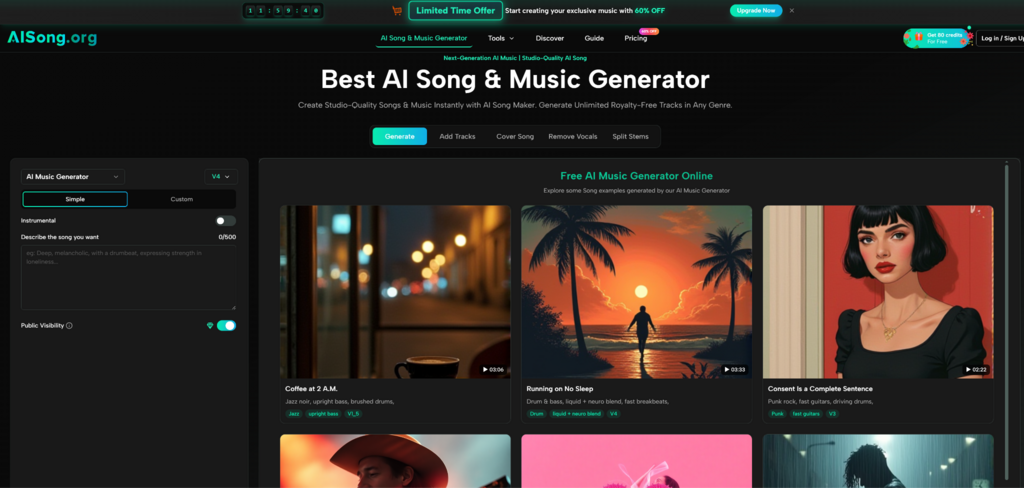
AI Song Maker stands out because it feels broader than a one-click generator. It supports song generation, lyric assistance, vocal removal, stem splitting, track extension, and add-track style editing tools. In practice, that makes it useful not only for creating a first song, but also for continuing to shape that song afterward.
Why It Takes The First Position Here
In my view, the strongest part of AI Song is workflow depth. Many free tools are good at producing an initial result, but weaker when the user wants to separate vocals, expand a promising idea, or reuse a draft in a more modular way. AI Song feels more complete for users who want one place to generate and revise.
2. Suno For Fast Prompt To Song Results
Suno remains one of the most recognizable names in AI music because it makes full-song generation feel immediate. It is especially strong for users who want to move from a text prompt to a polished draft quickly.
3. Udio For Controlled Song Iteration
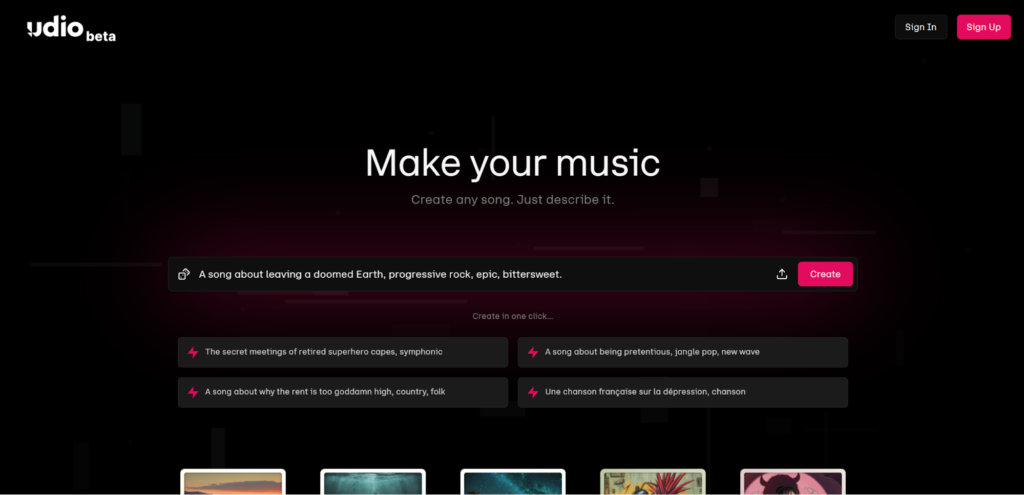
Udio is often appealing to users who care about shaping the feel of a track with a bit more intentionality. It is useful when you want to compare versions and refine direction rather than just accept the first pass.
4. AIVA For Structured Composition Work
AIVA feels different from the more consumer-facing prompt tools. It is especially useful for users who think in terms of composition, mood building, and music structure rather than social-ready vocal songs alone.
5. Boomy For Speed And Simplicity
Boomy is still one of the easiest places for a beginner to create a song draft without prior music experience. Its appeal is convenience. You can get to a result quickly, which is often enough for testing ideas.
6. Mubert For Creator Focused Music Output
Mubert is strongest when the goal is functional music for content. It is a good option for creators who want fast, royalty-oriented music generation for videos, podcasts, and background use.
7. Loudly For Creator Friendly Music Experimentation
Loudly is useful for users who want AI music generation connected to a broader creator ecosystem. It works well when speed, customization, and social-friendly workflows matter more than traditional songcraft depth.
How These Seven Tools Differ In Practice
A direct comparison makes it easier to see why one platform may fit better than another.
| Platform | Free Access Value | Best For | What Stands Out |
| AI Song | Strong free starting access | Full song creation and revision | Generation plus editing style tools in one workflow |
| Suno | Easy to test quickly | Prompt-to-song drafting | Fast full-song generation |
| Udio | Good for experimentation | Iterative song shaping | Flexible creative refinement |
| AIVA | Useful for structured composing | Instrumental and compositional work | Strong composition-oriented approach |
| Boomy | Very beginner-friendly | Quick song creation | Low-friction entry point |
| Mubert | Practical for creators | Background and utility music | Creator-focused royalty-friendly direction |
| Loudly | Accessible and versatile | Social and creator workflows | Broad music creation environment |
Why AI Song Feels Best For A Balanced User
The reason I would still place AI Song first is not because every user needs the same thing. It is because it covers more of the creative journey inside one platform.
It Starts With Intent Instead Of Technical Setup
The platform lets users define a song through title, style, lyrics, genre, mood, voice, tempo, and advanced controls. That makes it easier for non-producers to express what they want before they understand how to build it manually.
It Continues After The First Output
This is where many tools separate from each other. AI Song does not stop at the first draft. The presence of stem splitting, vocal removal, extension, and add-track functions suggests a more practical understanding of how songs actually get developed.
The First Draft Becomes Editable Material
That shift matters. A song draft is more useful when it can be stretched, separated, or rebuilt. In my observation, that makes the platform more valuable for repeat use than tools that mainly reward novelty.
A Simple Three Step Official Workflow
One reason AI Song is easier to recommend is that the platform’s workflow remains clear. It does not ask the user to learn too much before starting.
Step 1 Describe The Song Direction Clearly
Begin with the core information the platform asks for, such as style, mood, lyrics, genre, and related settings. Better inputs usually lead to more coherent outputs.
Step 2 Generate The First Song Draft
Once the creative direction is entered, the system turns that information into a song. This stage is best treated as the first useful version, not necessarily the last one.
Step 3 Refine Through Built In Music Tools
After generation, users can continue by extending the song, removing vocals, splitting stems, or adding tracks. This is the part that makes the platform feel like a workshop rather than a one-time generator.
Who Should Use Which Platform
The best choice depends on what kind of creator is actually using the tool.
Choose AI Song For Broader Song Development
If you want one platform that can move from initial generation to more practical revision, AI Song feels like the strongest all-around free choice.
Choose Suno Or Udio For Fast Song Exploration
If your main goal is to hear multiple full-song ideas quickly, these two remain very relevant. They are useful when speed and inspiration matter most.
Choose AIVA For More Composed Musical Thinking
If you care more about structure, scoring feel, or compositional control than instant pop-style output, AIVA may fit better.
Choose Boomy, Mubert, Or Loudly For Lightweight Creation
These tools are especially useful for fast experimentation, creator workflows, and practical music generation without a steep learning curve.
The Limits Are Part Of The Honest Comparison
No AI music platform is perfect, and free tools always come with tradeoffs.
Free Access Usually Means Some Constraint
That may mean fewer generations, shorter lengths, lighter downloads, fewer rights, or limited editing depth. Users should expect some boundary in the free tier.
Song Quality Still Depends On Prompt Quality
Even the best generator works better with specific direction. Broad prompts often produce generic results, while clearer instructions usually create more identity.
The First Output Is Rarely The Final One
This is especially true in music. A track may have the right genre but the wrong emotional intensity, or a good melody with a weaker arrangement. That is why revision tools matter so much.
Read More: The Growing Importance of Predictive Insights in Marketing
The Best Free AI Song Generator Is The One That Keeps Momentum
If the goal is simply to test a fun idea, several free AI song generators can do the job. But if the goal is to keep moving after the first result, AI Song feels like the best overall starting point in this group. It combines accessible generation with a more complete creative path, which makes it practical for both beginners and more deliberate creators.
That is ultimately what makes a free music platform worth using. Not just that it can produce a song, but that it helps users stay in motion after the song appears.


